Yield to God

 I read a story about a radio exchange that took place some time ago between a U.S. Navy ship and Canadian authorities off the coast of Newfoundland. The Canadians warned the Americans and the conversation went something like this: “Please divert your course 15 degrees to the south to avoid a collision.”

The Americans responded, “Recommend you divert your course 15 degrees to the north to avoid a collision.”

The Canadians said, “Negative. You will have to divert your course 15 degrees to the south to avoid a collision.”

The Americans: “This is the captain of a U.S. Navy Ship. I say again, divert your course.”

“No. I say again, you divert your course.”

“This is the aircraft carrier USS Lincoln, the second largest ship in the United States Atlantic fleet. We are accompanied by three destroyers, three cruisers, and numerous support vessels. I demand that you change your course 15 degrees north. I say again, that is 15 degrees north or countermeasures will be undertaken to assure the safety of our ship.”

After brief moment of silence, the Canadians responded: “This is a lighthouse. It is your call.”

Sometimes we don’t like what God wants us to do, and we want Him to change course when, in reality, it is us who ought to change course.

We need to understand that God’s plans are better than ours. Having said that, it does not mean that they are always the easiest or even the most appealing at the moment. There are times when we are going through life that we might not like the plan of God. But God’s plans are always better for us in the long run.

“My thoughts are nothing like your thoughts,” says the Lord.
    “And my ways are far beyond anything you could imagine.

Isaiah 55:8, NLT

Can you say, “Yes, Lord. I am Your servant. Take me, use me, spend me. Fulfill all Your holy, eternal purposes in and through my life, whatever the cost”?

That area you have insisted on controlling, that part of you you’ve just stubbornly refused to yield, where you have insisted on things being your way – it’s time to drop your sword and raise your white flag. It’s time to surrender.

Those of us with a chronic illness can find many of their issues can be resolved by this simple act of yielding to God. There will be aspects that linger, but much peace of heart and mind will can come through a quiet release of your will to Him.

 bry-signat (2)
flourish31

Afflictions That Heal Us

Today I especially wanted to share a message the David Wilkerson shared on his blog a few years ago.  It is probably one of the better messages I’ve read in quite awhile on the issue of pain and affliction in a believer’s life.  I hope this helps!

“Curse the scalpel if you must; but kiss the Surgeon’s hand.”

flourish14

“Before I was afflicted I went astray: BUT NOW have I kept thy word”

Psalm 119:67

“I believe in healing. I believe in affliction. I believe in “healing afflictions.” Any affliction that keeps me from going astray—that drives me deeper into his Word—is healing. God’s most gracious healing force spiritually and physically can be afflictions.

To suggest that pain and affliction are of the devil is to suggest that David was driven by the devil to seek God’s Word. I have suffered great pain. I have called on God for deliverance and I believe him for complete healing. Yet, while I go on believing, I continue to thank God for the present condition and let it serve to remind me how dependent on him I really am. With David I can say, “It is good for me” (Psalm 119:71).

Pain and affliction are not to be despised as coming from the devil. Such burdens have produced great men of faith and insight.

“Casting ALL your care upon him…”

1 Peter 1:5

Paul spoke of the “cares” of the churches that were thrust upon him (see 2 Corinthians 11:28). Every newborn church was another “care” on his shoulders. Growth, expansion, lengthening of stakes always involve new cares. The man God uses must have broad shoulders. He dare not shrink under the challenge of numerous cares and responsibilities.

Every new step of faith God leads me to take has brought with it numerous new cares and problems. God knows just how many cares he can trust us with. It is not that he seeks to break us—in health or strength; it is only that willing laborers are few and the harvest is so great. Cares are taken from those who refuse them and given as gifts to those who are not afraid of them. Forget the load of cares you carry—can we not cast them all on him?

Every new blessing is related to a family of cares. They cannot be divorced. You cannot learn to live with the blessing until you learn to live with the cares.”

Source: http://davidwilkersontoday.blogspot.com/


Call To All Sons

12624 “For it was fitting that he, for whom and by whom all things exist, in bringing many sons to glory, should make the founder of their salvation perfect through suffering.”

Hebrews 2:10, ESV

“God is the One who made all things, and all things are for his glory. He wanted to have many children share his glory, so he made the One who leads people to salvation perfect through suffering.”

Hebrews 2:10, NCV

There is complexity embedded in this verse. But that shouldn’t stop us from understanding its scope and meaning, yet there is the compelling question.

How did Christ learn obedience through suffering when he was already perfect?

Christ was human and “tempted in all points as we are and yet perfect and without sin,” and thus Christ was sinless.  The humanity of Jesus can be seen throughout the gospels. He hungered, and he got thirsty. We see him very tired, and sleeping in the back of a boat in a storm, which reveals his humanity. However, “He committed no sin, neither was their deceit found in his mouth” (1 Peter 2:22).

Only humans need to learn obedience. And everyone of us have faltered. Yet he didn’t. He had to learn, but He didn’t fail. As a man, He met every issue and every obstacle with a solid and a profound obedience. He learned how to obey, but without any failure, or fault.

In every person’s life, we are challenged to obey. There are so many twists and turns, and each of us has stumbled. It can be quite painful. We are also learning “obedience through our suffering.” It seems our own trials and suffering are the tutors teaching us about our Father, and His kingdom.

This thought, “bringing many sons to glory” is of significant consideration. It reveals the intent and purpose of Jesus coming and doing all of this. He wanted to open the doors for all those who come to salvation. In a direct way, His intention was to become our escort, or safeguard to make a way for us into the Presence.

The words, “many sons,” shows the breadth and width of His work. It is considerable. The idea of “sons” is just as astonishing. We are not slaves, forced to labor in the quarries or mines. We are sons and daughters, His own children. Eternity is too short of time, I suppose, for us to hold and occupy this kind of glory.

“They strengthened the believers. They encouraged them to continue in the faith, reminding them that we must suffer many hardships to enter the Kingdom of God.”

Acts 14:22, NLT

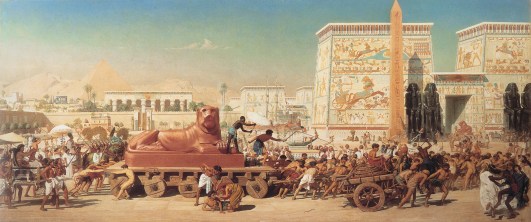
So You Wanna Go Back to Egypt?


1867_edward_poynter_-_israel_in_egypt

God has always wanted to lead His people. I think that He is almost catatonic with joy when we allow Him to do this. Throughout the ages, and all through Israel’s history, we see Him reaching out to people,  who are stubborn and selfish in their choices. But He reaches out to them anyway.

Israel had been sovereignly led out of Egypt. Miracle after miracle had made this happen. A dramatic exodus from slavery would make the front page that day. People from every generation would know that God was setting His people free.

God didn’t tell them the way, but rather showed them the path Himself. He led them with “a cloud by day and a pillar of fire by night” (Exodus 13:20-22). The people, however, repeatedly refused to trust their Deliverer-Shepherd. They hardened their hearts and rebelled against Him.

“Our fathers were unwilling to be obedient to him, but repudiated him and in their hearts turned back to Egypt, 40 saying to Aaron, ‘Make for us gods who will go before us; for this Moses who led us out of the land of Egypt—we do not know what happened to him.’”

Acts 7:39-40, NASB

They made the choice themselves, they would turn around. They would go back in slavery to Egypt. (Actually in their hearts, they had already done so!) They were rejecting and renouncing God, and turning their backs on Him.

But we are given what we want. Even if it takes us into bondage again.

When we begin to follow, God starts to lead. He takes an active role to guide and direct us, and to bring us into victory. When we try to go back to Egypt, we will experience His discipline.

“So Christ has truly set us free. Now make sure that you stay free, and don’t get tied up again in slavery…” 

Galatians 5:1, NLT

“Because of their unbelief they were not able to enter His rest” (Hebrews 3:19). Then the author draws a clear distinction: “They didn’t share the faith of those who listened to God. For only we who believe can enter His rest” (Hebrews 4:2-3).

There is a wonderful and real rest. But I am tempted to turn back. Will I decide to let God lead me?

1brobry-sig4 (2)

k

k

cropped-christiangraffiti1-3-1