“For God knew his people in advance, and he chose them to become like his Son, so that his Son would be the firstborn among many brothers and sisters.”
Romans 8:29, NLT
“Just as we are now like the earthly man, we will someday be like the heavenly man.”
1 Corinthians 15:49
Much speculation has been made regarding these two ‘pinnacle’ verses. We must approach them humbly to see what they are all about. We must see for ourselves all that concerns us. “They will not hear the voice of a stranger,” (John 10:5).
The Father has decreed, “Christlikeness.’ This is a mandate from the One who loves us unconditionally. (There are no whips being used.) We really need to enter this holy process with a sure confidence of a solid love.
His face burns brighter when we are positioned appropriately in His glory.
It begins now. The heavenly Father’s exclusive purpose is to “bring many sons to glory” (Heb. 2:10).We do not have to wait until heaven to become like Jesus. We can accelerate the joy by starting today. And when He comes, He will ‘clean house,’ (so to speak). Holiness is mandatory to everyone who wishes to walk with Him.
You are one of the selected. Few have the options and opportunities that have been offered. To ‘put on’ Christlikeness is a rare privilege. From this point on, you will move through the confusion as one assured of his place and calling. He has ‘marked’ you, you are His. Everything will move aside in the light of His calling.
I so want you to ‘long for heaven.’ It is the place where we will dwell permanently. But at this point, the Father needs you to ‘hash it out’ on planet Earth. There is a need for volunteers who will come from ‘free will.’ After all, we get to choose Him who holds our destinies within; He alone carries our burdens and sins. He knows me thoroughly, yet loves me still.
You need to decide soon of your next step. But know this– Christlikeness will never be forced or coerced. Yet it is the ‘ride of a lifetime.’ Sheer boredom will probably ‘do-you-in’ if you choose to just ‘pray the prayer’ and walk away.
But you will never know the thrill of standing under God’s grace blasting full over your thirsty heart.
How do you handle pain as a believer? What do you do when you want to curl up in a ball and want to die? Understand that pain isn’t in God’s original plan. We who are hurt have got to be very much aware of this.
There are many different kinds of pain: post-surgical, chronic, and self-inflicted. The pain of separation or divorce or misguided children can get pretty destructive. There’s the pain of misunderstanding or something inflicted by a bad relationship with someone.
There are far too many possibilities and far too much hurt to go around.
At times you can’t even imagine how you’re going to handle another day. Sometimes the doctors have the arrogance to tell you that you need to get used to it because it’s never going to get better. So now you must sort things out–and apart from a miracle, it’s only going to get worse. I understand this. Truly.
Here are ten thoughts that come to my mind. They’re not in any order. (Maybe they should be? IDK.)
One
Treat false humility as a worse disease than you’re facing physically. You’ll be very tempted to milk your pain for all its worth. You’ll try to take advantage of others, and you’ll put yourself in the best possible light. But pain and ego were never meant to mix–especially as a disciple of Jesus. Renounce them now. Turn from it constantly.
Two
Never find fault with God. He’s not to blame whatever the evil one tells you. Our Father loves you deeply, and He will carry you all the way through this. Satan always tells lies. You must take a stand against him. Put on your armor! Super-glue Ephesians 6:19-18 into your thought life–and never let go!
Three
You can never lose track of a very real eternity. My special verse is Revelation 21:4, “And God shall wipe away all tears from their eyes; and there shall be no more death, neither sorrow, nor crying, neither shall there be any more pain: for the former things are passed away.” Please keep this front and center. It’ll help a lot!
Four
You’ll start to learn to see others differently. There’ll always be another who has it worse. Think about them, and all that they must deal with. It helps a lot. Also, you’ll discover that your pain will be like new glasses for a strange source of spiritual astigmatism. You’ll see things far more clearly now.
Five
Your walk will deepen. You’ll learn to be joyful when all you want to do is cry. The littlest things become a cause of great joy. God values your singing more now, especially when you’re singing out of excruciating pain. The Word, and worship music, all seem to be more meaningful. Surround yourself with music (and preaching too), anything that builds you up inside.
Six
You’ll discover the art of weaving your pain into your discipleship. Sleepless nights become diving boards for prayer, reading, and worship. You’ll change and deepen, and that’s always good. Also, be open to new ways of ministry. Look for doors to open up. (They may be different than you think.)
Seven
You’ll discover that there can be solace in medications and treatment. I know that this, but sometimes a handful of Motrin or other pain meds will be a real relief. Also, listen closely to your doctor and therapist. Pray for them, pray they’ll have special wisdom for your situation.
Eight
You start to see that you’ll never be able to do this alone. God is giving you a gift. He will give you insight. You’ll also start to see people less in terms of ‘rank’ and more in the light of what they’ve had to suffer. As you begin to see pain and sorrow as odd friends, they’ll often show you who your true brothers and sisters are.
Nine
You’ll understand the Father’s love in a new way. Like an old-style pharmacist who measured out powder instead of pills, we find God measures out exactly what we need. He never gives you a single grain of medicine more than is necessary. Trust him. All that happens to you has come through nail-pierced hands. He understands pain and He understands you.
Ten
You must learn to laugh again. Little things become a source of real joy. The smallest things will make you laugh. Get a joke book, that may help, especially when you get sour and withdrawn. “A cheerful disposition is good for your health; gloom and doom will leave you bone-tired” (Pro. 17:22, MSG).
(This list is not complete. I apologize, there are many others that really should be added, but maybe this is a start.)
Also–just one more (number 11 maybe?) Be easy on yourself. You’ll find that you’ve much to learn. And that’s okay. Just open up your heart, and look to Jesus.
We must be aware that our pain allows us access to His careful grace. Our trials, properly received, endow us with special abilities.
They’re now our new ‘superpowers.’ 😁
You should learn to embrace your pain and your sorrows, and not many can do this. Our own suffering comes to us at too high of a cost to us. They’re precious and way too valuable to neglect. Squeeze them and extract all that they can give.
Here’s a quote that has always sustained me. It’s really good for me to remember, and it may help you.
“Some Christians are called to endure a disproportionate amount of suffering. Such Christians are a spectacle of grace to the church, like flaming bushes unconsumed, and cause us to ask, like Moses: Why is this bush not burned up?'”
–John Newton
Exodus 3:2-3
A good site is Joni Eareckson Tada. She’s a believer who has suffered a great deal and has a ministry to the afflicted, Joniandfriends.org.
I have another site you might want to checkout: alaskabibleteacher.com.
: Loss of hope and surrender to despair. 2. : a state of hopelessness leading to rashness.
Synonyms–desperation · concern · dejection · depression · despondency · disconsolateness · distraction · distress · pang · torture · trouble · worry. noun as in rashness.
A terrific study is finding the people who fell at Jesus’ feet. Tucked in the Gospels you’ll find stories of those who despair. You’ll also see them come to Jesus in brokenness and humility, without any other recourse. I call these the feet-finders.
They came to Jesus because they had no hope otherwise. They were people who were hopeless and wretched, they had long ago run out of options. They came to Jesus, falling down in front of Him. They were all feet-finders.
They were men and women who were truly desperate.
“Now when Mary came to where Jesus was and saw him, she fell at his feet, saying to him, “Lord, if you had been here, my brother would not have died.”
John 11:32
One of the classic scenes in the Gospels is when Mary meets Jesus after her brother’s death. She doesn’t understand Jesus’ delay, Lazarus has been very ill and Jesus could have healed him. She is grieving and confused. But she only has one posture and one place in her heart to be– at the feet!
There are some common characteristics that feet-finders have:
A great need that can’t be met without His touch
To understand one’s true condition–humility, brokenness
To beg for a healing, for self or family
To honor Jesus as the Messiah
To be more receptive to His teaching, to understand Him
To become a witness to others (although it does seem secondary)
The following 3 verses are just a small selection of those who fell at Jesus feet.
“And great crowds came to him, bringing with them the lame, the blind, the crippled, the mute, and many others, and they put them at his feet, and he healed them.”
Matthew 15:30
“But immediately a woman whose little daughter had an unclean spirit heard of him and came and fell down at his feet.“
Mark 7:25
“Then people went out to see what had happened, and they came to Jesus and found the man from whom the demons had gone, sitting at the feet of Jesus, clothed and in his right mind.”
Luke 8:35
But there are several other instances where people came to sit at Jesus’ feet:
Mark 5:22-23, Jairus, a leader in the local synagogue
Luke 7:37-38, a sorrowing mother for her daughter
Luke 8:41, also Jairus
Luke 10:39, Mary, when Jesus was teaching
John 11:32, Mary, meeting Jesus entering Bethany
John 12:3, Mary, with her perfume
Revelation 1:17, John to express what he was seeing (also 19:10)
In every case we find people consciously coming and kneeling at the feet of the Lord Jesus. It was a deliberate action that came from their hearts. Each had a terrible need, and each was without hope.
Formality and religious politeness are jettisoned. Brokenness and true humility takes their place. A foot-finder is no longer operating on spiritual niceties. Religion is comfortable, noble, and respectable, but it cannot heal or change people deeply.
Feet-finders know that they need Jesus desperately and will go to any length just to be touched by Him. They defy what is conventional and proper. They are not what we call respectable. You can find them at the feet of Jesus. They are feet-finders. Foot-finders weep, kneel, beg, shout. Too many tears and maybe some snot.
Hardly decent to religious people.
Are you really that desperate yet? Have you seen your need, and do you realize how lost you would be without His healing touch?
Often when I do pray, I sometimes think of the woman who was unclean. She speaks to me about approaching Jesus. I see myself in a crushing crowd of people, and I’m reaching out just to touch the hem of His robe. I know only Jesus can stop my own uncleanness. (Matthew 9.)
I’m convinced only Jesus can make me clean and whole.
I’ve tried to be holy and acceptable to Him. But I felt like a juggler, trying to keep my balls in the air all at the same time, and I could never pull it off. So I tried again and again.I was the unofficial master of religious effort.
But I found my rightful place at His feet. It’s where I belong. I love Him.
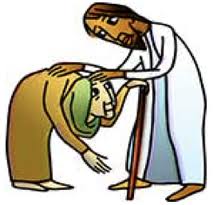
“One Sabbath day as Jesus was teaching in a synagogue, 11 he saw a woman who had been crippled by an evil spirit. She had been bent double for eighteen years and was unable to stand up straight. 12 When Jesus saw her, he called her over and said, “Dear woman, you are healed of your sickness!” 13 Then he touched her, and instantly she could stand straight. How she praised God!”
Luke 13:10-13
When we read through the Gospels we see that Jesus never laid His hands on those who were demon possessed, rather He would first command the demon to leave. (Interesting.)
The text tells us that the woman had been bent over for 18 years. (That’s a long, long time.) The cause was being “demonized” which is very different than being possessed.
There is a difference. Demons can oppress people and influence their lives, especially if that person is living in sin and rebellion.
“The physical cause of her inability to straighten up has been examined by J. Wilkinson, who identified the paralysis as the result of spondylitis ankylopoetica, which produces the fusion of the spinal bones.”
14 But the leader in charge of the synagogue was indignant that Jesus had healed her on the Sabbath day. “There are six days of the week for working,” he said to the crowd. “Come on those days to be healed, not on the Sabbath.”
That is absurd. There’s a truth here that this “leader” is covering up. The woman is instantly healed, and this so-called leadertries to nullify what has just happened. Rather than rejoicing, he renounces what has just happened, and claims that the Sabbath law has been violated. He declares the Law is greater than this woman’s healing.
Jesus never once asserts His authority. Rather He points to this woman’s healing as being truly the very essence of the Law. In spite of what the Law means legalistically, it can never invalidate mercy.
“For eighteen years she had not gazed upon the sun; for eighteen years no star of night had gladdened her eye; her face was drawn downward towards the dust, and all the light of her life was dim: she walked about as if she were searching for a grave, and I do not doubt she often felt that it would have been gladness to have found one.”
CH Spurgeon
Her private agony was never to be found again. She was free. The pain she lived with was no more. The captivity was gone, and she was freed. The biblical text seems to ignore this and concentrates on the synagogues leader’s response, and that’s well and good. Perhaps though we should focus on this woman’s healing from an awful terrible darkness.
She is free. The stoop is gone. The pain is gone. Jesus has set her free, she gazes at the sun after many years. She stands erect, and though everything now seems different, she now knows her deliverer, and her healer.









 Broken Believers