Yield to God

 I read a story about a radio exchange that took place some time ago between a U.S. Navy ship and Canadian authorities off the coast of Newfoundland. The Canadians warned the Americans and the conversation went something like this: “Please divert your course 15 degrees to the south to avoid a collision.”

The Americans responded, “Recommend you divert your course 15 degrees to the north to avoid a collision.”

The Canadians said, “Negative. You will have to divert your course 15 degrees to the south to avoid a collision.”

The Americans: “This is the captain of a U.S. Navy Ship. I say again, divert your course.”

“No. I say again, you divert your course.”

“This is the aircraft carrier USS Lincoln, the second largest ship in the United States Atlantic fleet. We are accompanied by three destroyers, three cruisers, and numerous support vessels. I demand that you change your course 15 degrees north. I say again, that is 15 degrees north or countermeasures will be undertaken to assure the safety of our ship.”

After brief moment of silence, the Canadians responded: “This is a lighthouse. It is your call.”

Sometimes we don’t like what God wants us to do, and we want Him to change course when, in reality, it is us who ought to change course.

We need to understand that God’s plans are better than ours. Having said that, it does not mean that they are always the easiest or even the most appealing at the moment. There are times when we are going through life that we might not like the plan of God. But God’s plans are always better for us in the long run.

“My thoughts are nothing like your thoughts,” says the Lord.
    “And my ways are far beyond anything you could imagine.

Isaiah 55:8, NLT

Can you say, “Yes, Lord. I am Your servant. Take me, use me, spend me. Fulfill all Your holy, eternal purposes in and through my life, whatever the cost”?

That area you have insisted on controlling, that part of you you’ve just stubbornly refused to yield, where you have insisted on things being your way – it’s time to drop your sword and raise your white flag. It’s time to surrender.

Those of us with a chronic illness can find many of their issues can be resolved by this simple act of yielding to God. There will be aspects that linger, but much peace of heart and mind will can come through a quiet release of your will to Him.

 bry-signat (2)
flourish31

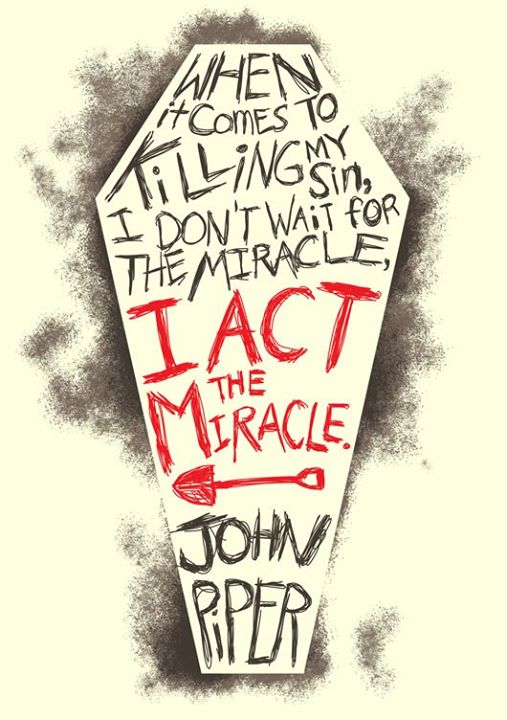
Killing My Sin, Before It Kills Me

killing-sin-act

We are for the most part anyway, eager to please God. We are Jesus’ people with the occasional brush with sin. But hey, who doesn’t? But that attitude must be questioned.

“My little children, these things I write to you, so that you may not sin.”

1 John 2:1

John hopes that his readers would make a choice— not to commit sin. After all, what soldier goes into battle with the intent of getting just a little wounded? Often we will sin just because it seems so inevitable, and we feel we can’t help ourselves. (But the reality is that we can.)

But the Holy Spirit now lives inside. Cooperation with Him is needed. Often we will work ourselves into a ‘no win scenario’ where we believe that sin rules. We can’t beat it, so we stop trying. That is common, and sad.

‘Passivity’ is defined as not participating readily or actively; inactive. When we are passive spiritually, we disengage ourselves from any effort of living holy and pure lives. Not being ‘hot’, but content to be lukewarm. At this point sin becomes, reluctantly, tolerated. “After all, I’m a sinner, what else can I do?”

Mentally ill people are often passive. We are told that we have an uncontrolled illness which dictates that we act ‘irresponsible.’ Our depression often escalates and we feel victimized by it. My experience has taught me that there are three kinds of depression:

  • organic depression, or the ‘biochemistry’ of the disease,
  • guilty depression, the kind that feels bad because of what we’ve done (or didn’t do),
  • reactionary depression, the type we feel when experiencing a loss, a loved one, or a job

Depression will almost always fall in these three categories. And passivity plays a part in all three. We  frequently feel victimized and ‘acted upon.’ When it comes to our discipleship we don’t act, we react. We are utterly convinced of the Bible— God’s truth, but we are so sporadic we can’t seem to get it to work for any length of time.

Yes, we are believers. And yes, we have issues. We’re waiting for a miracle, and hope we get a breakthrough soon.

At the base point of our lives, quite often, there is a passive attitude. Passivity aggravates our depression or mental illness. It deepens, spreading through our lives like a contagious illness. Our discipleship sputters and stalls. We no longer act on God’s Word, but we find ourselves fabricating a faith that makes allowances for our situation.

But we must ‘act the miracle.’ Everything God gives… everything… must be received by a convinced faith. We must be persuaded to give up our flawed ideas, and believe God for the real thing. I opened up this with 1 John 2:1. But there’s much more to this verse:

“My little children, these things I write to you, so that you may not sin.  And if anyone sins, we have an Advocate with the Father, Jesus Christ the righteous.”

I don’t want you to sin. Avoid sin. But even if you do— we have someone who will plead our case before God. He stands and argues our plight. He loves us that much.


bry-signat (2)

cropped-christiangraffiti1.jpg


Going Crossless

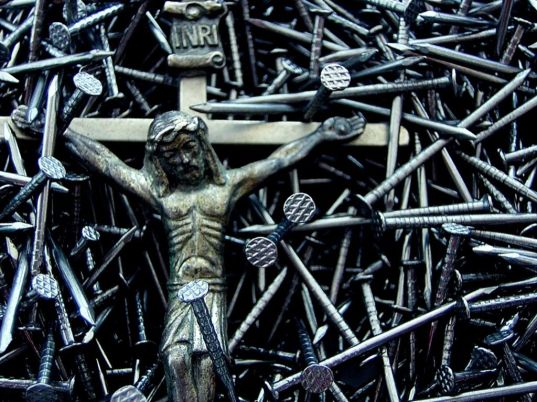
We are a bucket full of nails,

“Whoever does not take up their cross and follow me is not worthy of me.“

Matt. 10:38

“Then Jesus said to his disciples, “Whoever wants to be my disciple must deny themselves and take up their cross and follow me.”

Matt. 16:24

We can so easily process our faith to something respectable and somewhat pleasant.  This is a natural tendency. But the cross has a stigma, we might think we can easily defuse it, rendering it as harmless.  Acceptability is a wonderful thing to the modern day believer.  It is easy to turn from all that would make us different, and grasp a crossless faith. It does seem we conform rather than transform.

Effort is being made right now to twist and nullify your belief in Jesus.  It is a force that works on us, relentlessly.  Satan intends to destroy you. He is frightened by the power of the cross, and the spiritual truth it contains. The cross (and resurrection) destroyed the devil’s kingdom of twisted darkness. He will never recover.

Just as Jesus carried the cross He was to die on, you and I are to follow His example.  Jesus had to go to this place of death, and so are we.  My cross is not purely emblematic or abstract symbolism.  It entails a real death.  I pick it up and go to die.  Crucifixion is the end of me, it all comes down to this final point of termination.

Jesus escorts us to the point of death.  This is to become the framework for a sincere discipleship.  The cross, our cross, brings us to an end.  To be worthy of Jesus is to bear it boldly.  The cross develops into our thinking, and its dynamic pounds us into a spiritual reality.  Jesus intensifies the cross, making it the mark of authenticity of a disciple.

We have no options, if we follow it must be with a cross.  There is absolutely no room for us if we approach Him without it.  The cross transmutes our lives, and transmits a signal that we have complied with Jesus’ wishes.  If we advance at all, it will be through the cross only.

We must deny ourselves.  That denial is an intense working. “I do not know the man” was Peter’s statement against Jesus.  If we deny ourselves, we will take a stand against our own selves, turning against ourselves.  We will be pinned to the mat.

Our focus should be on the cross.  We must infuse it into our lives.  A tea bag will flavor an entire cup.  It turns a cup of boiling water into a wonderful beverage.  The cross that belongs to us will have the same effect.  It will make something where there was nothing.

“All heaven is interested in the cross of Christ, all hell terribly afraid of it, while men are the only beings who more or less ignore its meaning.” 

 Oswald Chambers

aabryscript


A Finder’s Fee of Joy

New Testament 3 Production Still Photography “Tax collectors and other notorious sinners often came to listen to Jesus teach. This made the Pharisees and teachers of religious law complain that he was associating with such sinful people—even eating with them!” (Luke 15:1)

“If a man has a hundred sheep and one of them gets lost, what will he do? ” (v. 4)

“Or suppose a woman has ten silver coins and loses one.” (v. 8)

“For this son of mine was dead and has now returned to life. He was lost, but now he is found.’ So the party began.” (v. 24)

flourish10

The lost sheep, the lost coin, and the ‘lost son’ tell us that this is a time for recovery. This is a unique period for the Church. It is a season of special grace that allows us to seek and find things that are valuable to us. It is a time of finding out things about ourselves as well.

What is precious to you? With the woman, it was a lost coin (probably a part of her dowry) and she made a substantial effort to get it back. With the shepherd, what was valuable was a lost sheep, and he would take a calculated risk to find it, and rejoin the flock. And the father lost his son, and he had to wait for him to return to his senses.

These three parables were directed to the different issues that effected the “notorious sinners.” But they also spoke to the pharisees who were present. Both groups understood and there were plenty of implications for everyone.

It’s a funny thing, Jesus never minced words. No one could be neutral around him. That is still the case today. I think God is seeking His lost children. This is what He is up to, this is His passion. Understanding this salient fact should enlighten us,

  1. to His will,
  2. to know His passion and love, (His pleasure in finding what was lost)
  3. and the true purpose of His Church.

As the Parable of the Prodigal Son develops, we see the pharisees equated to the ‘grouchy’ older brother. He begrudges his newly returned brother, and he really can’t see what is happening all around him. The idea of grace eludes him. Perhaps that is far more common than we think. Whenever ‘religion’ exerts control over a person or group, duty is almost always elevated over joy.

The Church is only as relevant as when it’s seeking out the lost.

The Church is meant to extend to the lost ‘sons’ of Adam, and the ‘daughters’ of Eve. This is God’s passion, and we must find out what He wants us to do to share His heart. It’s almost as if He wants to give us a chance to taste His joy.

aabryplain