Two O’ Clock in the Morning Poetry, #2

John-Donne-Quotes-1

“Death Be Not Proud, Holy Sonnets, no. 10 ” by John Donne

Death be not proud, though some have called thee
Mighty and dreadful, for thou art not so;
For those whom thou think’st thou dost overthrow

Die not, poor death, nor yet canst thou kill me.
From rest and sleep, which but thy pictures be,
Much pleasure, then from thee much more must flow,
And soonest our best men with thee do go,
Rest of their bones, and souls’ delivery.
Thou art slave to fate, chance, kings, and desperate men,
And dost with poison, war, and sickness dwell,
And poppy, or charms can make us sleep as well,
And better than thy stroke; why swell’st thou then?
One short sleep past, we wake eternally,
And death shall be no more; death, thou shalt die.

U

flourish-8
john-donneJohn Donne (/ˈdʌn/ dun) (between 24 January and 19 June 1572[1] – 31 March 1631) was an English poet, satirist, lawyer and a cleric in the Church of England. He is considered the pre-eminent representative of the metaphysical poets. His works are noted for their strong, sensual style and include sonnets, love poetry, religious poems, Latin translations, epigramselegies, songs, satires and sermons. His poetry is noted for its vibrancy of language and inventiveness of metaphor, especially compared to that of his contemporaries.
Donne’s style is characterised by abrupt openings and various paradoxes, ironies and dislocations. These features, along with his frequent dramatic or everyday speech rhythms, his tense syntax and his tough eloquence, were both a reaction against the smoothness of conventional Elizabethan poetry and an adaptation into English of European baroque and mannerist techniques. His early career was marked by poetry that bore immense knowledge of British society and he met that knowledge with sharp criticism.
–from Wikipedia
88
Bonus—
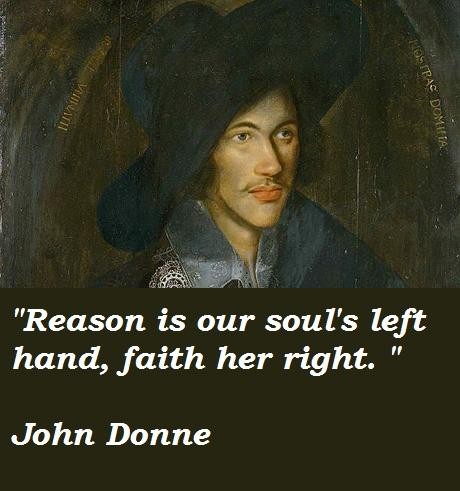
John+donne+famous+quotes+3

A Pastor’s Transformation

Pastor-homeless-peoplePastor Jeremiah Steepek (pictured left) transformed himself into a homeless person and went to the 10,000 member church that he was to be introduced as the head pastor at that morning. He walked around his soon to be church for 30 minutes while it was filling with people for service, only 3 people out of the 7-10,000 people said hello to him. He asked people for change to buy food – NO ONE in the church gave him change. He went into the sanctuary to sit down in the front of the church and was asked by the ushers if he would please sit n the back. He greeted people to be greeted back with stares and dirty looks, with people looking down on him and judging him.

As he sat in the back of the church, he listened to the church announcements and such. When all that was done, the elders went up and were excited to introduce the new pastor of the church to the congregation. “We would like to introduce to you Pastor Jeremiah Steepek.” The congregation looked around clapping with joy and anticipation.

The homeless man sitting in the back stood up and started walking down the aisle. The clapping stopped with ALL eyes on him. He walked up the altar and took the microphone from the elders (who were in on this) and paused for a moment then he recited– Matthew 25:31-46.

 “But when the Son of Man comes in his glory, and all the angels with him, then he will sit upon his glorious throne.32 All the nations will be gathered in his presence, and he will separate the people as a shepherd separates the sheep from the goats. 33 He will place the sheep at his right hand and the goats at his left.

34 “Then the King will say to those on his right, ‘Come, you who are blessed by my Father, inherit the Kingdom prepared for you from the creation of the world. 35 For I was hungry, and you fed me. I was thirsty, and you gave me a drink. I was a stranger, and you invited me into your home. 36 I was naked, and you gave me clothing. I was sick, and you cared for me. I was in prison, and you visited me.’

37 “Then these righteous ones will reply, ‘Lord, when did we ever see you hungry and feed you? Or thirsty and give you something to drink? 38 Or a stranger and show you hospitality? Or naked and give you clothing? 39 When did we ever see you sick or in prison and visit you?’

40 “And the King will say, ‘I tell you the truth, when you did it to one of the least of these my brothers and sisters, you were doing it to me!’

41 “Then the King will turn to those on the left and say, ‘Away with you, you cursed ones, into the eternal fire prepared for the devil and his demons. 42 For I was hungry, and you didn’t feed me. I was thirsty, and you didn’t give me a drink. 43 I was a stranger, and you didn’t invite me into your home. I was naked, and you didn’t give me clothing. I was sick and in prison, and you didn’t visit me.’

44 “Then they will reply, ‘Lord, when did we ever see you hungry or thirsty or a stranger or naked or sick or in prison, and not help you?’

45 “And he will answer, ‘I tell you the truth, when you refused to help the least of these my brothers and sisters, you were refusing to help me.’

46 “And they will go away into eternal punishment, but the righteous will go into eternal life.”

After he recited this, he looked towards the congregation and told them all what he had experienced that morning. Many began to cry and many heads were bowed in shame. He then said, “Today I see a gathering of people, not a church of Jesus Christ. The world has enough people, but not enough disciples. When will YOU decide to become disciples?”

He then dismissed service until next week.

Being a Christian is more than something you claim. It’s something you live by and share with others.

flourishx

Bryan’s Note: Some have made this account to be nothing more than a “urban myth,” kind of a good piece of  Christian “schlock” that never happened. I personally can’t say for sure. I simply can’t vouch for its veracity. But all I really know is that it speaks to me in many ways about following Jesus. For that alone, I am thankful.

More of Jesus, less of Bryan.

ybic, Bryan

kyrie elesion.

Growth in the Troughs of Life

This post has been floating around in my head for almost two weeks now, and I had fully intended to post it here at Broken Believers last weekend, but just didn’t get it done. In retrospect, learning of the great trough our dear brother Bryan is going through, I realize that either I should have made the time or the timing of posting it today is part of God’s design. All I know for sure is that it needs to be posted.

I recently purchased a new book titled The Soul of C.S. Lewis that consists of one-page reflections on various quotes from many of Lewis’ best-loved writings followed by a Bible verse. The book has 10 different contributing authors, and each essay is not attributed to an individual author, but they are all wonderful. Today I want to share a little about one of those essays, along with my own thoughts on the topic at hand.

The Lewis quote that begins the essay is from The Screwtape Letters, one of my favorites of Lewis’ fiction. Although fictional, there is a great deal of truth about the struggles and potential downfalls of the believer in Christ to be found in this short collection of letters between Screwtape, a high-level demon, and Wormwood, his nephew who is a low-level tempter in the minions of Satan. The quote at hand is:

“It is during such trough periods, much more than during peak periods, that it is growing into the sort of creature He wants it to be.” Screwtape, chap. 8, p. 40.

The trough periods Screwtape refers to are the low times in life that for some are manifested as periods of deep depression. Many a strong Christian has experienced such troughs over and over throughout their lives. I have experienced them to differing degrees myself, and our dear Bryan is experiencing just such a trough now. They are certainly no fun, and we often wish we could avoid them altogether, but experience tells us that is not possible. Perhaps it is not even truly preferable in the grand scheme of things as God sees it.

In the essay based on this quote, the author writes:

“Although the emotional peaks are bright and lovely and certainly more enjoyable, that doesn’t mean that the trough is the wrong place for us. The truth is that God is often most at work in the troughs—the hard places where we feel most desolate and alone. Sometimes when we’re trying to clamber back up to the peak, God may be calling us to stay awhile in the trough.”

“At these times we often feel full of confusion, fear, and sadness because we cannot see God’s hand at work, molding us by the very things we wish to escape. It is often only afterward, when he has moved us to a different place, that we can look back and see how he was working in the midst of the difficult spots.” The Soul of C.S. Lewis, pg. 115.

As I read this essay, I was reminded of Psalm 23. This well-known and beloved Psalm begins and ends in the peaks – “The Lord is my Shepherd, I shall not want” and “I will dwell in the house of the LORD forever.” But in the middle is a definite trough – “the valley of the shadow of death.” I’m pretty sure there is no trough deeper or darker than this valley. But – and this is the important part – we don’t travel that valley alone. God is with us in the valley of the shadow of death, He is with us in the troughs of life.

The valleys of deep depression are not signs that we have been forsaken by God or that God has given up on us. He is walking with us through that valley, using every step of the way to help us grow in faith and grace, so that we will be able to dwell in the house of the Lord forever. So let us not try to clamber out of the troughs we encounter ahead of God and by our own power, but let us instead walk close by our Lord, following in His footsteps to see where He will lead. He is our Light in the darkness of the deep valley. May we stop to see all that He is illuminating there.

Jesus said, “I have come into the world as a light, so that no one who believes in me should stay in darkness.” John 12:46 (NIV).

Pondering Panic

For me, a panic attack is almost a violent experience. I feel disconnected from reality. I feel like I’m losing control in a very extreme way. My heart pounds really hard, I feel like I can’t get my breath, and there’s an overwhelming feeling that things are crashing in on me.”

“It started 10 years ago, when I had just graduated from college and started a new job. I was sitting in a business seminar in a hotel and this thing came out of the blue. I felt like I was dying.”

“In between attacks there is this dread and anxiety that it’s going to happen again. I’m afraid to go back to places where I’ve had an attack. Unless I get help, there soon won’t be anyplace where I can go and feel safe from panic.”

Panic disorder is a real illness that can be successfully treated. It is characterized by sudden attacks of terror, usually accompanied by a pounding heart, sweatiness, weakness, faintness, or dizziness. During these attacks, people with panic disorder may flush or feel chilled; their hands may tingle or feel numb; and they may experience nausea, chest pain, or smothering sensations. Panic attacks usually produce a sense of unreality, a fear of impending doom, or a fear of losing control.

A fear of one’s own unexplained physical symptoms is also a symptom of panic disorder. People having panic attacks sometimes believe they are having heart attacks, losing their minds, or on the verge of death. They can’t predict when or where an attack will occur, and between episodes many worry intensely and dread the next attack.

Panic attacks can occur at any time, even during sleep. An attack usually peaks within 10 minutes, but some symptoms may last much longer.

Panic disorder affects about 6 million American adults and is twice as common in women as men. Panic attacks often begin in late adolescence or early adulthood, but not everyone who experiences panic attacks will develop panic disorder. Many people have just one attack and never have another. The tendency to develop panic attacks appears to be inherited.

People who have full-blown, repeated panic attacks can become very disabled by their condition and should seek treatment before they start to avoid places or situations where panic attacks have occurred. For example, if a panic attack happened in an elevator, someone with panic disorder may develop a fear of elevators that could affect the choice of a job or an apartment, and restrict where that person can seek medical attention or enjoy entertainment.

Some people’s lives become so restricted that they avoid normal activities, such as grocery shopping or driving. About one-third become housebound or are able to confront a feared situation only when accompanied by a spouse or other trusted person.  When the condition progresses this far, it is called agoraphobia, or fear of open spaces.

Early treatment can often prevent agoraphobia, but people with panic disorder may sometimes go from doctor to doctor for years and visit the emergency room repeatedly before someone correctly diagnoses their condition. This is unfortunate, because panic disorder is one of the most treatable of all the anxiety disorders, responding in most cases to certain kinds of medication or certain kinds of cognitive psychotherapy, which help change thinking patterns that lead to fear and anxiety.

Panic disorder is often accompanied by other serious problems, such as depression, drug abuse, or alcoholism.These conditions need to be treated separately. Symptoms of depression include feelings of sadness or hopelessness, changes in appetite or sleep patterns, low energy, and difficulty concentrating. Most people with depression can be effectively treated with antidepressant medications, certain types of psychotherapy, or a combination of the two.


Source: NIMH, Panic Disorder