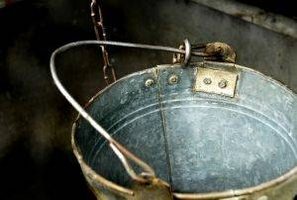
Bitter Water, [The Cross]

bitterwater

24 Then the people complained and turned against Moses. “What are we going to drink?” they demanded. 25 So Moses cried out to the Lord for help, and the Lord showed him a piece of wood. Moses threw it into the water, and this made the water good to drink.

It was there at Marah that the Lord set before them the following decree as a standard to test their faithfulness to him.”

Exodus 15

In this brief narration we have a graphic portrait of the condition of many within the Church today. The situation is becoming critical and its effects are devastasting. Some call it ‘crossless Christianity,’ ‘cheap grace’ or the ‘new cross.’ The writer of Exodus 15 calls it ‘bitter water.’

The children of Israel had begun to murmur. They demanded water for the long and hot journey through the Sinai desert. Coming to the ‘springs of Marah’ they discovered it bitter and undrinkable.

Moses responds directly to directly quell this potential rebellion. He begins to cry out to the Lord (what else can you do?) and begs the Lord for wisdom. He must know the next step.  So Moses cried out to the Lord for help,”

There was a tree, a piece of wood, and when that wood was tossed into the waters, the water were made sweet.

********

Today– people are waiting— searching for water. And never, ever has there been such a desperate search. They stampede to any new well on the horizon, and they search for anything.  Any well will do. Most will seek there lives away, only to perish at the ‘end.’ They’re chasing a mirage.

The Church is to be a well, an oasis in a dry and desperate land. But the water is becoming ‘bitter.’ We have defiled it with ‘sin and self.’ Friends, please understand— the ‘bitterness’ of our ‘uncrucified’ flesh pollutes our wells. We have poisoned our own selves.

We need ‘the cross.’ It is a sweet source for our ‘bitterness.’

We must return to ‘the old rugged cross.’ We need to embrace its reality again. Jesus, himself said this: “Whoever doesn’t bear his cross, and follow me cannot be my disciple.’ Those who followed after Him needed no preacher to interpret.

Rome had a nasty habit of executing her criminals publicly. Everyone who had listened to Jesus Christ had seen people crucified.

One Roman general, after suppressing a Jewish rebellion crucified 2,000 men at one time. The roads into Jerusalem were lined with crosses of dying men. This was done purposefully and publicly.

Every man and woman would see the terrible price of resisting Rome. This would result in death, and there are no halfway about it. A cross is a radical thing. There is nothing ‘halfway’ about it. It demands ‘no less than all.”

The Cross is in danger of being misinterpreted’ today. Our cross seems somehow different. It seems softer, and more padded, it doesn’t rub us the wrong way.” It allows us much: our favorite habits, our prideful ways, and our self-centered ideas. It would seem that what we call ‘our cross’ has a built-in ‘life-support’ system that keeps our old man alive just a little bit longer.

********

Dr. A.W. Tozer in an article entitled “The Old Cross and the New” wrote:

“The new cross is not opposed to the human race, rather it is a friendly pal, and if understood aright, it is the source of oceans of good clean fun, and innocent enjoyment. His life motivation is unchanged, he still lives for his own pleasure, only he takes delight in singing choruses and watching religious films, instead of singing bawdy songs, and drinking hard liquor. The accent is still on enjoyment, though the fun is on a higher plane morally, if not intellectually.The new cross does not slay the sinner, but redirects him.”

The old cross is a symbol of death. It stands for an abrupt and violent end of a human being.

 “Examine yourselves to see if your faith is genuine. Test yourselves. Surely you know that Jesus Christ is among you; if not, you have failed the test of genuine faith.”

2 Corinthians 13:5

Are we really carrying the cross of the Bible? Is our faith real? Are we carrying the real cross? We cannot be really His disciples unless we do so, and we are apostate if we do not.

“Then, calling the crowd to join his disciples, he said, “If any of you wants to be my follower, you must turn from your selfish ways, take up your cross, and follow me.”

Mark 8:34

bry-signat (1)

cropped-christiangraffiti1.jpg

The Hidden Smile of God, [Discovery]


63744965_1019400944_z

Imagine for just a moment, you can actually see the face of God. Is He…?

  • angry, seething with a vindictive hostility
  • rolling His eyes, amused, maybe a bit perplexed
  • disturbed, frustrated, ready to give up on you
  • not looking at all, bored, detached, not caring
  • smiling at you, like a proud Father?

Three simple verses for the God’s ‘face-seeking’ person.

13 “If you look for me wholeheartedly, you will find me. 14 I will be found by you,” says the Lord.”

Jeremiah 29:13-14

3 “Long ago the Lord said to Israel: “I have loved you, my people, with an everlasting love. With unfailing love I have drawn you to myself.”

Jeremiah 31:3

32 “Fear not, little flock; for it is your Father’s good pleasure to give you the kingdom.”

Luke 12:32

There are many, many more like these three. (But I didn’t want to scare you.)

God’s love is not logical, or mechanical. and you can’t see His face based on your performance. You simply just can’t do enough. So we all must come to Him the same way— on our knees. God’s love is outrageously understood, it is completely undeserved and perhaps just a bit scandalous. So settle this now, you’ll never, ever be good enough, (but you can be bad enough).

I believe the face of God is smiling on us, and He ‘lights up’ when we come into His presence. He is incredibly gracious. You can thank Jesus— it was His cross and resurrection that made access to God possible. (O.K., just one more verse.)

19 “So then you are no longer strangers and aliens, but you are fellow citizens with the saints and members of the household of God.”

Ephesians 2:19

There is a freedom that comes when you quit struggling and simply believe in ‘the smiles of God,’ and when you know deep-down that you belong. Everyone who comes to Him comes by the goodness (and sacrifice) of Someone else. And that is remarkably good news.

Hallelujah,

bry-signat (1)

cropped-christiangraffiti1.jpg

Unfixable Things, [Desperation]

sisyphis-bwLife is jam-packed with problems.  Money, marriage, children, work, health, church and so much more.  In Greek mythology, we find lessons from a man named Sisyphus.  He was the king of Corinth, and known to be a rascal. He was conniving and arrogant  (a good description, “hubris”). The gods hate hubris in people.

Somewhere along the line, he really ticked someone off and he was condemned for all eternity to roll a huge boulder up a large hill.  He would toil and sweat, to reach the top, only to have that boulder roll down the hill.  He would have to start all over again– endlessly repeating this work. Up and down– forever and ever. (Apparently– he’s at it today.)

I suggest that there are quite a few things that are inherently unfixable. It certainly seems like we are going to resolve them.  It may even seem like we’re making some headway.  When we get close, our boulder rolls down the hill. And we stand there looking dumbfounded, wondering what we can do differently next time. Often when we are aware of the tedium and the monotony– the repetitive effort; it seems about time that we do something different.

But there are also hard, and ghastly things, issues that we will never change.  We try, and then we try harder.  But it is apparent we can never make things so they click.  These are simply unfixable from our point of view. We’re completely– “over our head.” And, guess what?  We really are.

But the Lord answered her, “Martha, Martha, you are worried and upset about many things. 42 Only one thing is important. Mary has chosen the better thing, and it will never be taken away from her.”

Luke 10:41-42, NCV

Making things work should never be your top priority.  We face problems that in ourselves we will never correct.  I must tell you this, we can’t turn these issues into our primary focus.

  1. The Lord Jesus is to be all that we seek.  He is our first priority. We are to concentrate on His dear presence– above all else.
  2. Perhaps, instead of seeking solutions for our lives, we should be seeking His face?
  3. Apart from His power we will forever labor and toil.

“Whatever I have, wherever I am, I can make it through anything in the One who makes me who I am.”

Philippians 4:13, MSG

We are to talk to Him about these things that perplex us. I would suggest that these convoluted problems are the Fathers’ way of driving us to Him.  Eternity is now our real home, and we must come to the place in God where we seek Him now, just like we will in heaven.  We can quit rolling our boulder up the hill.  We will cease and desist. Instead we will trust and seek His face.

“I will instruct you and teach you in the way you should goI will counsel you with my eye upon you. ” 

Ps. 32:8, ESV

“But we are citizens of heaven and are eagerly waiting for our Savior to come from there. Our Lord Jesus Christ 21 has power over everything, and he will make these poor bodies of ours like his own glorious body. ” 

Phil. 3:20-21, CEV

bry-signat (1)

Condemnation Can’t Stay [Guilt]

make-faucet-bucket-fountain-800x800

“Lord, I crawled across the barrenness to you with my empty cup uncertain in asking any small drop of refreshment. If only I had known you better I’d have come running with a bucket.”

-Nancy Spiegelberg

There can be no freedom from condemnation without submission to the saving life of Christ.  This is a definite and critical point.

Without a faith in Him, we are left with the option of carrying our own guilt.  This is a staggering possibility, and our lives turn to drinking and “drugging” and other things.  We must escape from all this pain and sin.  We are walking out condemnation, and the weight of this is immense.

Much of our life can be distilled from this viciousness.  We absorb it, adapt to it, thinking it will ease up some.  But it doesn’t, and it won’t.  We turn to all kinds of ‘pain absorbers’ looking to cope with this mindset.  There are escapes, and we try them all.  But ultimately we end up with one that is quite imperfect, and we ‘sort of’ become a little numb. Our hearts become numb and hard.

Condemnation twists us and who are in Christ. 

It deforms our spirit and destroys our confidence before our Father in Heaven.  His love is still being poured out, but we have placed a cover on our vessel.  We are blocking His mercy by our unwillingness to be forgiven.  All of our guilt seems a reasonable reaction to the heaviness of our sin.

Humans were not designed to handle guilt, and its “cousin” fear.  When we do try, we short-circuit.  Pain is always avoided, and that ends up corralling us into bondage.  From here, we can still mentally assent to the Bible; we can still have a sense of spirituality.  But it will always be filtered through our sense of condemnation.

Faith in the complete action of Jesus is enough.  Because I believe He carried the full weight of my sin, past—-present—future, I can walk out a free man.  Yes, sin does require justice, it is to be condemned.  But my faith, trust or confidence enables me to separate from the sin that would take me, straight to the bottom.

In this release, we are supposed to live. Freed from every condemnation. You must displace condemnation with grace.

We have the joy of the forgiven sinner, and that really makes no sense at all. 

It isn’t at all rational.  But it is legal, and it is binding.  And permanent.  There have been too many lies, for too long.  Grace is meant to be the most radical concept we have ever confronted.  And truly it is.

“Therefore there is now no condemnation for those who are in Christ Jesus.”

Romans 8:1


bry-signat (1)

cropped-christiangraffiti1.jpg