Change is Mandatory, [Transformation]

coal-diamond

“The Lord your God will change your heart and the hearts of all your descendants, so that you will love him with all your heart and soul and so you may live!”

Deuteronomy 30:6, NLT


8 “So all of us who have had that veil removed can see and reflect the glory of the Lord. And the Lord—who is the Spirit—makes us more and more like him as we are changed into his glorious image.”

2 Corinthian 3:18, NLT

Geologists tell us that a lump of coal can be transformed into a diamond.  It is not an easy process, and there is little economic value. But it can be done, but with much effort and time. This involves tremendous heat, and incredible pressure.

Something is happening to us and we are being transformed. This is part of God’s plan for us. This takes action on His part, it is a special work of His Holy Spirit.  Slowly, but very surely, “we are becoming.”

Becoming is not an easy process. It is not a skill to be mastered but a new life to be lived. We are called to deny ourselves and bear our cross and follow Him every day. His Spirit comes along side and encourages us to believe God is changing us. We are slowly becoming like Jesus. We are growing “more and more like him.”

“And I am certain that God, who began the good work within you, will continue his work until it is finally finished on the day when Christ Jesus returns.”

Philippians 1:6

We should conclude that God is surely working on us until Jesus returns, or we die. If you are a believer, you can have faith that His work is ongoing. It may seem delayed, or stalled but be assured that you’re His special project and He is not going to give up on you.

He is making ‘diamonds’ out of lumps of coal.

1brobry-sig4

cropped-christiangraffiti1 (1)

How Things Grow, [Work]

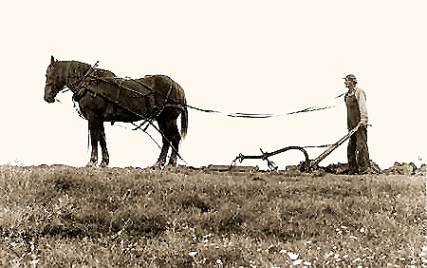
plow1930s

A farmer slowly walks behind his plow. The ground is hard and unyielding, but the steel cuts the heavy sod like a knife. He is preparing the soil for receiving the seed. He knows that what he is doing is imperative and he shouts out to encourage the horse. Its getting late and he wants to cut another furrow before night.

Plodding behind the plow he thinks many things. He can break up the ground, till and fertilize it, sow the seed— and then wait. He is powerless it get the seed to germinate and grow. He is limited to cultivating the soil and waiting. That is all he can really do, and he accepts this powerlessness. He can do everything right, and still not have a crop. All he can do is his part.

The farmer works in partnership with God. He is dependent on Him to grow the seed. The farmer must rely on the weather to meet and engage the planted seed. There are no shortcuts here. He does all he can, and then hopes that it is enough.

Farming is a joint endeavor between man and God. The man does what he has to do. God takes what the man has done and then finishes it. The crop will grow because He wills it. The farmer plays a part for sure, but ultimately God must become involved. Afterall, He makes the seed to sprout and grow.

We can say decisively that the pursuit of holiness in a Christian’s life is a joint endeavor between a believer and God.

Each have made the effort. The Christian does what is necessary, and then the seed is finally sown. It is then up to God to make the seed become the seedling. But each must work to finish the growth.

No one can attain holiness in their life apart from the work of preparation (it’s indeed work). The man must prepare the ground through plowing and cultivating. The farmer works the ground in order to make the ground ready. On the other hand, God provides both the environment and the growth needed to grow the seedling. Both the farmer and God must do their work.

A life of holiness is not automatic. It will never come at measured pace, trickling into our souls at a mechanized rate. (It would be nice if it would). Rather it wheat-field-landscape-picture_1920x1200_79595seems to come, in fits and spurts, sputtering rather than simply flowing.

Holiness is like a steamy Amazon jungle, vibrant and full of life. It is saturated with things living and green. It is not like an arid and sterile desert. Holiness is pulsating and powerful, full of lush growing things.

Becoming a person of holiness is the grandest adventure for the human soul. It defies our tendency to be rigid and legalistic. It is quite the opposite. It is tapping into life itself, and who is up to the task? Our morbid ideas of what holiness are not worthy of what really is.

Yes, to be holy is to work. Just as the farmer must prepare the soil for the seed, we too must guide our plows. God is ready to sow, and we should be ready to be ready. That is if we want to be fruitful and productive.

“Oh, the fullness, pleasure, sheer excitement of knowing God on earth!”

 Jim Elliot

bry-signat (1)

cropped-christiangraffiti1.jpg

A Doubting Faith

faith-and-doubt“”Then the disciples came to Jesus in private and asked, “Why couldn’t we drive it out?”

He replied, “Because you have so little faith. Truly I tell you, if you have faith as small as a mustard seed, you can say to this mountain, ‘Move from here to there,’ and it will move. Nothing will be impossible for you.””

Matthew 17:19-20, NLT

The text is intriguing; it seems to direct us to consider the unbelief of the disciples. They had tried so hard to do what Jesus wanted; they get an “A” for effort, but they can’t heal this boy. They correctly discern a demons presence, but they are stymied after trying to exorcise it.

The disciples “crash and burn” is uppermost in their hearts. They have a private meeting with Jesus to determine what went wrong. Their expectations were running high; they expected success in this encounter with darkness. After all, weren’t they Jesus elite followers?

Even after Jesus had performed so many signs in their presence, they still would not believe in him.” 

John 12:37, NIV

 Jesus is on his way to be crucified. It would be fair to say that his mind was occupied with this. He is still performing healings for the needy, and although awesome things are happening, the crowds remained doubting. They would remain uncertain about him, and many would go on to mock and revile him in just a few days.

Doubt is an insidious thing. It allows one to see, but not respond. It seems to be a cowardly attitude that masks itself as safety and security. There is a willingness not to make a response when that is precisely what is being called for. It is content to live uncommitted and remain unaffiliated. Truth is neutered and we want it to be so.

I certainly don’t mean to be overly harsh to those with doubts. But there are some who put their faith in their doubts and that is slightly disturbing. They see, but do not perceive. They hear, but do not really listen.

“So faith comes from hearing, and hearing through the word of Christ.”

Romans 10:17

 Believers who doubt are in a strange place. But saving faith is always growing, in spite of one’s own skepticism. Questions are to be welcomed; honest inquiry is not a threat, but an issue of a seeking heart. Faith without evidence is no better than superstition. I think believers who never ever doubt are “a freak of nature.” Our faith may struggle, and hard questions be asked, but my faith still holds even when I doubt.

“Now faith is confidence in what we hope for and assurance about what we do not see.”

Hebrews 11:1

We are to grow in our faith. The Bible describes it as “life.” To be a believer in Jesus is a journey of confidence and hope (these words have been carefully chosen). When we find ourselves without these two working in our hearts we become unbelieving believers.

Maybe we should doubt our doubts before we doubt our faith.

“Faith never knows where it is being led, but it loves and knows the One who is leading.”   

Oswald Chambers

bry-signat (1)

cropped-christiangraffiti1.jpg

The Gentile Woman, Matthew 15:21-28

This is a chapter from my book, “They Met Jesus: Stories from the Gospels.” Hope you like it!

Chapter 6

The Gentile Woman, Matthew 15:21-28

Then Jesus left Galilee and went north to the region of Tyre and Sidon. 22 A Gentile woman who lived there came to him, pleading, “Have mercy on me, O Lord, Son of David! For my daughter is possessed by a demon that torments her severely.”

23 But Jesus gave her no reply, not even a word. Then his disciples urged him to send her away. “Tell her to go away,” they said. “She is bothering us with all her begging.”

24 Then Jesus said to the woman, “I was sent only to help God’s lost sheep—the people of Israel.”

25 But she came and worshiped him, pleading again, “Lord, help me!”

26 Jesus responded, “It isn’t right to take food from the children and throw it to the dogs.”

27 She replied, “That’s true, Lord, but even dogs are allowed to eat the scraps that fall beneath their masters’ table.”

28 “Dear woman,” Jesus said to her, “your faith is great. Your request is granted.” And her daughter was instantly healed.

I grew up watching the sea, it always brought me peace. I loved its serene beauty. My girl loved flowers. As a little child, I remember her making daisy chains, and the way she laughed. When the darkness came she was never was the same. I stood by and helplessly watched Satan consume my daughter.

She was sick. Sick with something evil and dark. Somebody said it was demons, but she was possessed by something I didn’t fully understand, and I had immense hatred for it. I was angry for what it had done to my precious little girl. I hated the darkness that stole her heart.

That’s when a neighbor told me about the Jewish healer that might help us. That gave me hope. We already wearing out our welcome at the local temples. We had recently returned from nearby Eshmun, a pagan temple specializing in healing. The priests knew us by name. But my daughter’s condition seemed to worsen.

I made the decision to see Jesus. As a Canaanite woman I knew it wouldn’t be easy. We were not Jews and we were accustomed to being treated poorly. I knew there would be conflict. But I would do whatever it took to see him. I believed he would help us.

We came to see Jesus at the house he and his disciples were staying at. Standing outside the door I began to plead for my daughter, Have mercy on me, O Lord, Son of David! My daughter is possessed by a demon.” I spoke as plainly as I knew how. I spoke from my heart.

Jesus seemed to ignore my pleas. So I kept asking. I suppose I made his disciples uncomfortable, but you have to understand, I had no place to go. He had to heal her. I couldn’t go home without seeing him.

The disciple were advising Jesus to send me away. They knew I was a Gentile woman and they could take no time with me. I felt the silent rage of racial prejudice. Still I stayed, and I continued to beg.

Then Jesus finally turned to me and said, I was sent only to help God’s lost sheep—the people of Israel.” My heart almost broke. But I knew if he would only listen to my need he still might help me.

I came and worshiped him and then I continued to plead. I must make him see, he was my only hope at that moment. “O Jesus, help me!”

Jesus responded, “It isn’t right to take food from the children and throw it to the dogs.”

I cringed inside. The Jews call the Gentiles dogs. I felt the rebuke and I struggled to respond.“That’s true, Lord, but even dogs are allowed to eat the scraps that fall beneath their masters’ table.” I firmly believed that was the proper thing to say.

Dear woman,” Jesus said to me, “your faith is great. Your request is granted.” And my daughter was instantly healed. In that moment she completely recovered. I saw the darkness lift and light returned to her eyes.

Yesterday my daughter and I went to the seashore together. I went to see the ocean and she picked flowers. She is completely recovered. My heart is full of praise to the Living God who hears a desperate woman’s cries. I know that he is full of mercy.

Jesus, many of the people I meet are sick inside, let me be a light for them to see by. Evil is all around, but you rule over it, Help me to see your power and grace. Amen.


1brobry-sig4 (2)


cropped-christiangraffiti1-3