Different Ways to Fall Out of a Tree

boy-falling
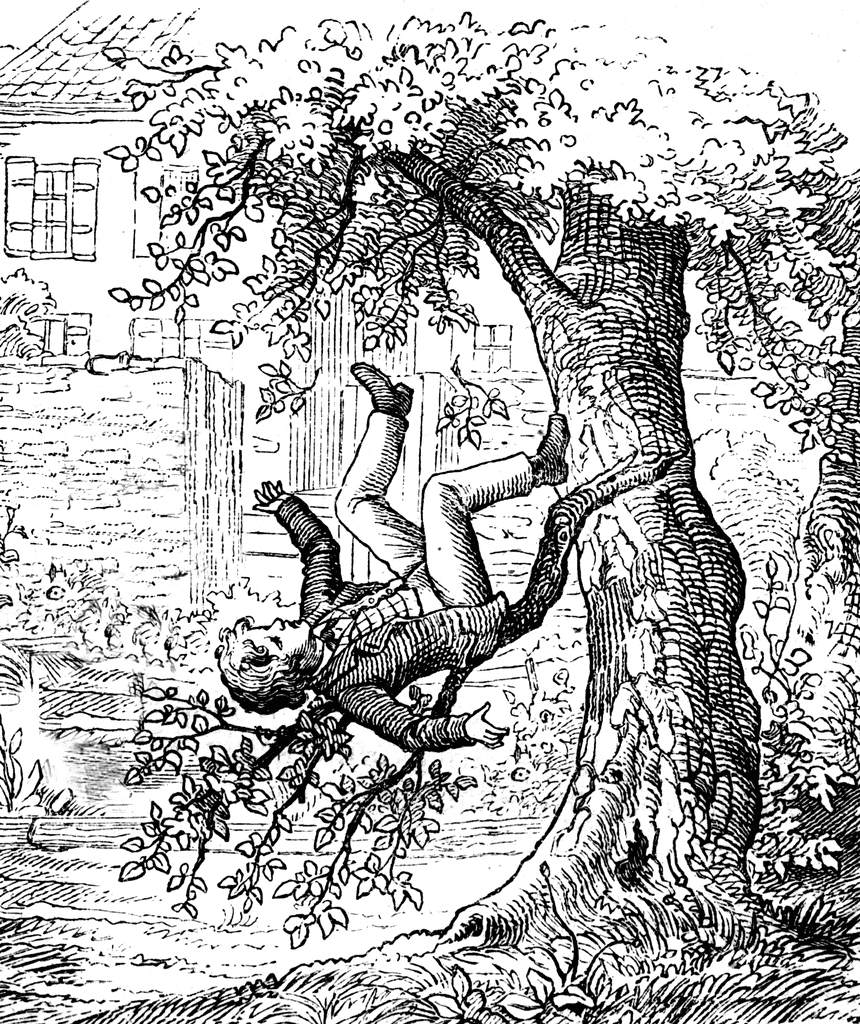
Imagine climbing up to the top of a very tall tree. You work your way up to the highest point– you can go no further. The view is completely glorious, it’s more than you hoped for. You want to post it on Facebook, so you dig into your pocket to get your camera-phone. You suddenly slip, and because your arms are occupied getting your camera, you fall. And you fall fast.

As you plummet, you realize that you’re hitting every branch on the way down. The smaller ones break, and the bigger ones, well– you just bounce off. The trip down is very fast, and perhaps even a bit illuminating.

  1. First, you think of death.
  2. Then you think about the pain each branch causes, and wonder about your imminent arrival on terra firma.
  3. Perhaps you consider how stupid you are, and how you are going to explain it.
  4. Lastly, I suppose, you wonder if you have clean underwear on, like your mother always told you to wear.

This is how my life has gone, the last 20 years. This metaphor is a good way for me to process things, and to find some understanding. I now believe that some of us go through life sideways, or horizontal. We careen off of every branch on the way down, and it seems we are hitting branches that we didn’t even know were there. Tree limbs are snapping, as we are dropping.

Others who are wiser (or maybe more experienced,) try to fall more vertically. As they fall, they use their hands to try to slow their descent. (This does work!) They will take their fair share of jolts, no doubt. But their journey to the forest floor is way less traumatic. They may end up in the hospital– but not in emergency surgery like the first guy.

It sometimes seems like every trouble I have faced I have gone into it sideways. I have broken a lot of branches on my way down. I suppose I’ve entertained some who have watched me plummet, and seen me careen and spiral my way to the bottom. These have been some painful times, I have inflicted considerable amount of bruises on myself.

People who go through life sideways will invariably suffer. They seem to hit every obstacle and trial that could be in their flight path. The existence of pain in this life cannot be disputed.

“I have told you all this so that you may have peace in me. Here on earth you will have many trials and sorrows. But take heart, because I have overcome the world.”

John 16:33, NLT

Jesus understands. Especially if you are one of those people who are “trial magnets” going through life horizontal. (You just seem to collect them.) My hope for you that as you break your branches on the way down (for maybe the 100th time). You will try to plummet vertically. Not that it is any easier, life will hurt. But perhaps it won’t be as agonizing. And I suppose that would be a good thing.

“Now unto him that is able to keep you from falling, and to present you faultless before the presence of his glory with exceeding joy,”

Jude 24

Just hanging on!bry-signat (1)

cropped-christiangraffiti1.jpg


kyrie elesion.

The Blue Letter Version

molaw_b

The ‘red letter’ Bible emphasizes the words of Jesus by making them red. But sometimes we can learn just as much by which words he didn’t say.  I would like to submit to you the ‘Blue Letter Version’ of things Jesus never said.

He never said:

V. 1) You’re too far gone to be saved.

V. 2) I’m so disappointed in you.

V. 3) This wouldn’t be happening if you were a better Christian.

V. 4) It’s okay not to love certain people.

V. 5) Everyone should be just like you.

V. 6) Its all up to you.

V. 7) You don’t have to forgive someone who has hurt you.

V. 8) You missed my will for your life.

V. 9) I’ve given up on you.

V. 10) This is a cross you must bear alone. 

When we think through these we should realize that each ‘verse’ is wrong. Jesus never said any of these; I am certain he wouldn’t even think these things about us. We can only surmise that what he did declare is real, and that his love for us is boundless and limitless. People like you, and like me, are loved in spite of our sins. His love doesn’t fit the conventional wisdom.

“All that the Father gives Me will come to Me, and the one who comes to Me I will by no means cast out.”

John 6:37

There are other verses to consider. These affirm his love to each of us.

“But God demonstrates His own love toward us, in that while we were still sinners, Christ died for us.”

Romans 5:8

“Behold what manner of love the Father has bestowed on us, that we should be called children of God! Therefore the world does not know us, because it did not know Him.”

1 John 3:1

The Blue Letter Version exists only in my mind. Yet sometimes I catch myself thinking things from our list. But in a way, each of the above is logical. But each are also wrong.

“For My thoughts are not your thoughts,
Nor are your ways My ways,” says the Lord.”

Isaiah 55:8

I encourage you to listen to the ‘drum roll’ of grace that is beating from the heart of Jesus. He loves you with a supernatural love that can not be silenced. Accept his love (or not) and he will love you the same. “For God so loved the world” (John 3:16). Securely attach yourself to this love.

bry-signat

flourish31

The Lady and the Knight in Shining Armor

“Be kind to one another, tenderhearted, forgiving one another, as God in Christ forgave you.”

Eph. 4:32

“It’s unfortunate and I really wish I wouldn’t have to say this, but I really like human beings who have suffered. They are kinder.”

Emma Thompson

She has nailed down a thought here.  It is only a starting point, a beginning that one should work-out, over and over.  We begin at this realization that there can be a definite link between suffering and kindness.  It’s like two wheels of a bicycle.

I’m in love with kind people.  All the people I have met who were truly wonderful, had very kind hearts.  Kindness set them apart.

Historically, kindness was regarded as one of the “Knightly Virtues” of medieval times.  Having it was to be a mark of chivalry.  In theology, it was one of seven virtues, that mirrored the “Seven Deadly Sins.” It seems to me that believers who practice kindness are to be regarded as part of a spiritual nobility.

This connection between suffering and kindness isn’t so much as a “cause and effect,” but rather a ‘fruit’ which has to ripen, or mature.  Pain is not always this productive in our lives.  It can bring bitterness and loss as easily as it can bring kindness and gentleness.  And many of us who struggle with mental illness or substance abuse understand this all to well.

The apostle Paul was right to link his sufferings to spiritual growth.  If you can do this you are moving in the right direction.  It will not lift you out of the pain; you will still have the sense of being overwhelmed, but you will see through it with the eagle eye of faith.

Why is it that so many who have suffered, will go on to become kind people?

It may have to do with two dynamic principles. The first metaphor would have to be the smelter/the potter.  These are significant because they illustrate how believers are always in process.  We are in flux, either moving under the hand or under the heat.

The second metaphor is the grape vine dresser/bread maker.  These strike me as harsh, although it may not always feel that way.  But both are definite “hands-on” from a supervisory source–the Holy Spirit.

Suffering is a lot like learning another language.  Some days it will just click, and then other days you can’t remember your previous lesson.  But if you are really patient you will learn to speak the dialect of suffering.  Learning languages can open up the world to you.  If you learn to speak “suffering” you will be able to touch the hearts of millions.

But there needs to be patience.  You must wait for “kindness.”  Transformation will never be smooth or easy.  There are no switches for God to flip to make you Christlike.  You will not wake up tomorrow morning with the character of Jesus–his mercy, love, wisdom and kindness.  I’m sorry.  (Choose to dispute this, and I will let you.)

flourish-bird

“I prefer you to make mistakes in kindness than work miracles in unkindness.”

Mother Teresa’s counsel 

“God has chosen you and made you his holy people. He loves you. So you should always clothe yourselves with mercy, kindness, humility, gentleness, and patience.”

Col. 3:12, NCV 

1brobry-sig4 (2)


cropped-christiangraffiti1-2


Do You Love Me?


“When they finished eating, Jesus said to Simon Peter, “Simon son of John, do you love me more than these?” 

   He answered, “Yes, Lord, you know that I love you.” 

   Jesus said, “Feed my lambs.” 

   Again Jesus said, “Simon son of John, do you love me?” 

   He answered, “Yes, Lord, you know that I love you.” 

   Jesus said, “Take care of my sheep.” 

John 21:15-16

This is a favorite passage for believers throughout the whole world.  I think the reason is that it’s a transferable concept; it is something that communicates well to a heart and life that is struggling very hard.  If you think about it everything in the story is coming to us from two places.  Either Peter’s failure, or Jesus’ grace.

Failure is a brutal teacher; but man, do you learn! Much of the teaching had already been done in Peter’s life. His denial and cowardice had already been worked out, and Peter then had to live with himself.  He was defeated and very lost before this meeting on the beach.

Jesus’ heart is to reconcile his errant disciple with Him, and with Peter himself.  Peter is stuck; in his own failure and denial, and he needs Jesus to touch him in His own impenetrable darkness.  People who have failed God will understand this.  We have been in the darkness, and only Jesus can rescue us from its empty pain.

We see what amounts to a ‘good’ interrogation.  Peter, the failure, is asked over and over by Jesus the “Question”.  “Do you love me?  This is a simple and basic inquiry.  “Do you love me?”

Peter in his pathetic state, is forced to generate a response to Jesus that destroys his own confusion and apathy.  It’s neat to see Jesus pulverizing the foundations of darkness in Peter’s life.  He does it with a skill and deftness that leaves us in awe of Jesus’ love. Peter had denied knowing the Lord three times. It is fitting that Jesus would ask His question three times as well.

For us, the questions keep coming.  We are repeatedly asked, over and over, “do you love me?”  We must process the penetration of the question.  Do you really, really love Jesus?  Is it a show? Do we really love Him, or is it just words, a misbegotten display of cultural appropriateness?

Jesus moves Peter into the light.  Never again will he live in confusion and despair.  His interview with Jesus has placed him there, into the light.  Jesus’ incredibly wise questions led Peter to the place of authenticity.  Peter, from this new place of completeness and recovery, is finally restored and healed.

But do we love Him?  Do we turn the ministry we do, whatever that might be, does it come from a place of love and confidence.  Our love for Him is the essential basis, the root foundation of all Christian activity.  It’s all about the “love”.  “Do you love me?”

1brobry-sig4 (2)


cropped-christiangraffiti1-3-1

*