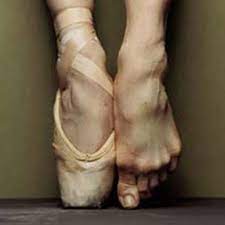
Dancing With Bruises

ballerina stretching
Photo by Beto Franklin on Pexels.com

It seems like bruises are part of our life.

Dancers are some of the most talented people I know. Their gracefulness can be seen both on and off the stage. A dancer’s training is far from easy. But by choosing to become dancers they have made a decision to absorb pain.

Their toes and feet are blistered and bruised; they take constant abuse. Some live with chronic tendonitis. Their feet bleed sometimes, and pain is their constant companion, but they still choose to dance.

Two things to consider.

  • They choose to dance. Dancers must operate with an iron will and an elegant grace. I suppose that is why they can dance the way they do. They have painfully blended the two.
  • The scars and bruises often become “badges of honor.” They would rather dance in pain, than not dance at all.

I once heard someone describe depression as having a mental bruise. I understand this. It makes sense.

As one prone to depression, I know what it is like to bury myself in my bed for weeks at a time. My own mental bruise was simply more than I could take. There was a sensation of sinking into blackness, a sense of total and complete despair. I felt lost and completely alone.

I prayed. I groaned, and I prayed again. Things weren’t going well.

dancer-feet

My sense of being totally lost in sad, dark thoughts was beyond comprehension. Dear reader, this was something quite real, and you must become aware of these things. Some of your friends are suffering, and it is often a hellish and desperate depression.

We would never say that diabetics are that way because of the enemy. The dark one will surely exploit it, but I think you give him far too much credit if you suggest he was able to initiate it. I don’t think Satan has the spiritual “voltage.”

I refuse to hide my mental bruises from those who share my pain. I will make the choice to dance. I’m bruised, but I will try to ignore the pain. I would exult in my God, walk in His love, and “leaping with joy like calves let out to pasture” (Malachi 4:2.)

“A bruised reed he will not break, and a smoldering wick he will not snuff out, till he has brought justice through to victory.”

Isaiah 42:3

The great pastor/evangelist Charles Spurgeon once spoke about his own personal battle with depression. Read this quote slowly and deeply:

 “I find myself frequently depressed – perhaps more so than any other person here. And I find no better cure for that depression than to trust in the Lord with all my heart, and seek to realize afresh the power of the peace-speaking blood of Jesus, and His infinite love in dying upon the cross to put away all my transgressions.”

Charles Spurgeon

Repeat Offenders

“Father, every family has a rascal someone who breaks the rules a juvenile delinquent of untold frustrations and sleepless nights a repeated offender and bearer of sad woe the problem child who needs the most discipline.

Is this why you love me most persistently? When you correct me, is it because I’m the one most contrary?

Or is it that you love me so much?”

 I wrote this thinking about Hebrews 12 and God’s purpose of chastening. I don’t pretend to understand this dynamic completely–all I can say is that my childhood was punctuated by much difficulty. But now, as a father (my two children are now grown), fatherhood has become far easier than my dad had with me.

7 “As you endure this divine discipline, remember that God is treating you as his own children. Who ever heard of a child who is never disciplined by its father? 10 For our earthly fathers disciplined us for a few years, doing the best they knew how.

But God’s discipline is always good for us, so that we might share in his holiness. 11 No discipline is enjoyable while it is happening—it’s painful! But afterward there will be a peaceful harvest of right living for those who are trained in this way.”

Hebrews 12:7, 10-11

I really think we understand our Heavenly Father when we spend quality time with Hebrews 12. We are given insight into His care and into our own issues. It is a good thing He gives us— it enriches our spiritual lives.

It’s never nice to be corrected.

It’s not pleasant. Part of being corrected is being reminded that we’re not as righteous as we think we are. To be corrected strikes us to a reprimand, an admonition that something isn’t right inside of us.

The Father corrects His children–in many ways through a myriad of circumstances. He loves us far too much to allow us to continue in our sin. He’s making us into the image of Christ.

We should welcome His correction. He has a plan for you.

When He disciplines you, it only proves that He is your Father. It’s critical to remember: God’s correction is always for our good. It may be painful yes, but it comes with real hope. It’s not to harm or punish you.

“Father, I’m so sorry that I grieve you as often as I do. I promise to behave. Thank you for being a faithful Father who cares deeply for my soul. Amen.”

 Hannah Whitall Smith.

When God Doesn’t Heal You

Mike Mason

God heals. Of that I have no doubt. We have many promises and see so much actual healing in Scripture. Jesus’ ministry would connect with hundreds of people who would be physically touched. The Lord would pass the baton on to His Church. We’re called to “lay hands on the sick,” (James 5:14-15).

But not everyone who is sick will receive physical healing. Even those who were active in ministry knew sickness.

In the second episode of season 3 of “The Chosen,” Little James, who we’ve seen walks with a limp, comes to Jesus after He commissions the Apostles. He tells him he finds it hard to believe that he will be healing people, given that Jesus hasn’t healed him.

“Do you want to be healed?” asks Jesus.

“Yes, of course,” James says, “if that’s possible. Why haven’t you?” he asks Jesus—again, a question some of us would’ve asked.

“Because I trust you,” Jesus says. “Little James. Precious Little James. I need you to listen to me very carefully, because what I am going to say defines your whole life to this point and will define the rest of your life. Do you understand?”

Jesus tells James that he will heal many people, and they will have a good story to tell.

“To know how to proclaim that you still praise God in spite of this—to know how to focus on all that matters, so much more than the body—to show people that you can be patient with your suffering here on Earth, because you know you’ll spend eternity with no suffering—not everyone can understand that. How many people do you think the Father and I trust this with? Not many.”

“But the others,” James says, “they are so much more … stronger, better at this.”

“James, I love you,” Jesus says, “but I don’t want to hear that ever again.”

“I know how easy it is to say the Psalm of David, that I am beautifully and wonderfully made, but it doesn’t make this any easier,” says James, begins to weep. “It doesn’t make me feel like any less of a burden.”

“When you pass from this earth,” Jesus says to James, “and you meet your Father in Heaven, where Isaiah promises you will leap like a deer, your reward will be great. So hold on a little longer. And when you discover yourself finding true strength because of your weakness, when you do great things in my Name in spite of this, the impact will last for generations. Do you understand?”

James cries, and says, “Yes. Thank you, Master.”

I believe that there are two truths that every Christian can count on. These are solid, and completely trustworthy. They are forever fixed and will never change.

“Fear not, for I am with you; be not dismayed, for I am your God; I will strengthen you, I will help you, I will uphold you with my righteous right hand.” Isaiah 41:10

“He will wipe away every tear from their eyes, and death shall be no more, neither shall there be mourning, nor crying, nor pain anymore, for the former things have passed away.” Revelation 21:4

     John Henry Newman  

The Pain of Shattered Dreams

How you handle these fragile moments is key to the remainder of your life. It’s ok to feel abandoned or alone. It’s ok to be depressed.

But let God know about where you’re at. I’m convinced He really wants to teach you to walk in the truth. And dear one, nothing will be as challenging as that.

I really hope that these thoughts might help. There is no question that we’ll face challenges and difficulties. Just maybe this post will strengthen your walk? I chose each thought purposefully and every one contains something helpful (I hope). 

These quotes should speak wisdom as we try to understand what’s happening to us.

A.W. Tozer

“It is doubtful whether God can bless a man greatly until He’s hurt him deeply.” (Roots of Righteousness, Chapter 39)

Calvin Miller

“Hurt is the essential ingredient of ultimate Christ-likeness.” (Quoted in Christianity Today, July 2007, p41)

Larry Crabb

“Brokenness isn’t so much about how bad you’ve been hurt but how you’ve sinned in handling it.” (Christianity Today, A Shrink Gets Stretched, May 1, 2003)

“Shattered dreams are never random. They are always a piece of a piece in a larger story. The Holy Spirit uses the pain of shattered dreams to help us discover our desire for God, to help us begin dreaming the highest dream. They are ordained opportunities for the Spirit to first awaken, then to satisfy our highest dream.” (Shattered Dreams, 2001)

Alan Redpath

“When God wants to do an impossible task, he takes an impossible person and crushes him.” (Quoted by Gary Preston, Character Forged from Conflict: Staying Connected to God During Controversy. The pastor’s soul series, (Minneapolis, MN: Bethany House, 1999)

Bruce Wilkinson

“Are you praying for God’s superabundant blessings and pleading that He will make you more like His Son? If so, then you are asking for the shears.” (Secrets of the Vine, 60.)

Charles Swindoll

“Someone put it this way, ‘Whoever desires to walk with God, walks right into the crucible.’ All who choose godliness live in a crucible. The tests will come.” (Moses, Great Lives from God’s Word, 285.)

“Being stripped of all substitutes is the most painful experience on earth.” (David, p70)

Elisabeth Elliot

“The surrender of our heart’s deepest longing is perhaps as close as we come to an understanding of the cross… our own experience of crucifixion, though immeasurably less than our Saviour’s nonetheless furnishes us with a chance to begin to know Him in the fellowship of His suffering. In every form of our own suffering, He calls us into that fellowship.” (Elisabeth Elliot, Quest For Love, (Grand Rapids, MI: Fleming H. Revell, 1996), 182.)

George MacDonald

“No words can express how much our world ‘owes’ to sorrow. Most of the Psalms were conceived in a wilderness. Most of the New Testament was written in a prison. The greatest words of God’s Scriptures have all passed through great trials. The greatest prophets have “learned in suffering what they wrote in their books.” So take comfort afflicted Christian! When our God is about to make use of a person, He allows them to go through a crucible of fire.”

Helen Keller

“Character cannot be developed in ease and quiet. Only through the experience of trial and suffering can the soul be strengthened, vision cleared, ambition inspired, and success achieved.” (Quoted in Leadership, Vol. 17, no. 4.)

Oswald Chambers

“God can never make us wine if we object to the fingers He uses to crush us with. If God would only use His own fingers, and make me broken bread and poured-out wine in a special way! But when He uses someone whom we dislike, or some set of circumstances to which we said we would never submit, and makes those the crushers, we object. We must never choose the scene of our own martyrdom. If ever we are going to be made into wine, we will have to be crushed; you cannot drink grapes. Grapes become wine only when they have been squeezed.” (Chambers, O. (1993, c1935). My utmost for his highest : Selections for the year (September 30). Grand Rapids, MI: Discovery House Publishers.)

“No-one enters into the experience of entire sanctification without going through a ‘white funeral’ — the burial of the old life. If there has never been this crisis of death, sanctification is nothing more than a vision… Have you come to your last days really? You have come to them often in sentiment, but have you come to them really?… We skirt around the cemetery and all the time refuse to go to death… Have you had your ‘white funeral’, or are you sacredly playing the fool with your soul? Is there a place in your life marked as the last day, a place to which the memory goes back with a chastened and extraordinary grateful remembrance–’yes, it was then, at that ‘white funeral’ that I made an agreement with God.” (Oswald Chambers, My Utmost for His Highest, January 15, (Uhrichsville, OH: Barbour and Company, Inc., 1963).)

Jesus Christ had no tenderness whatsoever toward anything that was ultimately going to ruin a person in his service to God…. If the Spirit of God brings to your mind a word of the Lord that hurts you, you can be sure that there is something in you that He wants to hurt to the point of its death.” (Oswald Chambers, My Utmost for His Highest, September 27, (Uhrichsville, OH: Barbour and Company, Inc., 1963.)

Charles Stanley

Does God purposefully allow suffering? “The comfortable, but theologically incorrect, answer is no. You will find many people preaching and teaching that God never sends an ill wind into a person’s life, but that position can’t be justified by Scripture. The Bible teaches that God does send adversity – but within certain parameters and always for a reason that relates to our growth, perfection, and eternal good.” (*Stanley, C. F. 1997, c1996. Advancing through adversity (electronic ed.). Thomas Nelson: Nashville, TN.)