
“Darkness is My Only Companion”

—Ambrose of Milan (340-397)

Our theology makes all the difference in fighting depression, writes Kathryn Greene-McCreight, Author of “Darkness, Is My Only Companion” and Episcopal priest.

In his Problem of Pain, C. S. Lewis says that suffering is uniquely difficult for the Christian, for the one who believes in a good God. If there were no good God to factor into the equation, suffering would still be painful, and  ultimately meaningless.

For the Christian, who believes in the crucified and risen Messiah, suffering is always meaningful. It is meaningful because of the one in whose suffering we participate, Jesus. This is neither to say, of course, that suffering will be pleasant, nor that it should be sought. Rather, in the personal suffering of the Christian, one finds a correlate in Christ’s suffering, which gathers up our tears and calms our sorrows and points us toward his resurrection.

In the midst of a major mental illness, we are often unable to sense the presence of God at all. Sometimes all we can feel is the complete absence of God, utter abandonment by God, the sheer ridiculousness of the very notion of a loving and merciful God. This cuts to the very heart of the Christian and challenges everything we believe about the world and ourselves.

I have a chronic mental illness, a brain disorder that used to be called manic depression, but now is less offensively called bipolar disorder. I have sought help from psychiatrists, social workers, and mental health professionals; one is a Christian, but most of my helpers are not. I have been in active therapy with a succession of therapists over many years, and have been prescribed many psychiatric medications, most of which brought quite unpleasant side effects, and only a few of which relieved my symptoms. I have been hospitalized during the worst times and given electroconvulsive therapy treatments.
All of this has helped, I must say, despite my disinclination toward medicine and hospitals. They have helped me to rebuild some of “myself,” so that I can continue to be the kind of mother, priest, and writer I believe God wants me to be.

During these bouts of illness, I would often ask myself: How could I, as a faithful Christian, be undergoing such torture of the soul? And how could I say that such torture has nothing to do with God? This is, of course, the assumption of the psychiatric guild in general, where faith in God is often viewed at best as a crutch, and at worst as a symptom of disease.

How could I, as a Christian, indeed as a theologian of the church, understand anything in my life as though it were separate from God? This is clearly impossible. And yet how could I confess my faith in that God who was “an ever-present help in trouble” (Ps. 46:1) when I felt entirely abandoned by that God? And if this torture did have something to do with God, was it punishment, wrath, or chastisement? Was I, to use a phrase of Jonathan Edwards’s, simply a “sinner in the hands of an angry God”?

I started my journey into the world of mental illness with a postpartum depression after the birth of our second child. News outlets are rife with stories of women who destroy their own children soon after giving birth. It is absolutely tragic. Usually every instinct in the mother pushes toward preserving the life of the infant. Most mothers would give their own lives to protect their babies. But in postpartum depression, reality is so bent that that instinct is blocked. Women who would otherwise be loving mothers have their confidence shaken by painful thoughts and feelings.

Depression is not just sadness or sorrow.

When I am depressed, every thought, every breath, every conscious moment hurts.

And often the opposite is the case when I am hypomanic: I am scintillating both to myself, and, in my imagination, to the whole world. But mania is more than speeding mentally, more than euphoria, more than creative genius at work. Sometimes, when it tips into full-blown psychosis, it can be terrifying. The sick individual cannot simply shrug it off or pull out of it: there is no pulling oneself “up by the bootstraps.”

And yet the Christian faith has a word of real hope, especially for those who suffer mentally. Hope is found in the risen Christ. Suffering is not eliminated by his resurrection, but transformed by it. Christ’s resurrection kills even the power of death, and promises that God will wipe away every tear on that final day.

But we still have tears in the present.

We still die. In God’s future, however, death itself will die. The tree from which Adam and Eve took the fruit of their sin and death becomes the cross that gives us life.

The hope of the Resurrection is not just optimism, but keeps the Christian facing ever toward the future, not merely dwelling in the present. But the Christian hope is not only for the individual Christian, nor for the church itself, but for all of Creation, bound in decay by that first sin: “Cursed is the ground because of you … It will produce thorns and thistles for you …” (Gen. 3:17-18).

This curse of the very ground and its increase will be turned around at the Resurrection. All Creation will be redeemed from pain and woe. In my bouts with mental illness, this understanding of Christian hope gives comfort and encouragement, even if no relief from symptoms. Sorrowing and sighing will be no more. Tears will be wiped away. Even fractious [unruly, irritable] brains will be restored.

“Darkness: My Only Companion”

Kathryn Greene-McCreight is assistant priest at St. John’s Episcopal Church in New Haven, Connecticut, and author of Darkness Is My Only Copanion: A Christian Response to Mental Illness (Brazos Press, 2006).

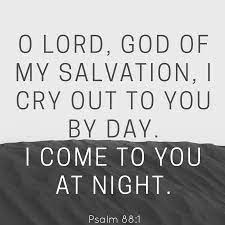
Click to read Psalm 88

A Few Bipolar Basics

Bipolar disorder symptoms are characterized by an alternating pattern of emotional highs (mania) and lows (depression). The intensity of signs and symptoms can vary from mild to severe. There may even be periods when your life doesn’t seem affected at all. Take care when this happens.

The manic phase of bipolar disorder–
Signs and symptoms of the manic phase of bipolar disorder may include:

  • Euphoria
  • Extreme optimism
  • Inflated self-esteem
  • Poor judgment
  • Rapid speech
  • Racing thoughts
  • Aggressive behavior
  • Agitation
  • Increased physical activity
  • Risky behavior
  • Spending sprees, credit card irresponsibility
  • Increased drive to perform or achieve goals
  • Increased sexual drive
  • Decreased need for sleep
  • Tendency to be easily distracted
  • Inability to concentrate
  • Drug abuse

The depressive phase of bipolar disorder–
Signs and symptoms of the depressive phase of bipolar disorder may include:

  • Sadness
  • Hopelessness
  • Suicidal thoughts or behavior
  • Anxiety
  • Guilt
  • Sleep problems
  • Appetite problems
  • Fatigue
  • Loss of interest in daily activities
  • Problems concentrating
  • Irritability
  • Chronic pain without a known cause

Types of bipolar disorder
Bipolar disorder is divided into three main subtypes:

  • Bipolar I disorder. You’ve had at least one manic episode, with or without previous episodes of depression.
  • Bipolar II disorder. You’ve had at least one episode of depression and at least one hypomanic episode. A hypomanic episode is similar to a manic episode but much briefer, lasting only a few days, and not as severe. With hypomania, you may have an elevated mood, irritability, and some changes in your functioning, but generally, you can carry on with your normal daily routine and functioning, and you don’t require hospitalization. In bipolar II disorder, the periods of depression are typically much longer than the periods of hypomania.
  • Cyclothymia. Cyclothymia is a mild form of bipolar disorder. Cyclothymia includes mood swings but the highs and lows are not as severe as those of full-blown bipolar disorder.

Other bipolar disorder symptoms:

In addition, some people with bipolar disorder may have rapid-cycling bipolar disorder. This is the occurrence of four or more mood swings within 12 months. These moods shifts can occur rapidly, sometimes within just hours. In mixed state bipolar disorder, symptoms of both mania and depression occur at the same time.

Severe episodes of either mania or depression may result in psychosis or a detachment from reality. Symptoms of psychosis may include hearing or seeing things that aren’t there (hallucinations) and false but strongly held beliefs (delusions).

Taken from the Mayo Clinic/Bipolar Disorder Symptoms.

Poetry of the Broken

Last Saturday I purchased a wonderful find at Powell’s Books (Portland, Oregon’s own homegrown new and used bookstore) – a used book called “Invisible Light: Poems about God” – for only $4.50. And it is in excellent condition.

It’s a collection of poems by various poets, some well-known and some not so well-known, as well as a few Psalms and other pieces of poetic scripture. I noticed in the table of contents that there were two poems by William Cowper, who I first heard of when reading “When the Darkness Will Not Lift” by John Piper. (See my book review of that book here).

Both of Cowper’s poems were so beautiful; it made me wonder why I even try to write poetry. (But I do know my poetry is getting better, and reading poems like Cowper’s just makes me want to learn more about poetry and get better at writing it).

I want to share one of Cowper’s poems with the readers at Broken Believers. I do so because it is a great reminder that even when we think we are too lost and broken to be of any use to God, even then God can do the impossible. He can take a broken vessel and cause great light and wonder to pour from its cracks. I am thankful for the poetry Cowper wrote, and for the witness that he provides of the truth that God uses the broken for astonishing things.

William Cowper, English poet and hymnodist
(1731-1800)

Cowper suffered from recurrent bouts of depression and severe mental illness. At times he was convinced that he was damned for all eternity and that he was a lost soul. Nonetheless, he was able to write some truly inspiring poetry and hymns to glorify God. This particular poem will cause the “Comfortless, broken, afflicted to delight in the joy of a life to come where all pain and sorrow will cease, and the glory of Jesus will be all we need.”

If you are struggling, feeling like you can never be of any use to God, take heart. God is in the business of using His power and wisdom in tandem with the broken believer to accomplish great things.

The Future Peace and Glory of the Church
by William Cowper

Hear what the Lord hath spoken:-
O my people, faint and few;
Comfortless, afflicted, broken,
Fair abodes I build for you:
Thorns of heartfelt tribulation
Shall no more perplex your ways;
You shall name your walls, Salvation,
And your gates shall all be Praise.
There, like streams that feed the garden,
Pleasures, without end, shall flow;
For the LORD, your faith rewarding,

All his bounty shall bestow:
Still in undisturb’d possession,
Peace and righteousness shall reign;
Never shall you feel oppression,
Hear the voice of war again.
You no more your suns descending,
Waning moons no more shall see;
But, your griefs forever ending,
Find eternal noon in me:
God shall rise, and shining o’er ye,
Change to day the gloom of night;
He, the LORD, shall be your glory,
God, your everlasting light.

Hymn No. 10 of The Olney Hymns

Peace, Linda K.

You can find Linda’s own blog at anotherfearlessyear.net.

8

Are There Benefits to Being Bipolar?

Bipolar people can be really different.

Originally Published on July 20, 2010 in “Psychology Today”

Let me start by acknowledging what is well known: Manic Depression or Bipolar disorder can be a devastating illness. Affecting at least 1% of the population, it can, untreated, result in suicide, ruined careers and devastated families. Bipolar disorder is often accompanied by alcohol and drug abuse and addiction, criminal and even violent behavior. I acknowledge this because I do not want to make light of the burden this illness places on people’s lives, families, and communities.

On the other hand, the history of the world has been influenced very significantly by people with manic depression (see website www.wholepsychiatry.com for details). They include:

“It seems clear that for at least some people with Bipolar disorder, there is an increased sense of spirituality, creativity, and accomplishment. It may be that having bipolar disorder holds great potential, if one is able to master or effectively channel the energies, which are periodically available, to some higher task. This would of course presume the ability to abstain from harmful drugs and alcohol, to have good character, and at least some supportive relationships and community networks.”

Y
It might be helpful to consider a reconceptualization. Perhaps instead of it being a disorder, we can think of people with bipolarity as having access to unusual potency. This potency will find a way to be outstanding-either in a destructive way, or in a constructive way. If such a choice is presented to the person, perhaps it can open some doors.
——————————————–
 

“And we know that God causes everything to work together for the good of those who love God and are called according to his purpose for them”

Romans 8:28

Source of this article: Psychology Today 

Bryan’s note: A great book, a favorite of mine, that works a lot of this out is “Exuberance: The Passion for Life,” by Kay Redfield Jamison.