
The Real Battle

Then it happened in the spring, at the time when kings go out to battle, that David sent Joab and his servants with him and all Israel, and they destroyed the sons of Ammon and besieged Rabbah. But David stayed at Jerusalem.
Now when evening came David arose from his bed and walked around on the roof of the king’s house, and from the roof he saw a woman bathing; and the woman was very beautiful in appearance. So David sent and inquired about the woman. And one said, “Is this not Bathsheba, the daughter of Eliam, the wife of Uriah the Hittite?” David sent messengers and took her, and when she came to him, he lay with her; and when she had purified herself from her uncleanness, she returned to her house.

2 Samuel 11:1-4, NASB

Where was the real battle being fought? David walks the rooftop and engages the enemy; it was within his own heart. He puts himself right into sin.

Perhaps he couldn’t sleep. It was a warm spring night, and he needed air and to stretch his legs. His troops and his generals were out to war. Maybe he was anxious about how things were progressing. Perhaps he was not where he should be.

Little did he know but he would face his own battle up on his roof.

David was a seasoned veteran; a trained warrior with skill on the battlefield. But he was also king– with kingly perks. He had wives and concubines at his ‘beck and call.’ His “appetites” were sufficiently met. That is the prerogative of kings.

She was naked– and more beautiful than he had ever seen. A servant was near, and he wanted to know more about her. He began to plan how he could have this exceptionally beautiful woman.

She was also the wife of Uriah, one of his elite warriors and one of his “mighty men,” (2 Sam. 23:39).

But he burned for her, and wanted her now. He had lost the battle.

Even kings “reap what they sow,” (Galatians 6:7-8).

“Father, keep us in the battle and protect us from sin. We want to please you. Don’t let us walk in sin and disobedience. Amen.”

[Suggested reading: Proverbs 4]


 

cropped-cropped-cropped-christiangraffiti1-11.jpg

Superglue Your Crown On

crown-vintage

“Because you have obeyed my command to persevere, I will protect you from the great time of testing that will come upon the whole world to test those who belong to this world. 11 I am coming soon. Hold on to what you have, so that no one will take away your crown.

Rev. 3:1o-11, NLT


The crown you wear is vulnerable.  Sorry.  But the truth is that the crown we wear can be snatched, and taken away from us.  The dark enemy would love to lift it up, and the hoards of evil would rejoice over their victory in a dark demonstration of their power over you.

Jesus has issued a command.  His instruction communicates to us an awareness of what evil is about to do.  He tells us that there is a testing, and that there is the need for endurance.  We can so easily be led into darkness, and the enemy is pressing us with all his might.

Our crowns can be taken.  They will not be returned, at least not without issues.  Evil will come from this failure to keep watch.  Our spiritual life has been harmed and weakened.  Our crown becomes Satan’s trophy, and he gloats as shows off his collection.  We will become destitute of spirit, and our life starts to reflect the darkness.  Evil repeatedly does this, and we should realize that this. We cannot give in to this intimidation.

Remember, the crown the Holy Spirit gave you is extremely important.  It has a significance.  We look at our crown, and we can draw conclusions.  First He has given us an authority, and a place in his kingdom which is secure. He meets our needs as we work out the kingdom in this world. He works hard to turn us into a ‘marvel’ of grace.  We are royalty; princes and princesses of the High King. We serve Him alone.

My dear brother or sister, you wear a crown that sets you apart.  Wear it, with a spiritual awareness that you are special.  You are of a kingly lineage.  Rub shoulders with all that is good.  Become a companion of all those who are friendly to the truth.  Walk humbly, yet boldly. You must hold on to everything that belongs to you.

aabryscript


Flourish-61

Walking With the Lord Jesus, [Humility]

jesuschrist_mary_marymagaleneandthedisciples_20130319

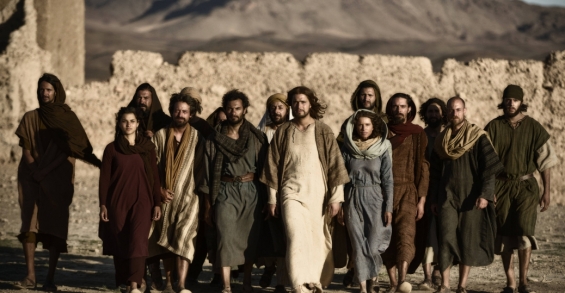
The subject and emphasis on is becoming obscure— “just like Jesus.” I suppose my main contention is this– our understanding of discipleship has too much “me, and not enough Him.” This can be a gentle error of a young believer.

When Jesus who was the fullness of God in bodily form came, He came as a lowly slave. We see Him stripping down, filling a basin, and scrubbing dirty feet. He actively made Himself a broken and humble servant. It was deliberate and conscious.

Read Philippians 2. It will blow you away!

I think we learn this from Him. The disciple never exceeds his master. He made it very clear that we were to follow Him in this. It’s processed by us when we are very firmly aware that the One who knows us. To be loved by Him is enough (or is it?)

Exceptional effort is made by the Holy Spirit to help us understand. There is a repeated thought given to us in various permutations. In one of my favorite verses King David, standing in front of God, and his people, declared,

“But who am I, and who are my people, that we could give anything to you? Everything we have has come from you, and we give you only what you first gave us! 15 We are here for only a moment, visitors and strangers in the land as our ancestors were before us. Our days on earth are like a passing shadow, gone so soon without a trace.”

1 Chronicles 29:14-15, NLT

“We don’t remember what happened in the past, and in future generations, no one will remember what we are doing now.” This is the cheery assessment found in Ecclesiastes 1. This view irks us big time. Especially if we have invested so much in our wealth, gifts, experiences and accomplishments.

“Our days on earth are like grass;  like wildflowers, we bloom and die.  The wind blows, and we are gone— as though we had never been here.”

Psalm 103:15-16, NLT

In the New Testament, the emphasis is only stronger. Remember when James and John tried to get the corner on the authority and honor of being on “the right and left?” (My, but they were ambitious lads!)

“When the ten other disciples heard what James and John had asked, they were indignant. 42 So Jesus called them together and said, “You know that the rulers in this world lord it over their people, and officials flaunt their authority over those under them. 43 But among you it will be different. Whoever wants to be a leader among you must be your servant, 44 and whoever wants to be first among you must be the slave of everyone else. 45 For even the Son of Man came not to be served but to serve others and to give his life as a ransom for many.”

Mark 10:41-45, NLT

There are two certain issues here:

  • The first is authentic discipleship.
  • The second is a decided and eager servanthood.

Both ideas are often missing in our churches, and in our teaching. Somehow we are not communicating the real transferable concepts. Their simplicity evades us.

I intend to return to this fairly soon. Again, I appreciate any constructive criticism, your own thinking on this, and your prayers.

*

1brobry-sig4


cropped-christiangraffiti1 (1)


The Lady and the Knight in Shining Armor

“Be kind to one another, tenderhearted, forgiving one another, as God in Christ forgave you.”

Eph. 4:32

“It’s unfortunate and I really wish I wouldn’t have to say this, but I really like human beings who have suffered. They are kinder.”

Emma Thompson

She has nailed down a thought here.  It is only a starting point, a beginning that one should work-out, over and over.  We begin at this realization that there can be a definite link between suffering and kindness.  It’s like two wheels of a bicycle.

I’m in love with kind people.  All the people I have met who were truly wonderful, had very kind hearts.  Kindness set them apart.

Historically, kindness was regarded as one of the “Knightly Virtues” of medieval times.  Having it was to be a mark of chivalry.  In theology, it was one of seven virtues, that mirrored the “Seven Deadly Sins.” It seems to me that believers who practice kindness are to be regarded as part of a spiritual nobility.

This connection between suffering and kindness isn’t so much as a “cause and effect,” but rather a ‘fruit’ which has to ripen, or mature.  Pain is not always this productive in our lives.  It can bring bitterness and loss as easily as it can bring kindness and gentleness.  And many of us who struggle with mental illness or substance abuse understand this all to well.

The apostle Paul was right to link his sufferings to spiritual growth.  If you can do this you are moving in the right direction.  It will not lift you out of the pain; you will still have the sense of being overwhelmed, but you will see through it with the eagle eye of faith.

Why is it that so many who have suffered, will go on to become kind people?

It may have to do with two dynamic principles. The first metaphor would have to be the smelter/the potter.  These are significant because they illustrate how believers are always in process.  We are in flux, either moving under the hand or under the heat.

The second metaphor is the grape vine dresser/bread maker.  These strike me as harsh, although it may not always feel that way.  But both are definite “hands-on” from a supervisory source–the Holy Spirit.

Suffering is a lot like learning another language.  Some days it will just click, and then other days you can’t remember your previous lesson.  But if you are really patient you will learn to speak the dialect of suffering.  Learning languages can open up the world to you.  If you learn to speak “suffering” you will be able to touch the hearts of millions.

But there needs to be patience.  You must wait for “kindness.”  Transformation will never be smooth or easy.  There are no switches for God to flip to make you Christlike.  You will not wake up tomorrow morning with the character of Jesus–his mercy, love, wisdom and kindness.  I’m sorry.  (Choose to dispute this, and I will let you.)

flourish-bird

“I prefer you to make mistakes in kindness than work miracles in unkindness.”

Mother Teresa’s counsel 

“God has chosen you and made you his holy people. He loves you. So you should always clothe yourselves with mercy, kindness, humility, gentleness, and patience.”

Col. 3:12, NCV 

1brobry-sig4 (2)


cropped-christiangraffiti1-2