Our Gentle God Loves Kindness

His hands are gentle

When I think “gentleness”, what pops into my mind is my wife holding and caressing my infant daughter almost 20 years ago.  Her touch is soothing.  She softly hums a lullaby.  The farthest thing from her thinking at that quiet moment, is anything  harsh or cruel. 

One of my favorite verses telegraphs the wonderous news, “He will not crush the weakest reed or put out a flickering candle.”  (Isaiah 42:3, NLT).  God’s temperament is gentle and kind.  He is patient far beyond any human logic.  As a matter of fact, his love seems to be borderline ridiculous.   As believers, we need to get used to His strange proclivities of loving all and turning away none.  I really believe that harshness and cruelty are the furthest thing from His mind or heart.

I for one, am glad God is like this.  When I’m depressed or manic, paranoid or confused, I am so glad that God is not a man.  He doesn’t give up on me, others have marked me off as a discipleship failure, and let me go.  But He loves me even more than a mother loves the baby on her lap.

A.W. Tozer writing on Psalm 18:35: “Your gentleness has made me great.”

“God is easy to live with. Satan’s first attack upon the human race was his sly effort to destroy Eve’s confidence in the kindness of God. Unfortunately for her and for us he succeeded too well. From that day, men have had a false conception of God, and it is exactly this that has cut out from under them the ground of righteousness and driven them to reckless and destructive living.

Nothing twists and deforms the soul more than a low or unworthy conception of God. Certain sects, such as the Pharisees, while they held that God was stern and austere, yet managed to maintain a fairly high level of external morality; but their righteousness was only outward.

Instinctively we try to be like our God, and if He is conceived to be stern and exacting, so will we ourselves be. The truth is that God is the most winsome of all beings and His service one of unspeakable pleasure.

The fellowship of God is delightful beyond all telling. He communes with His redeemed ones in an easy, uninhibited fellowship that is restful and healing to the soul.

He remembers our frame and knows that we are dust. He may sometimes chasten us, it is true, but even this He does with a smile, the proud, tender smile of a Father who is bursting with pleasure over an imperfect but promising son who is coming every day to look more and more like the One whose child he is.”

………………………………

– A.W. Tozer in The Root of the Righteous, pp. 13-16. As quoted in the Banner of Truth Magazine (issue 531; Dec. 2007).

bry-signat (1)

cropped-christiangraffiti1.jpg

Is it Wrong to Get Angry with God?

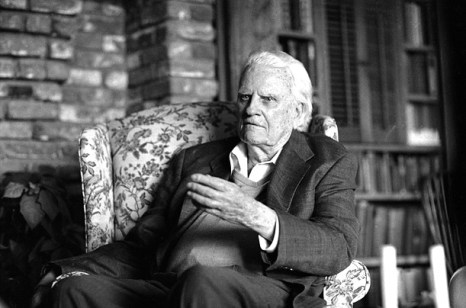
Evangelist Billy Graham

Interview with Dr. Billy Graham

Q: Is it wrong to get angry at God?

I’ve beten through some very hard times recently and I feel like God has let me down. I’d like to get past this, I guess, but right now I can’t help feeling angry at God.

A: The real question is this: Will God get angry at you if you get angry at Him, and refuse to have anything more to do with you?

The answer is “No”! Even when we’re angry at Him, He still loves us and yearns for us to turn to Him for the comfort and encouragement we need. And that’s what I pray you will do.

jonah-sulkingDo you remember the prophet Jonah in the Old Testament? Some have called him “the reluctant prophet,” because he tried to flee when God called him to preach to his enemies. Later (after God sent a large fish to stop his flight), he reluctantly obeyed God and preached to his enemies. To his surprise they repented and turned to God.

He should have rejoiced – but instead “Jonah was greatly displeased and became angry” (Jonah 4:1). Gently God explained to him that He loved even Jonah’s enemies – and so should Jonah. What is the point? Simply this: Jonah was angry at God – but God didn’t reject him. Instead, Jonah needed to learn to trust God, even if he didn’t like what was going on.

Perhaps this is one of the lessons God wants to teach you. Life doesn’t always go the way we want it to. But God still loves us; He loves us so much that He sent His only Son into the world to die for us. Put your life into Christ’s hands, and then ask God to help you begin to trust Him, no matter what happens to you.

_______________________________


 Affectionately known as the “World’s Preacher” for more than 60 years, the Rev. Billy Graham is one of the most influential and respected spiritual leaders of the 20th century. He has been a friend and spiritual advisor to ten American presidents and has preached the Gospel to more people in live audiences than anyone else in history — nearly 215 million people in more than 185 countries and territories — through various meetings. Hundreds of millions more have been reached through television, video, film, and webcasts.

cropped-christiangraffiti1.jpg


Send your queries to “My Answer,” c/o Billy Graham, Billy Graham Evangelistic Association, 1 Billy Graham Parkway, Charlotte, N.C., 28201; call 1-(877) 2-GRAHAM, or visit the Web site for the Billy Graham Evangelistic Association:  http://www.billygraham.org.

Devotions, [Eugene Peterson, Interview]

eugene-petersonInterview with Eugene Peterson

Why Can’t I Hear God? By Nancy Lovell

The musical group U2’s Bono quotes Eugene Peterson from the stage. Readers of the best selling Bible, ‘The Message,’ find themselves holding onto lines from his ‘fog-slicing’ Bible paraphrase, and many other works. For several years now, TheHighCalling.org has provided a daily prayer and reflection by Eugene Peterson. Recently, we asked the man himself: What are devotions and why do they matter in our daily work?

Why do so few people who believe in God bother to know Him?

The most obvious answer is that we’re in a hurry and not used to listening. We’re trained to use our minds to get information and complete assignments; but the God revealed to us in Jesus and our Scriptures is infinitely personal and relational. Unless we take the time to be quiet, in a listening way, in the presence of God, we never get to know him.

The same question is why so few married couples really know their spouses. People get divorced after 20 years of marriage, and the rejected spouse says, “I never knew this was coming. I thought everything was fine.” But there was not much listening in those 20 years. Devotions are the discipline of being quiet and listening for what we don’t hear in the streets, in the media, in the workplace.

What about people who sincerely set apart time, read the Bible, stay still, and hear nothing? They ask themselves whether God’s voice is anything more than their own thoughts.

We’re not good at this. We’ve had no practice doing it. No wonder we only hear our own thoughts. This is why the church is so insistent that we do this whether anything happens or not. Supported by 2000 years of history, we know that God does commune with us in our listening. But because we’re so unused to this way of communion, we don’t hear it. So it takes time.

How would you direct someone trying to start?

I would say: Get your Bible and find a place. If you can’t do this daily (some people can’t because of their life circumstances; mothers with young children are obvious instances), try for at least 20-30 minutes, two or three times a week, or four. Don’t make demands on yourself too high. Don’t ask questions about, “How long is this going to take?” Believe that something does happen in that silence—usually through Scripture, but not always—in prayerful, attentive listening, knowing that you’re in the presence of God.

I ask for a commitment of six months; so don’t come back in three weeks and say nothing’s happened. I’ve never had anyone who’s done this at least six months who came back to me and said, “I did it and nothing happened; I’m going on to something else.” Not many who give this a fair test ever say that nothing happens. Also, when I’ve asked people to do this as their pastor, I also ask them to worship regularly. This is a place where the whole community is gathered and listening and being in the presence of God.

Is that how you started?

I was lucky. In the family I grew up in, I started when I was about 14 …mostly with the Psalms, but all the Scriptures become part of it.

In your writing and speaking, you must have seen moments when a person realizes, “Yes, I want more and I want God.” What turns on the light for people?

Often the motivation is that people are tired of the way they’re living. They think there’s got to be more than just the motions they’re going through and the work they’re doing. There’s a craving and hunger that they identify with God. There’s enough pain or boredom or something to motivate them to do something that the culture’s not telling them to do. I got a letter recently from a friend of 40 years. She had been a parishioner of mine for a long time. Then she was ill, and divorced; and she quit, just gave up. She quit reading the Bible, quit going to church. Six months ago she wrote me a lovely letter that she was sitting with a group of friends and, in her words, “a rooster crowed”—it all came back and she was a Christian again and aware of the presence of God. Isn’t that a wonderful phrase? ‘A rooster crowed.’

Who knows what went into that statement of hers? Twenty years of unhappiness, pain, suffering, disillusionment …but still there was the need.She would have said during that time she didn’t believe in God. But the rooster crowed. That’s why we use the term the Holy Spirit to explain times like this. Given that it’s hard to discipline ourselves to silence, listening—and to daily time in quiet—tell us about your devotions on this website. I wrote those in the early morning for 20 years, maybe 25 years. And what I was trying to do was be present to the Scripture, listen to God, and to write as honestly as I could. I wasn’t thinking about anybody else but me.

It’s really hard to be honest as a writer. You get these wonderful ideas, and you love to manipulate words and see if you can make it sound good. It’s hard to be honest, especially working for God. That was the thing I was most aware of. “Eugene: Don’t say anything that is not relational, immediate, honest; stay present to the text and be honest before God.” I believed if I could be honest, I could draw some other people to honesty, too.

To read the rest of this interview, you will need to follow this link: http://www.christianitytoday.com/workplace/articles/interviews/eugenepeterson.html


cropped-christiangraffiti1-3

Feeding the Dogs, [Choosing Holiness]

A toy I grew up with, they were magnetized pushing against each other.

There is a story of a Native American elder who once described his own inner struggles to understand the Bible and Christianity.

Inside of me there are two dogs. One is black, and the other is white. The black dog is mean and tries to talk me into making the wrong choices. The white dog is good and encourages me to make the right choices. The black dog fights the white dog all day.” When asked by the friend which dog wins, the elder reflected for a moment and replied;

“The one I feed the most.”

White Dog: As a believing Christian, there is a part of us that is Christ-spirited, compassionate, trusting, open, abundant and focused on helping others. We pray and are being filled with the Holy Spirit.

Black Dog: The other part is our flesh. We can be proud, evil, self-centered, greedy, manipulative, sullen, promiscuous, drunken, and only wants to he served by others.

“An analogy is made between the good white dog, our new nature in Christ, and the bad black dog, our old fallen nature. While we cannot eliminate the old nature, we can choose to feed the white dog.”

(From “The Holy Spirit: Activating God’s Power in our Life,” by Billy Graham 1978.)
 

howlingwolf3-300x281The main key for us to remember is that these two parts are in constant struggle.

Two Scriptures to help: One– “If you use your lives to do the wrong things your sinful selves want, you will die spiritually. But if you use the Spirit’s help to stop doing the wrong things you do with your body, you will have true life.”   Rom. 8:13, NCV

Two– “Our sinful selves want what is against the Spirit, and the Spirit wants what is against our sinful selves. The two are against each other, so you cannot do just what you please.”   Gal. 5:17

In thinking this through this analogy might help.  I’m inclined to think that holiness is not so much like an “on and off” switch.  But I think it’s more like a “dimmer” switch is turned to brighten or darken a room.  I actually think there are times when we should make a deliberate decision for God.  And yet other times we just need to turn up the dimmer from 30% to 80%. Maybe all the way?

I’m just thinking out loud here.

 bry-signat

flourish31