More Current, Please!

angel1I have always had a crazy connection with electricity. As a young boy of six or seven I started to push nails into the wall outlets of our home. My mom would come in to find me in a heap, with the nail still in the outlet. It would blow me backwards, and I remember “smelling the ozone” from each experience. I did this fairly often. Mom grew very concerned about me.

Then I discovered the shocking world of electric fences. Most were “pulse” currents, which meant they were alternately energized– and then off. If you grabbed it at the right time, you could beat the fencer and not be shocked. Of course, complicating things would be standing on wet grass. But bringing your little brother meant you could grab his hand, touch the wire, and he would get the full voltage. This was always fun.

Coming into the presence of a holy and loving God should be a powerful jolt. But it needs to be real– never theatrical or showy. Whether it is prayer or worship, we reach into a real world. While electrical shock is detrimental, the Holy Spirit is always strengthening and affirming. My prayer the last few months has been this: “May it be the real me who connects with the real You.”

In a nuclear power plant the workers clearly understand the nature of fission. They can’t see it, or feel it. They must take precautions, because what they handle is really dangerous. In 1 Samuel 6, we read of the time when the Philistines controlled the Ark of the Covenant. But the power they received was not anything they could handle or manage. They finally sent it back. “But the Lord killed seventy men from Beth-shemesh because they looked into the Ark of the Lord. And the people mourned greatly because of what the Lord had done. “Who is able to stand in the presence of the Lord, this holy God?” they cried out. “Where can we send the Ark from here?”

God is dangerous, “my Bible tells me so.” My thinking often would regard Him as docile and tame, but I challenge you to understand differently. I submit to you that our faith should put us into a perilous place– one in which we are asked to do outrageous things. Like building an ark, or going from a slave to a prime minister, or getting out of our boat and walking on the sea. Furthermore, the Book of Revelation is John’s account of being in God’s power and majesty (Rev. 15).

“We worship a dangerous God and He is coming to threaten every area of your life.  God is a loving God, do not be mistaken about that.  His love, however, is unlike any human love; its chief concern is not to make you comfortable, but to make you free and to be free is dangerous and the act of making us free is dangerous.” Joe Spann (and below)

electric-shockPlease don’t try to domesticate God.

He is wild and pretty much unpredictable– and we will not ever tame or teach Him. You can’t manage Him, or train Him to use a box. (He will defy this.) If we are truly going to draw close it will be like stepping into a spiritual reactor, or sticking a figurative nail into a metaphorical wall outlet.

“He is about to become dangerous to your everyday trappings, dangerous to your comfort, dangerous to your retirement plan, dangerous to your schedule, dangerous to your social standing, dangerous to your secrets, and dangerous to your religion. The good news is, He is also dangerous to your limits, dangerous to your fear, dangerous to your addictions, dangerous to your sickness, dangerous to your unforgiveness, dangerous to the chains that bind you chains that you have become way too comfortable with.”

The end result of this is that He wants to make you dangerous again; dangerous to your neighbors bondage, dangerous to the pain in the people around you, dangerous to the generations of abuse and pain in your family and the families you know, dangerous to the culture you are in every single day. And He wants to make us dangerous again. Dangerous to our neighborhoods, dangerous to our friends, dangerous to our culture, dangerous to the kingdom of darkness.”

I would like to make a toast, “May you see God as He is truly, and may you stick your nail into direct contact with Him. May you never settle for less, or want for anything more.” Amen.
1brobry-sig4

cropped-christiangraffiti1 (1)


*

From Spiritual Self-Destruction

handwater

A Very Simple and Honest Prayer

%

Change me.

God, please change me.

Though I cringe

Kick

Resist and resent

Pay no attention to me whatever.

When I run to hide

Drag me out of my safe little shelter.

Change me totally

Whatever it takes

However long You must work at the job.

Change me– and save me

From spiritual self-destruction. Amen.

Ruth Harms Calkin

6 “And I am certain that God, who began the good work within you, will continue his work until it is finally finished on the day when Christ Jesus returns.”

Philippians 1:6, NLT

7

flourishx

5

Is Mania A Spiritual Experience? [Bipolar]

by Chris Cole

I was eighteen years old when I first experienced acute manic psychosis. I had just arrived at the University of Georgia for my freshman fall semester when I suddenly had what seemed like a profound spiritual awakening. I felt as if I was waking up from a bad dream, as if my mind and body were merely figments of my imagination. I felt an incredible transcendence and oneness with the universe, an experience I could only fathom to be spiritual. Back then, I didn’t know anything about bipolar disorder.

My first thought upon being struck with this overwhelmingly blissful state was, “This is what God feels like; I must be Jesus!” It was from there that I began my deluded descent into madness. I ran upstairs in my dormitory, assuming that my friends would be my first disciples, and tried to perform miracles to prove my divinity. When they attempted to calm me down, I punched one of them in the face, calling him the devil, and ran back downstairs. Campus police promptly met me in the dorm lobby and arrested me on the spot.

On my way to jail, I was no longer feeling so ecstatic. In fact, it was the most excruciating fear I had ever experienced. I began believing that the police officers were the Pharisees taking me to my crucifixion. They placed me in my own jail cell, and I began stripping off my clothes, demanding for the officers to come look at my naked body. Throughout the whole experience, I felt almost completely dissociated, as if I was watching a movie of myself with little to no control of the actor.

After a few days of trying to convince my parents that I was returning humanity to the Garden of Eden, they realized my condition might not be from taking psychedelic drugs as they had thought. I was escorted to my local psychiatric hospital, and once medicated, came down from my messianic mission to create heaven on earth. The only problem was, I had never been more certain of God in my life, and the clinicians just kept telling me that it was normal for grandiose delusions to take on religious and spiritual themes. I was not convinced.

My thoughts immediately went to the biblical stories I grew up with: how God tested Abraham’s faith when he was told to sacrifice his son, and how God communicated to Moses through a burning bush. Were these not examples of delusions and hallucinations? Even Jesus was convinced to be the Son of God. Were the holy men of the Bible bipolar? I had a lot of questions, and my questions seemed to be forcing me to choose one side or the other—either spirituality or psychiatry.

It took me about a decade to finally integrate both truths and find some peace around my manic episodes. I studied spirituality and psychology, and I came to the conclusion that bipolar disorder and spiritual experiences didn’t need to exist in opposition. I’ve come to some basic definition of spirituality as the transcendence of ego. In this sense, mania was indeed a spiritual experience, albeit an unmanageable one. This didn’t mean my bipolar diagnosis was bogus, and I’m not saying all psychotic episodes are spiritual. But I can now rest easy knowing that my experiences were both spiritual and bipolar.

If I’m honest with myself, a major sign of my mania is increased spirituality, but at the same time, a major sign of my depression is a lack of spiritual significance. Finding balance in recovery means that I am able to seek both spiritual and clinical solutions to my bipolar symptoms without fear that I am falling out of grace with God. When I was first diagnosed, I had the idea that either bipolar existed or God existed. There was no space for both.

My spirituality has necessarily evolved over the years. Because of my history with manic psychosis, I have to guard myself against dogmatic or superstitious beliefs. I try my best to live a life of love, and I rest assured knowing that the more kindness I spread to the world, the more aligned I am with my spiritual path. Telling my story of recovery has become part of this spiritual process. My faith means a great deal to my health, and without it, my recovery wouldn’t be as strong as it is today. I hope that by sharing my story, others going through the same difficulties might not take so long to make sense of their own experiences.

____________________________

Chris Cole has authored a book recounting his experiences, and he’s now a life coach for folks in recovery.

Source: http://www.ibpf.org/blog/mania-spiritual-experience

cropped-cropped-christiangraffiti1.jpg

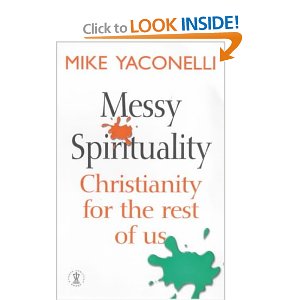
Messy Spirituality– Mike Yaconelli

Brokenness never means uselessness

“Messy Spirituality:” A Book Excerpt by Mike Yaconelli

For as long as I can remember, I have wanted to be a godly person. Yet when I look at the yesterdays of my life, what I see, mostly, is a broken, irregular path littered with mistakes and failure. I have had temporary successes and isolated moments of closeness to God, but I long for the continuing presence of Jesus.

Most of the moments of my life seem hopelessly tangled in a web of obligations and distractions. I want to be a good person. I don’t want to fail. I want to learn from my mistakes, rid myself of distractions, and run into the arms of Jesus. Most of the time, however, I feel like I am running away from Jesus into the arms of my own clutteredness. I want desperately to know God better. I want to be consistent. Right now the only consistency in my life is my inconsistency. Who I want to be and who I am are not very close together. I am not doing well at the ‘living-a-consistent-life’ thing.

I don’t want to be St. John of the Cross or Billy Graham. I just want to be remembered as a person who loved God, who served others more than he served himself, who was trying to grow in maturity and stability. I want to have more victories than defeats, yet here I am, almost 60, and I fail on a regular basis.

If I were to die today, I would be nervous about what people would say at my funeral. I would be happy if they said things like “He was a nice guy” or “He was occasionally decent” or “Mike wasn’t as bad as a lot of people. ”Unfortunately, eulogies are delivered by people who know the deceased. I know what the consensus would be.“Mike was a mess.”

You might say Christianity has a tradition of messy spirituality. Messy prophets, messy kings, messy disciples, messy apostles. From God’s people getting in one mess after another in the Old Testament to most of the New Testament’s being written to straighten out messes in the church, the Bible presents a glorious story of a very messy faith. Sounds like you and I are in good company.

A few years ago, I was introduced to a group of uncouth Christians who call themselves “the Notorious Sinners.”  These are men from all walks of life who meet once a year to openly share their messy spirituality with each other. The title ‘Notorious Sinners’ refers to the scandalous category of forgiven sinners whose reputations and ongoing flaws didn’t seem to keep Jesus away.

In fact, Jesus had a habit of collecting disreputables; he called them disciples. He still does. I like people who openly admit their ‘notoriousness’—people who unabashedly confess they are hopelessly flawed and hopelessly forgiven. Graciously, these men invited me to be a part of their group. The ‘Notorious Sinners’ meet yearly at spiritual-retreat centers, where from the moment we arrive, we find ourselves in trouble with the centers’ leadership.

We don’t act like most contemplatives who come to spiritual-retreat centers— reserved, quiet, silently seeking the voice of God. We’re a different kind of contemplative— earthy, boisterous, noisy, and rowdy, tromping around our souls, seeking God, hanging out with a rambunctious Jesus who is looking for a good time in our hearts.

A number of us smoke cigars, about half are recovering alcoholics, and a couple of the men could embarrass a sailor with their language. Two of the ‘Notorious Sinners’ show up on their Harleys, complete with leather pants and leather jackets. I admit I run with a rough crowd—Christians whose discipleship is blatantly real and carelessly passionate, characterized by a brazen godliness. Unafraid to admit their flaws, unintimidated by Christians who deny their own messiness, these guys sometimes look like pagans and other times look like Jesus.

They are spiritual troublemakers, really, which is why they look like Jesus (who was always causing trouble himself ). They are full of mischief, laughter, and boisterous behavior, which is why they look like pagans. Truly messy disciples. The ‘Notorious Sinners’ are definitely a bizarre mix of the good, the bad, and the ugly, living a spirituality which defies simple definitions.

Oh, and they are some of the most spiritual men I know.”

___________________________

Messy Spirituality [Book] by Michael Yaconelli, Karla Yaconelli in Books

$6 online

By Michael Yaconelli, Mike Yaconelli, Karla Yaconelli – Zondervan (2007) – Paperback -192 pages-ISBN 0310277302

I Guess I’m Not a Very Good Christian . . . Do you feel like: I don’t pray enough I don’t read my Bible enough I don’t share my faith enough I don’t love God enough I’m not committed enough I’m not spiritual enough Then this book is for you.

Messy Spirituality was written for the silent majority of us who have been convinced that we just don’t do Christianity right. We spend most of our lives worried about what we don’t do instead of what we have done, focused on our imperfections instead of God’s fondness for the imperfect. Why?

Because we’ve been bombarded with books, tapes, talks, seminars, and movies convincing us that real Christianity is all about perfection. Michael Yaconelli dares to suggest that imperfection, infiniteness, and messiness are, in fact, the earmarks of true Christianity; that real Christianity is messy, erratic, lopsided . . . and gloriously liberating.

What if genuine faith begins with admitting we will never have our act completely together? Maybe messy disciples are exactly the kind of imperfect people Jesus came to earth for and whose company he actually enjoyed–and still enjoys.

If you want to find Jesus today, look for him in the midst of burned-out believers, moral misfits, religious incompetents . . . men and women whose lives are, well, messy.

Messy Spirituality is a strong antidote for the spiritual perfectionism in us all. Here are truths that can cut you loose from the tyranny of ought-to’s and open your eyes to the deep spirituality of being loved, shortcomings and all, by the God who meets you and transforms you in the midst of a messy and unpredictable life.

 PDF File can be found at http://mikeyaconelli.com/yaconelli/words/SelectedYac.pdf