Blind From Birth

John 9:1-7

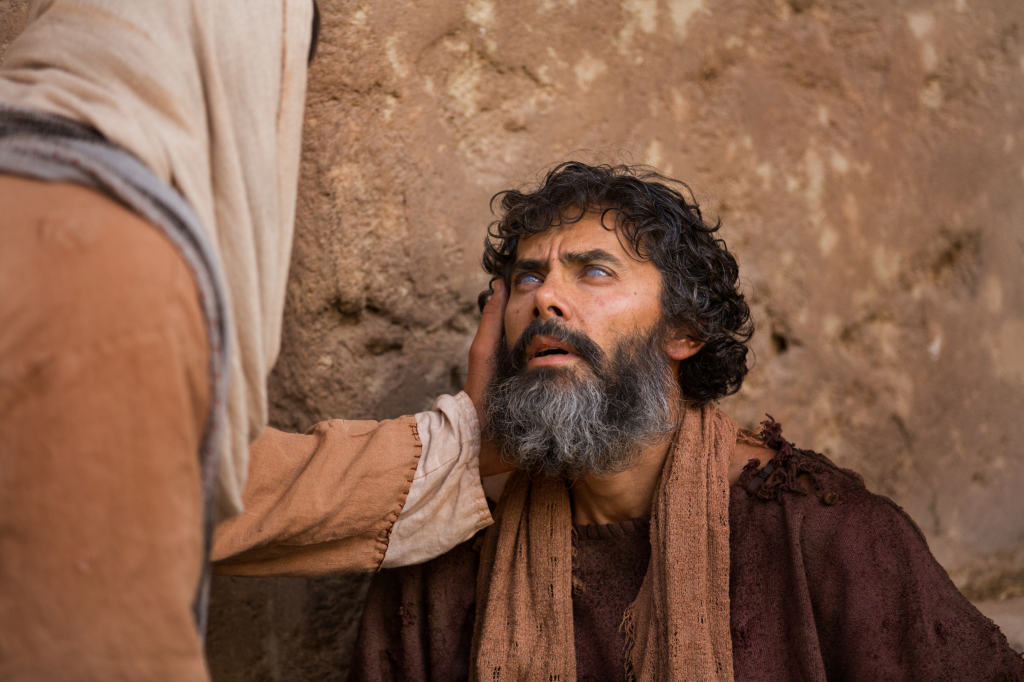
As he was walking along, he saw a man blind from birth.

“Master,” his disciples asked him, “why was this man born blind? Was it a result of his own sins or those of his parents?”

“Neither,” Jesus answered. “But to demonstrate the power of God. All of us must quickly carry out the tasks assigned us by the one who sent me, for there is little time left before the night falls and all work comes to an end. But while I am still here in the world, I give it my light.”

Then he spat on the ground and made mud from the spittle and smoothed the mud over the blind man’s eyes, and told him, “Go and wash in the Pool of Siloam” (the word Siloam means “Sent”). So the man went where nd washed and came back seeing!

Up to now I’ve tried to approach these posts from the first person viewpoint. Ihoped to understand those who met face-to-face with Jesus. I wanted to grasp what they were seeing through their own eyes. But I intend with this post to revert back to a more traditional approach to this passage.

First, we’re introduced to a man who is blind from birth.

I can’t even imagine what that would be like (just as he probably could imagine having sight). I’ve been told that he probably didn’t have a “dream” life–that requires having seen images (a dog, a tree, a mean person) and this wasn’t available to him. He never saw the color red, or seen a mountain. (He didn’t have the circuitry.)

I suppose we can only imagine what blindness like this would be.

Somehow I’ve come to an idea that this represents fallen men–we’re spiritually blind to the workings and truths of Jesus’ Kingdom. It seems a pretty good explanation of each of us–“blind from birth.”

Secondly, notice the response of the disciples who first met this unfortunate man. They don’t see his needs, rather they want to know the theology behind this. Perhaps that’s how we respond much of the time–we don’t see the needs, we only want to know the reasons. We’re not wise or discerning enough to see what’s going on–in short we’re not equipped to love or show mercy. (We haven’t got the circuitry.)

Perhaps this is how we operate as immature Christians.

We don’t engage the need, but rather we like having great theology over understanding compassion. If we really don’t love needy people, we miss so much. We don’t ever grow up. It’s easy to philosophize–it’s hard to get down and serve and really love others.

It’s funny but Jesus declares Himself to be the light of the world while speaking to the man who is born blind.

Third, we discover the gentle mercy that Jesus has when He meets needy people. Now the Lord does accommodate His followers, but not at the expense of engaging the need of the moment. Jesus is full of compassion–most especially when He meets broken people–and as His followers, we must grasp this.

Good theology is not the primary calling of Jesus’ followers.

As I mature in Christ I’m learning (slowly) that people are His real focus. He has come, not to theologize or philosophize, but to meet needs! Sure the reasons why become clearer, but that really isn’t Jesus’ primary goal. People are, not having impeccable theology.

Classes in systematic theology are good, but soup kitchens are better.

The miracle happens, and Jesus’ love and desire to restore this man is ‘front and center.’ The Lord’s methodology is interesting. Spit and mud, wiped on the blind man’s eyes. In Genesis we discover that God made man out of dirt and dust of the ground. Perhaps what He’s doing here mirrors that work.

And it’s also important to understand that Jesus never performs the exact same healing in the exact same way. For some reason He ‘tailors’ His work to the individuals deepest need. I suppose He doesn’t want us to grab a hold of a formula, as that’s what we want to have.

The story is primarily about a blind man’s healing.

It’s not theology, and it certainly isn’t about what is proper and acceptable. We really must understand this, and we really need to understand the tremendous mercy and power of God to both heal and restore.

Image: MCCC. Text from the “Living Bible,” published by Tyndale House

A Believer in Pain

by Joni Eareckson Tada

My chronic pain makes my quadriplegia feel like a walk in the park.

People often ask how I manage my pain. Well, when its fangs sink deep into my hips and back, that’s my signal. I begin deep breathing, slow and steady. And when fiery pain threatens to overtake me—just as the flames threatened to consume Shadrach, Meshach, and Abednego in that fiery furnace found in the book of Daniel—I have a conversation with it.

I don’t say, “I can’t stand this; it’s killing me,” because words like that are fraught with anxiety. Fear only makes things worse. Instead, I calmly ask Jesus to meet me in my pain, to not let it crush me. And the Son of God never fails to meet me, just as he met those three Hebrews in that hot furnace of fire.

And what does Jesus say to me in that agonizing place of pain?

He comforts me with his own words. He will say something like, “Joni, my Spirit inspired 2 Corinthians 4:8 for a good reason. For although you are ‘hard pressed on every side,’ you will not be crushed.”

Oh, what a promise! Pain may tighten its vice grip, but it cannot crush me. As I cling to God’s promises, my pain pushes me further into Jesus’s heart. There is nothing sweeter than finding my Savior in the middle of my hellish circumstances. It helps deflect the pain and helps me to suffer well. Jesus helps me be in that unhappy place well.

All the years I’ve lived in my wheelchair, I never got delivered from pain. But I met my Deliverer in it. I didn’t get healed, but I found intimate fellowship with the Healer.

Friend, pain does not have to crush you.

As you courageously look at the stern countenance of pain and enter unafraid into its recesses, you will defang it of its terror. You’ll see that the Lord is in your pain, having transfigured it to become a place of union with him. Jesus conquered the insidious ways of pain and because of that, he is your best prescription for pain—whether it’s in your hip, your head, or your heart.

And remember, there is a glorious day coming when it says, “He will wipe every tear from their eyes. There will be no more death or mourning or crying or pain, for the old order of things has passed away.” (Revelation 21:4). Until then, when pain encroaches, start deep breathing and cling to a Bible promise. There are thousands to hold onto.

Perhaps my favorite is this one uttered by almighty God to you and me, promising, “I have made you and I will carry you; I will sustain you and I will rescue you” (Isaiah 46:4b).

And he will. He promised.

Joni Eareckson Tada

One More Night With the Frogs

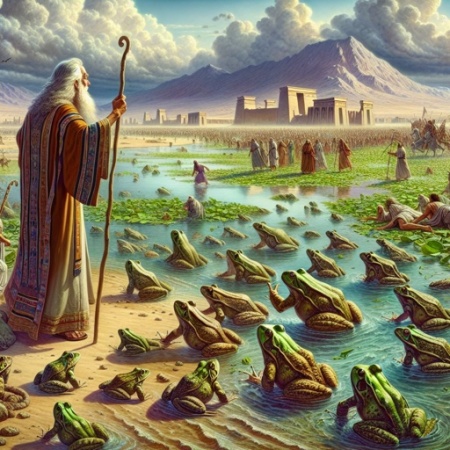
“You set the time!” Moses replied. “Tell me when you want me to pray for you, your officials, and your people. Then you and your houses will be rid of the frogs. They will remain only in the Nile River.”

“All right,” Moses replied, “it will be as you have said. Then you will know that there is no one like the Lord our God.

Exodus 8:9-10

Often there comes a point in a person’s life that not to make a decision, becomes the decision.

This was the dynamic working in Pharaoh’s mind. God had warned him earlier that he must release the Jews from slavery. But he oscillates, and vacillates after each warning. His stubborn indecisiveness  is remarkable. Pharaoh resists, and becomes more and more obstinate.

There is a deep danger of delay.

God sends 10 plagues– quite dramatic and miraculous. But “the supernatural” really can’t touch certain hearts. There were certain Pharisees in Jesus’ time that they would not believe, no matter what Jesus did. (We call this, “hardness of heart.”)

In this particular ‘show-down’ a plague of frogs is threatened. It’s kind of funny, but Pharaoh doesn’t dispute the possibility of this “green invasion.” He just absorbs the inevitable. Pharaoh simply replies, “I will take one more night with the frogs.”

Within Egyptian mythology the frog was regarded as “holy.” It wasn’t to be harmed or killed. It was regarded as a blessing to the people. But that was hardly the case among the enemies of God’s chosen.

Often there comes a point in a person’s life that not to make a decision, becomes the decision.

Sadly to say, there are so many like that man today. “Lord, I’m going to follow You, but let me have just one more fling, one more trip to Vegas, or the bar, or the Princess cruise, or a new car– just “one more night with the frogs!” And the “one more night” stretches out into a terrible, endless night, in the blackness of darkness forever.

2 Corinthians 6:2

Will you choose to spend another night with the frogs, that is, in your sins? Or will you come to Jesus Christ for salvation today? There are consequences that follow each decision. What will you decide today? Will it be sin or the Savior? Will it be Heaven or Hell? Will it be forgiveness or the frogs? What will you do with the message you have read here today?

Often there comes a point in a person’s life that not to make a decision, becomes the decision.

bry-signat (1)