God Will Sustain You

elijah-2

“Some Christians are called to endure a disproportionate amount of suffering. Such Christians are a spectacle of grace to the church, like flaming bushes unconsumed, and cause us to ask, like Moses: ‘Why is this bush not burned up?’

The strength and stability of these believers can be explained only by the miracle of God’s sustaining grace. The God who sustains Christians in unceasing pain is the same God — with the same grace — who sustains me in my smaller sufferings. We marvel at God’s persevering grace and grow in our confidence in Him as He governs our lives.”

— John Newton, 1725-1807, Author of “Amazing Grace”

“The angel of the Lord appeared to him in a blazing fire from the midst of a bush; and he looked, and behold, the bush was burning with fire, yet the bush was not consumed.”

Exodus 3:2, NASB

u

u

cropped-christiangraffiti1-3-1

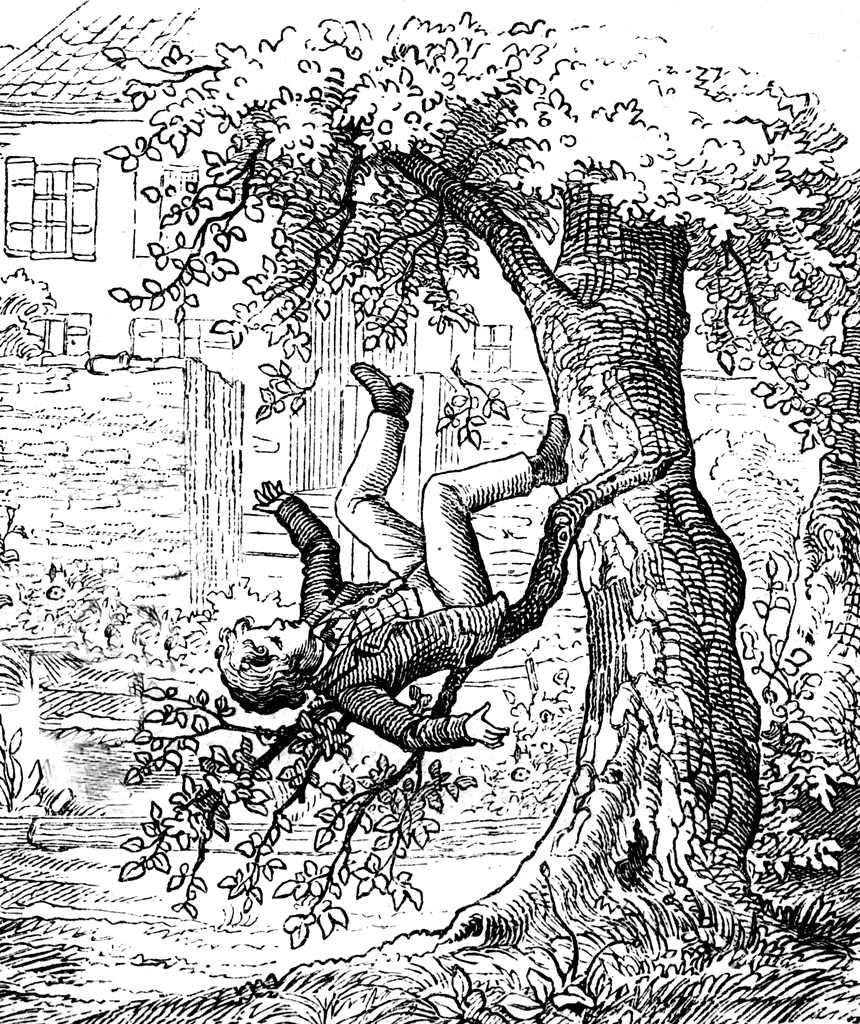
Different Ways to Fall Out of a Tree

boy-falling
Imagine climbing up to the top of a very tall tree. You work your way up to the highest point– you can go no further. The view is completely glorious, it’s more than you hoped for. You want to post it on Facebook, so you dig into your pocket to get your camera-phone. You suddenly slip, and because your arms are occupied getting your camera, you fall. And you fall fast.

As you plummet, you realize that you’re hitting every branch on the way down. The smaller ones break, and the bigger ones, well– you just bounce off. The trip down is very fast, and perhaps even a bit illuminating.

  1. First, you think of death.
  2. Then you think about the pain each branch causes, and wonder about your imminent arrival on terra firma.
  3. Perhaps you consider how stupid you are, and how you are going to explain it.
  4. Lastly, I suppose, you wonder if you have clean underwear on, like your mother always told you to wear.

This is how my life has gone, the last 20 years. This metaphor is a good way for me to process things, and to find some understanding. I now believe that some of us go through life sideways, or horizontal. We careen off of every branch on the way down, and it seems we are hitting branches that we didn’t even know were there. Tree limbs are snapping, as we are dropping.

Others who are wiser (or maybe more experienced,) try to fall more vertically. As they fall, they use their hands to try to slow their descent. (This does work!) They will take their fair share of jolts, no doubt. But their journey to the forest floor is way less traumatic. They may end up in the hospital– but not in emergency surgery like the first guy.

It sometimes seems like every trouble I have faced I have gone into it sideways. I have broken a lot of branches on my way down. I suppose I’ve entertained some who have watched me plummet, and seen me careen and spiral my way to the bottom. These have been some painful times, I have inflicted considerable amount of bruises on myself.

People who go through life sideways will invariably suffer. They seem to hit every obstacle and trial that could be in their flight path. The existence of pain in this life cannot be disputed.

“I have told you all this so that you may have peace in me. Here on earth you will have many trials and sorrows. But take heart, because I have overcome the world.”

John 16:33, NLT

Jesus understands. Especially if you are one of those people who are “trial magnets” going through life horizontal. (You just seem to collect them.) My hope for you that as you break your branches on the way down (for maybe the 100th time). You will try to plummet vertically. Not that it is any easier, life will hurt. But perhaps it won’t be as agonizing. And I suppose that would be a good thing.

“Now unto him that is able to keep you from falling, and to present you faultless before the presence of his glory with exceeding joy,”

Jude 24

Just hanging on!bry-signat (1)

cropped-christiangraffiti1.jpg


kyrie elesion.

Affliction Understood, [Daily Pain]

The 2009 Pulitzer Prize Winner

There is the unquestionable presence of affliction that is present in our lives.  Affliction is the general term for specific instances of trials, tribulations, persecutions, emotional or physical pain and suffering.

The ancient Assyrians used the word for “affliction” as the same word to describe their method of a public execution, which involved being impaled to the ground.  Rocks were gradually piled high until the victim expired.  The combination of being impaled and the rocks piled on you was quite devastating.

And you know what?  That is a terribly specific concept of what afflictions feel like.  Just ask someone, it is exceedingly terrible to be in pain and feel ‘buried’ at the same time.  There is a feeling of suffocating in suffering.  Some have described it, like being ‘hit with a 2×4’. You have just been completely blindsided.

In the letters from the Early Church there was a patentability, or openness when it came to persecution and pain.  The writers of the New Testament operated out of a profound awareness of the pain of the believers of their day.

  • “We think you ought to know, dear brothers and sisters, about the trouble we went through in the province of Asia. We were crushed and overwhelmed beyond our ability to endure, and we thought we would never live through it.”   2 Cor. 1:8
  • “We are pressed on every side by troubles, but we are not crushed. We are perplexed, but not driven to despair.”  2 Cor. 4:8
  •  “You have greatly encouraged me and made me happy despite all our troubles.”   2 Cor. 7:4

‘The Ostrich Effect’ in Affliction

One of the most extensive arguments concerning ‘affliction’ develops around the nature of the atonement.  The thought is that Jesus died and rose to bless me.  Sin and sickness, poverty or lack are not part of God’s plan for the redeemed.

Now, it is possible to refute this in this little post.  But I will try to nudge you a bit to examine the issues of the Early Church.  Know however that there are many people who will follow the ostrich’s example and bury their heads to avoid reality of affliction.  But, I can understand this impulse– this desire to honor God, even if we “play word games” with our faith.

I also know first-hand that the struggles are hard.  Wrestling with them is a brutal way to live the abundant life.  Failure and frustration are trying to short circuit our faith.  And our faith must be protected and valued.

“Afflictions add to the saints’ glory. The more the diamond is cut, the more it sparkles; the heavier the saints’ cross is, the heavier will be their crown.”

–Thomas Watson

 What Does the Scripture Say About Affliction?

  • “Dear friends, don’t be surprised at the fiery trials you are going through, as if something strange were happening to you.”   1 Peter 4:12
  • “…where they strengthened the believers. They encouraged them to continue in the faith, reminding them that we must suffer many hardships to enter the Kingdom of God.”   Acts 14:22
  • I have told you all this so that you may have peace in me. Here on earth you will have many trials and sorrows. But take heart, because I have overcome the world.”   John 16:33

“The wisdom of God appears in afflictions. By these He separates the sin which He hates, from the son whom He loves. By these thorns He keeps him from breaking over into Satan’s pleasant pastures, which would fatten him indeed, but only to the slaughter.”  

-James H. Aughey

I want to try to visit this subject again.  We will trust that ‘real light’ will come to our twilight worlds.

1brobry-sig4 (2)


cropped-christiangraffiti1-3-1

*

Do You Love Me?


“When they finished eating, Jesus said to Simon Peter, “Simon son of John, do you love me more than these?” 

   He answered, “Yes, Lord, you know that I love you.” 

   Jesus said, “Feed my lambs.” 

   Again Jesus said, “Simon son of John, do you love me?” 

   He answered, “Yes, Lord, you know that I love you.” 

   Jesus said, “Take care of my sheep.” 

John 21:15-16

This is a favorite passage for believers throughout the whole world.  I think the reason is that it’s a transferable concept; it is something that communicates well to a heart and life that is struggling very hard.  If you think about it everything in the story is coming to us from two places.  Either Peter’s failure, or Jesus’ grace.

Failure is a brutal teacher; but man, do you learn! Much of the teaching had already been done in Peter’s life. His denial and cowardice had already been worked out, and Peter then had to live with himself.  He was defeated and very lost before this meeting on the beach.

Jesus’ heart is to reconcile his errant disciple with Him, and with Peter himself.  Peter is stuck; in his own failure and denial, and he needs Jesus to touch him in His own impenetrable darkness.  People who have failed God will understand this.  We have been in the darkness, and only Jesus can rescue us from its empty pain.

We see what amounts to a ‘good’ interrogation.  Peter, the failure, is asked over and over by Jesus the “Question”.  “Do you love me?  This is a simple and basic inquiry.  “Do you love me?”

Peter in his pathetic state, is forced to generate a response to Jesus that destroys his own confusion and apathy.  It’s neat to see Jesus pulverizing the foundations of darkness in Peter’s life.  He does it with a skill and deftness that leaves us in awe of Jesus’ love. Peter had denied knowing the Lord three times. It is fitting that Jesus would ask His question three times as well.

For us, the questions keep coming.  We are repeatedly asked, over and over, “do you love me?”  We must process the penetration of the question.  Do you really, really love Jesus?  Is it a show? Do we really love Him, or is it just words, a misbegotten display of cultural appropriateness?

Jesus moves Peter into the light.  Never again will he live in confusion and despair.  His interview with Jesus has placed him there, into the light.  Jesus’ incredibly wise questions led Peter to the place of authenticity.  Peter, from this new place of completeness and recovery, is finally restored and healed.

But do we love Him?  Do we turn the ministry we do, whatever that might be, does it come from a place of love and confidence.  Our love for Him is the essential basis, the root foundation of all Christian activity.  It’s all about the “love”.  “Do you love me?”

1brobry-sig4 (2)


cropped-christiangraffiti1-3-1

*