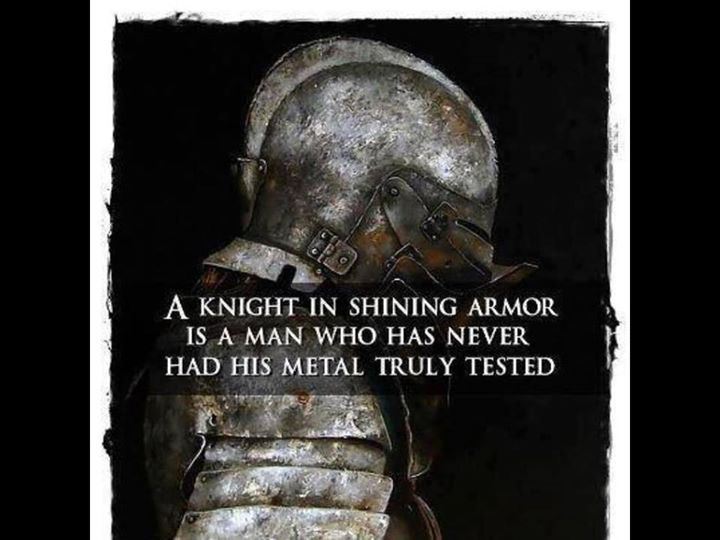
Life Can Be Brutal

“In this you rejoice, though now for a little while, if necessary, you have been grieved by various trials,”

1 Peter 1:6, ESV

So much has been written already from the perspective of suffering Christians.  We live in a painful world; there are plenty of cuts and bruises to go around.  Yet each blow we take is disturbing.  I’ve met so many who have been unfairly brutalized and must walk through mental or physical disabilities.

Some things are just plain brutal.

We may not fully understand this, but suffering provides us with incredible advantages and blessings.  The bruises which hurt us, can also bring us wisdom. We learn many things, but only when we hurt. The challenge is not to waste our sorrows.

Suffering offers us great benefits:

  1. Suffering verifies our faith (1 Pet. 1:6-7).
  2. Suffering confirms our sonship (Heb. 12:5-8).
  3. Suffering produces endurance (James 1:2-4; 1 Pet. 5:10).
  4. Suffering teaches us to hate sin (John 11:33).
  5. Suffering promotes self-evaluation.
  6. Suffering clarifies our priorities (Dt. 6:10-13).
  7. Suffering identifies us with Christ (2 Tim. 3:12; 1 Thes. 2:14-15; Gal. 6:17; Phil. 3:10).
  8. Suffering can encourage other believers (1 Thes. 1:6-7; Phil. 1:14).
  9. Suffering can benefit unbelievers (Acts 16:16-34).
  10. Suffering enables us to help others (Heb. 4:15-16).

 -John MacArthur

If you have ever been attacked, it can change you.  Spiritually, our vision clears and we will no longer be short-sighted people.  We are now able to see things much clearer and with more discernment and wisdom.  But the choice today is yours to make.

Will you make suffering work for you?

Joni Eareckson Tada

The pain is real. No question about it. However, I honestly beg of you to make this transaction with the Holy Spirit.  Exchange your anger and fear and doubt– for peace and confidence and joy. 

God will use your pain to bless others.

bry-signat (1)


On the Edge

The Balancing Act

Circus performers have my enthusiastic admiration– especially the tightrope walkers! They move with such grace and courage. Their work above the crowds must be perfect, or else. I don’t even want to consider their failure. (I hope they can bounce).

To be a mentally ill or disabled Christian is just as formidable. We must walk out our condition 24/7, 365 days a year. It is relentless. We struggle with a weakness that pits us against symptoms and gravity of a spiritual kind. We get little support from others– sometimes criticism. It often is a very solitary feeling. We are often overlooked or scorned.

My particular rope is depression. Everyday I mount up and walk out on to it, holding my breath. I still fall a lot, but have a good safety net, and the Holy Spirit is my strength. Losing my balance happens. I pick myself up and climb up the ladder for another go at it.

There is a stigma to having weakness or disabilities. Things are usually ‘slanted’ against us. We are not truly welcomed in many venues, even the Church, I grant you that. In 2 Cor. 12:8-19 we catch the higher perspective.

“Three different times I begged the Lord to take it away. 9 Each time he said, “My grace is all you need. My power works best in weakness.” So now I am glad to boast about my weaknesses, so that the power of Christ can work through me. 10 That’s why I take pleasure in my weaknesses, and in the insults, hardships, persecutions, and troubles that I suffer for Christ. For when I am weak, then I am strong.”

God’s program includes my weakness– it actually demands it! Sometimes we chose to seek a deliverance or a healing at the expense of the Kingdom. Scripture over and over tells us that the Lord uses weakness. That’s when it’s best.

“In fact, we expected to die. But as a result, we stopped relying on ourselves and learned to rely only on God, who raises the dead. 10 And he did rescue us from mortal danger, and he will rescue us again. We have placed our confidence in him, and he will continue to rescue us. 11 And you are helping us by praying for us.”

2 Corinthians 1:9-11, NLT

We must rely on God. It is His “job” to keep us, repeatedly. So day by day I “walk the line.” My meds are my balance pole, and I don’t need any special attention. I do whatever the day brings, and even that is from His hand.

ybic, Bryan

Covering Up Nakedness

“He replied, “I heard you walking in the garden, so I hid. I was afraid because I was naked.

Exodus 20:26

“Most important of all, continue to show deep love for each other, for love covers a multitude of sins.”

1 Peter 4:8

While I lived in the SOS Ministry house in the Mission district of San Francisco, a dear brother taught me this principle.  Living in a Christian community is a really wonderful thing.  But it also could be a challenge at times. Our purpose there was evangelism. What Michael shared on a communal level, allowed my understanding to grow to truly grow. It has guided me through the years.

The principle is this, it’s simple but fairly profound:  

We are called to cover up our brother’s nakedness.

 Throughout the scripture “being naked, or nakedness” is always a shame.  It comes welded to the concept of being vulnerable or exposed to the sight of everyone else.  It also carries the idea of sin; it is sin that everyone can see; it is very obvious. 

For those of us who sin often, we evolve the idea of keeping a lid on it, and being secretive.  There will be people who will never know, and it seems that is better than full disclosure.  Often sex sin, drug and alcohol sin, both are kept hidden from view of family and friends, and the Church.

Noah and His Nakedness, Genesis 9

“Noah became a farmer and planted a vineyard. When he drank wine made from his grapes, he became drunk and lay naked in his tent. Ham, the father of Canaan, looked at his naked father and told his brothers outside. Then Shem and Japheth got a coat and, carrying it on both their shoulders, they walked backwards into the tent and covered their father.”

“They turned their faces away so that they did not see their father’s nakedness.”  

Genesis 9:20-24

It’s hard to process this patriarch’s gross sin. 

However, in all fairness Noah had lost everything in the flood, so perhaps we should be gentle with him. On the other hand, people who cover up the nakedness of others seem to be gentle and humble.  They would never, ever dream of making a scandal.  They are trustworthy and understand to a great degree the things that make a man or woman of God. This is a gentle patience that knows God is still working on our stumbling brother.

Leviticus 18 is the “magnum opus” of nakedness.

We are pretty much told over and over in this chapter, not to ever uncover another. The idea of nakedness in Leviticus 18 is pretty emphatic and the chapter is somewhat redundant. But I think the Lord wanted it repeated this way.

Our vulnerabilities are there for all to see.  But there are also men and women who go out of their way to protect and shield.  They are safe people, in the classic sense of the word.  They cover-up, but never in negative way, but in love and blessing. (If it is a serious crime, the police should be involved.)

Mature believers will step forward and protect the open areas of others. 

Quite often we are exposed, open to attack on our weaknesses.  Mature believers will step forward and protect the open areas of others.  They will refuse to judge or point out sins.  But they will stand in the gap, shielding and protecting.

God’s final word on nakedness is in Revelation 3:18, and this is a good place to conclude this post.

“My advice to you is to buy pure gold from me, gold purified by fire—only then will you truly be rich. And to purchase from me white garments, clean and pure, so you won’t be naked and ashamed; and to get medicine from me to heal your eyes and give you back your sight.”

You need to cover a brother’s nakedness. This just maybe your next step in your own growth as a disciple.

*bry-signat (1)

Is the Master Unfair?

Luke 17:7-10

“Which one of you having a servant tending sheep or plowing will say to him when he comes in from the field, ‘Come at once and sit down to eat’? Instead, will he not tell him, ‘Prepare something for me to eat, get ready, and serve me while I eat and drink; later you can eat and drink’?” 

“Does he thank that servant because he did what was commanded? 10 In the same way, when you have done all that you were commanded, you should say, ‘We are unworthy servants; we’ve only done our duty.’”

“The will of God for your life is simply that you submit yourself to Him each day and say, “Father, Your will for today is mine. Your pleasure for today is mine. Your work for today is mine. I trust You to be God. You lead me today and I will follow.”

    Kay Arthur

Really now. What little we give determines so much, since we owe him so much. The service that we can give to our master is just a small repayment for everything. Settle that now and God will use you.

Question: Is the master unfair? Does he lord his authority over the servant–taking advantage of him? Every time I read this passage, questions like this always comes up.

#1, the Holy Spirit really hasn’t taught me yet. That’s very possible. Until he does, the parable isn’t truly understood.

#2, I’m a product of my country, no such things like slaves, we’re a democracy. Equal rights and all that jazz.

#3, It’s purposefully constructed to create issues in my mind and heart. Something that “irritates” me–but in a good way.

And maybe they’re all true. But no matter how I “squeeze” out this parable, I always hit this spiritual speed bump. But I like it, and I love reading it, no matter what it does to me.

We owe everything to him. Plain and simple.

Jesus wants to be my master. I’m his servant (at least I really want to be). Reading this parable puts this idea into a real perspective. I do like this verse, 1 Corinthians 6:20, in the CEV:

“God paid a great price for you. So use your body to honor God.”

A transaction has been made for your soul. God has intervened, and he’s given you salvation. We have a life now that will give us life, eternally. Since he is our master, we can no longer direct our own lives. Like the “unworthy servant” in verse 10, we now walk forgiven and very much redeemed. And we owe it all to him, he’s our savior and our master.

“The question in salvation is not whether Jesus is Lord, but whether we are submissive to His lordship.”

   John MacArthur

y

r

Art by Eugène Burnand