Two O’ Clock in the Morning Poetry, #3

Collector_Trench

Middle Parts of Fortune, by Frederic Manning

“The air was alive with the rush and flutter of wings; it was ripped by screaming shells, hissing like tons of molten metal plunging suddenly into water, there was the blast and concussion of their explosion, men smashed, obliterated in sudden eruptions of earth, rent and strewn in bloody fragments, shells that were like hell-cats humped and spitting, little sounds, unpleasantly close, lie the plucking of tense strings, and something tangling his feet, tearing at his trousers and puttees as he stumbled over it, and then a face suddenly, an inconceivably distorted face, which raved and sobbed at him as he fell with it into a shell-hole.”
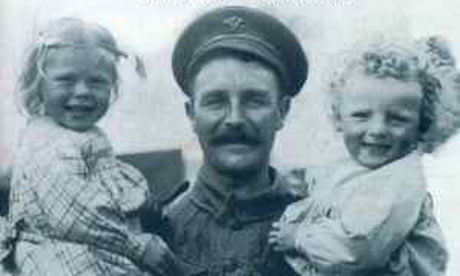
(Accounts of The Great War) 
R
FredricmanningManning was an Australian aspiring intellectual, already in his mid-30s when he enlisted as a private soldier in 1915. His prewar existence in England was dogged by unfulfilled literary hopes and emotional confusions. He served for only a few months in France, and his military career ended in alcoholism and disgrace. But in 1929 he composed a novel, obviously autobiographical, about three soldiers’ experience of the trench nightmare, which is outstanding. Almost certainly the finest work of its kind to emerge from the war. (Penguin)
&

Manning continued to write. In 1917 he published a collection of poems under the title Ediola. This was a mixture of verse predominantly in his former style alongside war poems heavily influenced by the imagism of Pound, which deal introspectively with personal aims and ideals tempered in the crucible of battle. He contributed to anthologies, for example, The Monthly Chapbook which appeared in July 1919 edited by Harold Monro, containing twenty-three poems by writers including John Alford, Herbert ReadWalter De La MareOsbert SitwellSiegfried SassoonD. H. LawrenceEdith SitwellRobert NicholsRose Macaulay and W. H. Davies alongside Manning and Aldington. He wrote for periodicals, including The Criterion, which was produced by T. S. Eliot.

&&&

Poetry did not pay, and so in 1923 Manning took a commission from his publisher John Murray to write The Life of Sir William White, a biography of the man who, as Director of Naval Construction, led the build-up of the Royal Navy in the last years of the nineteenth century. Galton had died in 1921, which not only left Manning effectively homeless, but also lacking a forceful directing influence in his life. He lived for much of the time at the Bull Hotel in Bourne, apart from a short spell when he owned a farmhouse in Surrey. At this time he was friendly with T. E. Lawrence, then serving in the Royal Air Force at RAF Cranwell, some twenty miles (a motorcycle ride) from where Manning was living. In 1926 he contributed the introduction to an edition of Epicurus’s Morals: Collected and faithfully Englished by Walter Charleton, originally published in 1656, published in a limited edition by Peter Davies. — from Wikipedia and Penguin

&

Bonus–
wwi13
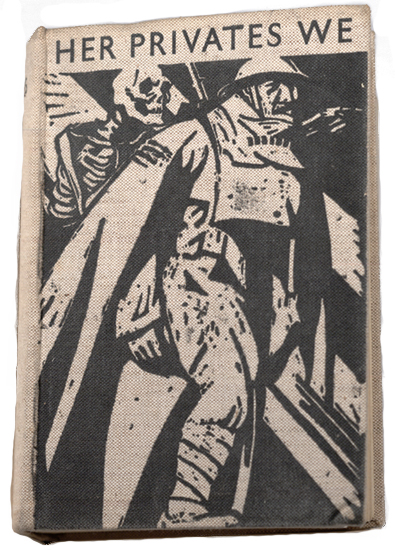
“Her Privates We” 1930, Cover art

Deciding What Makes Up Wisdom

kind-words1

“Often wise sayings fall on barren ground; but a kind word is never ever thrown away.” Sir Arthur Helps

There are so many things to grasp. Our own recovery practically insists we grab vital truths. When we latch on them, we must stick to them no matter what. When we lose someone, or even lose ourselves, we must listen so much closer– the Lord will send someone to our side.

Some rules though:

  • Curiosity is not ever the same as caring.
  • Losing ones balance is never the same as losing ones testimony.
  • A gentle touch can mean more than a powerful revelation.
  • Words of kindness are better than cold truth.
  • To really hear is better than a speech of true words.
  • We must live out the questions we whisper to God
  • Practising prayer is better than just simply praying.
  • Similar experiences that emphasize a connection is never the same as the individuals.
  • Our questions to God reveal far more than His answers.
  • When we do decide to dance, our true friends will dance too.

Ok, I must admit these are not always true and concrete in my heart. My life seems to be a cavern of emptiness; there is little inside but a silly reputation. But it’s a blanket that can’t warm my chilly heart.

12 “Since God chose you to be the holy people he loves, you must clothe yourselves with tenderhearted mercy, kindness, humility, gentleness, and patience. 13 Make allowance for each other’s faults, and forgive anyone who offends you. Remember, the Lord forgave you, so you must forgive others. 14 Above all, clothe yourselves with love, which binds us all together in perfect harmony.”

Colossians 3:12-14, NLT

“Share each other’s burdens, and in this way obey the law of Christ.”

Galatians 6:2

“It is a sin to belittle one’s neighbor;
    blessed are those who help the poor.”

Proverbs 14:21

recite-25825-95458975-1jznxku

*Dis–joint-ed Ideas* Out of Matthew 25:1-13

Ten-virgins-parable
 
KJV—————————->
 
Then shall the kingdom of heaven be likened unto ten virgins, which took their lamps, and went forth to meet the bridegroom.

2 And five of them were wise, and five were foolish.

3 They that were foolish took their lamps, and took no oil with them:

4 But the wise took oil in their vessels with their lamps.

5 While the bridegroom tarried, they all slumbered and slept.

6 And at midnight there was a cry made, Behold, the bridegroom cometh; go ye out to meet him.

7 Then all those virgins arose, and trimmed their lamps.

8 And the foolish said unto the wise, Give us of your oil; for our lamps are gone out.

9 But the wise answered, saying, Not so; lest there be not enough for us and you: but go ye rather to them that sell, and buy for yourselves.

10 And while they went to buy, the bridegroom came; and they that were ready went in with him to the marriage: and the door was shut.

11 Afterward came also the other virgins, saying, Lord, Lord, open to us.

12 But he answered and said, Verily I say unto you, I know you not.

13 Watch therefore, for ye know neither the day nor the hour wherein the Son of man cometh.

King James Version


NLT—————————>
 
“Then the Kingdom of Heaven will be like ten bridesmaids who took their lamps and went to meet the bridegroom. 2 Five of them were foolish, and five were wise. 3 The five who were foolish didn’t take enough olive oil for their lamps, 4 but the other five were wise enough to take along extra oil. 5 When the bridegroom was delayed, they all became drowsy and fell asleep.

6 “At midnight they were roused by the shout, ‘Look, the bridegroom is coming! Come out and meet him!’

7 “All the bridesmaids got up and prepared their lamps. 8 Then the five foolish ones asked the others, ‘Please give us some of your oil because our lamps are going out.’

9 “But the others replied, ‘We don’t have enough for all of us. Go to a shop and buy some for yourselves.’

10 “But while they were gone to buy oil, the bridegroom came. Then those who were ready went in with him to the marriage feast, and the door was locked. 11 Later, when the other five bridesmaids returned, they stood outside, calling, ‘Lord! Lord! Open the door for us!’

12 “But he called back, ‘Believe me, I don’t know you!’

13 “So you, too, must keep watch! For you do not know the day or hour of my return.

 New Living Translation

In recent years I have heard nothing relevant from Matthew 25. Zilch. Why? I honestly don’t know.

The language he uses in this chapter is not only important– but also quite evocative. Even winsome, like the resplendently gorgeous flowers you just have to pick from your neighbors flowerbed. They are the solar plexus kind of trouncingly beautiful.

goldilocks_tarrantWhichever version you like best must carry the authority of the original speaker– his imprimatur if you will– to be real, and valid and even significant. Now Jesus Christ is not speaking out some “weirdy nursery tale” to comfort us. This isn’t “Goldilocks and the Three Bears.” Not even close.

This group of parables, spoke from the mouth and mind of the Lord Jesus Christ (the Creator and Savior and Lord) is meant to connect with us. Try running out in a empty field, with a steel fence post in a the middle of a fierce, lightning storm– you’ll get connected with– real quick! Now back on the farm, you know that you take the needed shelter in a bad storm. One of my great-Aunties was electrocuted in a cast iron bed while sleeping (this led to the conversion of my Uncle Art, who became a prolific evangelist.)

The words of Jesus are not meant to be ignored, or even trifled with. Maybe minimized or entertained or even played with. His words are meant to sizzle, or “crisp us up.” Either way we dare not disregard, or demean them. If we even try, we will end up as very foolish virgins. gotoil

It must be duly noted that 50% missed it completely. But to their credit they really tried to make it work, having the awareness to try to “fix” things, and become available. But the painful part of these 13 verses was the stark-mad fear of not being able to “catch up.”

idea-light-icoBut run this through your “hopper.” MAYBE, I am missing something here? (It wouldn’t be the first time.) Let me know, ok?


*
kyrie eleison, Bryan

(Lord, have mercy)

*

Hell and Hope

inferno

Sometimes, I feel like a tour guide for believers that are walking through hell. I point out the different strugglers, and urge each one not to linger too long but to keep moving. We look on those trapped (they have no hope within them) but we hope that they are yet to reach out for the Savior. It is distressing, and yet somehow we understand them just a little bit.

Our journey out and down each sad corridor can be painfully disturbing for us. There are so many different types of prisons and chains used to confine and control. Dante wrote his “Inferno” (Italian, for hell), and somehow he in some curious way walks through the different levels (varieties) of hell with us. Virgil (Dante’s own tour guide) takes Dante through some pretty hairy stuff, and they pass through the very gate, which bears an inscription, of the infamous phrase “Lasciate ogne speranza, voi ch’intrate“, or “Abandon all hope, ye who enter here.”

Our own rescue from this dreadful place is based on that singular word, “hope”. Somehow, hope has distilled inside us, and that alone can enable us to walk out as the freed. We have chosen not to abandon hope, but to use it as our passport out of the bottom of hell itself. We show it to each guardian, and then pass through without any hinderance.

  • And so at last the poor have hope. (Job 5:16)
  • Having hope will give you courage. You will be protected and will rest in safety. (Job 11:18)
  • Lord, you know the hopes of the helpless. Surely you will hear their cries and comfort them. (Ps. 10:17)
  • All day long I put my hope in you. (Ps. 25:5)
  • Let your unfailing love surround us, Lord, for our hope is in you alone. (Ps. 33:22)
  • O Lord, you alone are my hope. (Ps. 71:5)
  • Your word is my source of hope. (Ps. 119:114)
  • “Listen to me, all who hope for deliverance— all who seek the Lord!” (Isa. 51:1)
  • And his name will be the hope of all the world.” (Matt. 12:21)
  • Even when there was no reason for hope, “Abraham kept hoping.” (Rom. 4:18)
  • We, too, wait with eager hope. (Rom. 8:23)
  • Rejoice in our confident hope. (Rom. 12:12)
  • The Scriptures give us hope and encouragement as we wait. (Rom. 15:4)
  • Three things will last forever—faith, hope, and love. (1 Cor. 13:13)
  • That you can understand the confident hope he has given us. (Eph. 1:18)
  • Our hope is in the living God, who is the Savior of all. (1 Tim. 4:10)
  • In order to make certain that what you hope for will come true. (Heb. 6:11)
  • This hope is a strong and trustworthy anchor for our souls. (Heb. 6:19)
  • Let us hold tightly without wavering to the hope we affirm. (Heb. 10:23)
  • They placed their hope in a better life after the resurrection. (Heb. 11:35)
  • You have placed your faith and hope in God. (1 Pet. 1:21)
  • If someone asks about your Christian hope. (1 Pet. 3:15)

I suppose we must say (it’s clear) that hope is what sets us free from the difficulty that rests in our minds. Whatever DSM-IV has branded us, whatever a psychiatrist has declared us to be, and whatever our therapist has told us– our hope, that’s in Christ, will open all doors that are closed and locked.

Hope really is the Christian’s freedom from hell. Those of us who have been freed from our incarceration from our mental illness are amazingly liberated. I know the lostness of being very much lost. But hope is everything. When our hope somehow connects with Jesus, our souls are set free. We walk out of hell, with our souls soaring clean.

kyrie elesion, Bryan

*