Evaluating Jesus Truly, [CS Lewis]

thinking

“The Difference Jesus Makes,”  from C.S. Lewis

What are we to make of Jesus Christ? This question…has, in a sense, a frantically comic side. For the real reason is not what are we to make of Christ, but what is He to make of us? The picture of a fly sitting deciding what it is to make of an elephant has comic elements about it. But perhaps the questioner meant what are we to make of Him in the sense of  “How are we to solve the historical problem set us by the recorded sayings and acts of this Man?” This problem is to reconcile two things. On the one hand you have got the almost generally admitted depth and sanity of his moral teaching, which is not very seriously questioned, even by those who are opposed to Christianity….

The other phenomenon is the quite appalling nature of this Man’s theological remarks. You all know what I mean, and I want rather to stress the point that the appalling claim which this Man seems to be making is not merely made at one moment of his career. There is, of course, the one moment which led to His execution. The moment at which the High Priest said to Him, “Who are you?” “I am the Anointed, the Son of the uncreated God, and you shall see Me appearing at the end of all history as the judge of the Universe.”….

On the one side clear, definite moral teaching. On the other, claims which, if not true, are those of a megalomaniac, compared with whom Hitler was the most sane and humble of men. There is no half-way house and there is no parallel in other religions. If you had gone to Buddha and asked him “Are you the son of Brahman?” he would have said, “My son, you are still in the vale of illusion.” If you had gone to Socrates and asked, “Are you Zeus?” he would have laughed at you. If you had gone to Mohammed and asked, “Are you Allah?” He would first have rent his clothes and the cut your head off.  If you had asked Confucius, “Are you heaven?” I think he would have probably replied, “Remarks which are not in accordance with nature are in bad taste.”

The idea of a great moral teacher saying what Christ said is out of the question. In my opinion, the only person who can say that sort of thing is either God or a complete lunatic suffering from that form of delusion which undermines the whole mind of man. If you think you are a poached egg, when you are looking for a piece of toast to suit you, you may be sane, but if you think you are God, there is no chance for you….

Now, as a literary historian, I am perfectly convinced that whatever else the Gospels are they are not legends. I have read a great deal of legend and I am quite clear that they are not the same sort of thing. They are not artistic enough to be legends. From an imaginative point of view they are clumsy, they don’t work up to things properly…

[Take, for example] the strangest story of all, the story of the Resurrection. It is very necessary to get the story clear. I heard a man say, “The importance of the Resurrection is that it gives evidence of survival, evidence that the human personality survives death.” On that view what happened to Christ would be what had always happened to all men, the difference being that in Christ’s case we were privileged to see it happening. This is certainly not what the earliest Christian writers thought. Something perfectly new in the history of the Universe had happened. Christ had defeated death. The door which had always been locked had for the very first time been forced open. This is something quite distinct from mere ghost-survival. I don’t mean that they disbelieved in ghost- survival. On the contrary, they believed in it so firmly that, on more than one occasion, Christ had had to assure them that He was not a ghost. The point is that while believing in survival they yet regarded the Resurrection as something totally different and new. The Resurrection narratives are not a picture of survival after death; they record how a totally new mode of being has arisen in the universe. Something new had appeared in the universe: as new as the first coming of organic life. This Man, after death, does not get divided into “ghost” and “corpse”. A new mode of being has arisen. That is the story. What are we going to make of it?

The things He says are very different from what any other teacher has said. Others say, “This is the truth about the Universe.  This is the way you ought to go,” but He says, “I am the Truth, and the Way, and the Life.” He says, “No man can reach absolute reality, except through Me. Try to retain your own life and you will be inevitably ruined. Give yourself away and you will be saved.” He says, “If you are ashamed of Me, if, when you hear this call, you turn the other way, I also will look the other way when I come again as God without disguise. If anything whatever is keeping you from God and from Me, whatever it is, throw it away. If it is your eye, pull it out. If it is your hand, cut it off. If you put yourself first you will be last. Come to Me everyone who is carrying a heavy load, I will set that right. Your sins, are wiped out, I can do that. I am Re-birth, I am Life. Eat Me, drink Me, I am your food. And finally, do not be afraid, I have overcome the whole Universe.” That is the issue.”

– Asking Them Questions, Third Series, edited by Ronald Selby Wright (OUP, 1050), also reproduced inUndeceptions (Geofffrey Bles, 1971) and God in the Dock, Chapter 9 (Fount, 1979)
&


cropped-christiangraffiti1 (3)

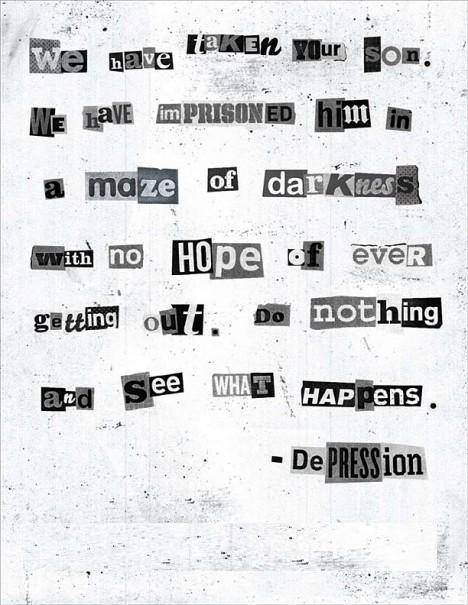
The Ransom Note

depression-note

“We collapse in the dust,
    lying face down in the dirt.
26 Rise up! Help us!
    Ransom us because of your unfailing love.”

Psalm 44:25-26, NLT

“For even the Son of Man came not to be served but to serve others and to give his life as a ransom for many.”

Mark 10:45

“God chose him as your ransom long before the world began, but he has now revealed him to you in these last days.”

1 Peter 1:20

I think that God has more or less ransacked the human language in His effort to get through to us the critical nature of what exactly has been done just for us. When it comes to our salvation and what that means to the universe, the word, “ransom” is used.

The connection for us, as we consider the implications, has mainly a connection with the crime of “kidnapping.” This is when someone is captured by other men, and held in captivity until certain terms are met. When the kidnapper feels his needs are fully met, then the hostage is released.

In the Bible sense, we should work through several verses. There are at least three Hebrew words. In the N.T. Greek just a single word to explain “ransom” is seen. And yet we can say, each word is linked back to the idea of being “helpless.” And helpless is far more than a definition, rather it is a description of a “state of being.”

We come to understand that helplessness is the natural state of human beings. We each have been captured, taken away and are being held, until terms are met for our release. I suppose that some see this helplessness easier than others. (And I’m sure a few will never acknowledge it at all). But nevertheless, it is real and it describes every single person that has ever lived.

Being completely helpless is hardly a situation we would ever choose. Having ransom demands being made to set us free is mostly awkward. And it’s an affront. Perhaps, we feel we are worth more? But the issues here are eternal, and currency concepts are never the consideration.

But there is a present need, to purchase back those who are being held as captives. The absolute clear position is that the Lord Jesus Christ, died in our place. Choosing to die for us, he was essentially tortured before his cruel death. In this decision, he himself paid my ransom. In doing this, I was set free and fully able to return home.

There are many who have been free. But there is a thing called “the Stockholm Syndrome.” This refers to those in captivity who somehow “connect” with their kidnappers through a prolonged captivity. This is to the point where they begin to act less than the victims, and more like the captor. It is confusing. They seem to go out of their way to act “pro-kidnapper”. This can get very disturbing.

We must look to our children, and closest family and our friends. They are toiling for Satan, the captor of our souls (past-tense). Many different tactics are being used– depression, addictions, lust, greed, anger, gluttony, pride, guilt and many other deceitful things. They are being held, until faith (the key) “springs” them out of their prison.

Thank you Jesus, for coming to free us. Thank you for forgiving us. We have been released, and now walk away free. You died, so we might live. We desperately want to see the others we love set free.

*

ybic, Bryan


cropped-christiangraffiti1 (3)

*

A 100% Authentic Sinner

‘This is a trustworthy saying, and everyone should accept it: “Christ Jesus came into the world to save sinners”—and I am the worst of them all.”  

1 Tim. 1:15, NLT

There are some things that can be easily understood, they are obvious.  As believers, there are certain things that are just written in stone.  They are revealed to us in a moment of time, and give us dimensions to a knowable truth.  In this case, ‘people sin all the time’. Our essential nature as a human being is to sin. We are “factories of sin.”

Paul’s relationship has its starting point in theology.  He declares to us directly the perhaps ultimate fact in the entire universe.  Jesus has come for sinners.  Sinners, transgressors, perverts, and the foolishly ignorant are special recipients of a grace that is irresistible.  This is why Jesus came, to find us who have been so twisted up by life, and left wrecked by the side of the road.

It’s funny but I have a point of departure with Paul’s proclamation of being the worst, or the chief of sinners.  I contend with it because I know and believe in my own wickedness.  (I’ve always felt Paul was a bit premature on this).  My own iniquity is such that I feel I can supplant Paul’s personal place.

But in this central verse in 1 Tim 1:15 lays out some vital truth.

  • Jesus has come.
  • He has focused on the “world.”
  • His purpose in coming was to save each of us.
  • Paul understands and thinks he is the ultimate sinner.

Who are we, exactly?  I think we need to realize that scriptural truth has come to us, and rather some diverse mist that just accepts all of us just as we are.  Rather, it’s more like each of us accepting God’s terms of what is theologically real and walking away from it, having absorbed the truth.

It is true, that united with Christ I live a resurrected life. But there can be no resurrection with something dying first. Both are needful. Both are to be part of our theology. Thats what is really important.

bry-signat (1)

cropped-christiangraffiti1.jpg

It’s Friday, but Sunday’s Coming!

easter
 “he humbled himself in obedience to God
    and died a criminal’s death on a cross.”

Philippians 2:8

Dr. Tony Campolo tells the story of a little preaching competition that he had with his pastor during services at the church where he attends. Dr. Campolo tells how he preached the “perfect” sermon, perfect in every way. He had taken the congregation to the heights of glory. And as he sat down beside his pastor, Dr. Campolo patted him on the knee and simply said, “Top that.” The older black pastor looked at him and said, “Boy, watch the master.”

It was a simple sermon, starting softly, building in volume and intensity until the entire congregation was completely involved, repeating the phrases in unison. The sermon went something like this.

It’s Friday. Jesus is arrested in the garden where He was praying. But Sunday’s coming.
It’s Friday. The disciples are hiding and Peter’s denying that he knows the Lord. But Sunday’s coming.
It’s Friday. Jesus is standing before the high priest of Israel, silent as a lamb before the slaughter. But Sunday’s coming.
It’s Friday. Jesus is beaten, mocked, and spit upon. But Sunday’s coming.
It’s Friday. Those Roman soldiers are flogging our Lord with a leather scourge that has bits of bones and glass and metal, tearing at his flesh. But Sunday’s coming.
It’s Friday. The Son of man stands firm as they press the crown of thorns down into his brow. But Sunday’s coming.
It’s Friday. See Him walking to Calvary, the blood dripping from His body. See the cross crashing down on His back as He stumbles beneath the load. It’s Friday; but Sunday’s a coming.
It’s Friday. See those Roman soldiers driving the nails into the feet and hands of my Lord. Hear my Jesus cry, “Father, forgive them.” It’s Friday; but Sunday’s coming.
It’s Friday. Jesus is hanging on the cross, bloody and dying. But Sunday’s coming.
It’s Friday. The sky grows dark, the earth begins to tremble, and He who knew no sin became sin for us. Holy God who will not abide with sin pours out His wrath on that perfect sacrificial lamb who cries out, “My God, My God. Why hast thou forsaken me?” What a horrible cry. But Sunday’s coming.
It’s Friday. And at the moment of Jesus’ death, the veil of the Temple that separates sinful man from Holy God was torn from the top to the bottom because Sunday’s coming.
It’s Friday. Jesus is hanging on the cross, heaven is weeping and hell is partying. But that’s because it’s Friday, and they don’t know it, but Sunday’s a coming…”


Dr. Tony Campolo

Campolo’s web site: http://www.tonycampolo.org/

(This sermon is in an audio format as well: http://tonycampolo.org/its-friday-but-sundays-coming/)


1brobry-sig4

cropped-christiangraffiti1 (1)