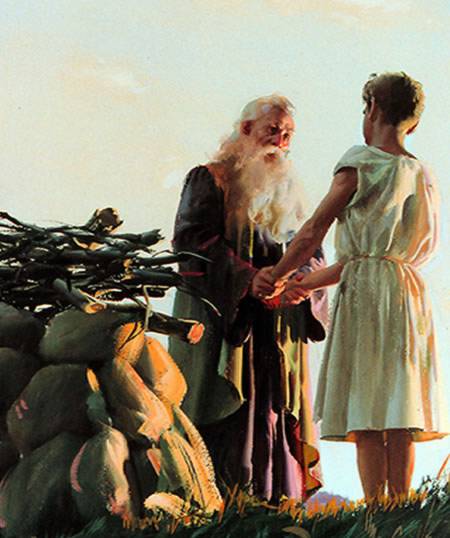
Little Pieces of Obedience

abraham_isaac_1

“It was by faith that Abraham offered Isaac as a sacrifice when God was testing him. Abraham, who had received God’s promises, was ready to sacrifice his only son, Isaac, 18 even though God had told him, “Isaac is the son through whom your descendants will be counted.”19 Abraham reasoned that if Isaac died, God was able to bring him back to life again. And in a sense, Abraham did receive his son back from the dead.”

Hebrews 11:17-19, NLT

The faith of Abraham is understood by believers everywhere. This simple man followed God to a obscure mountain in Judea. He came fervently, and yet logically to the command of the Lord. Abraham’s confident assurance would carry him to Mt. Moriah were he would sacrifice his son. He would prefigure God’s own sacrifice of Jesus Christ, His only Son.

There were many steps Abraham had to take: the knife, the rope, the firewood, the donkey. There was a dozen details to arrange. Abraham would have had to plan ahead of time to prepare. I’m relatively certain he had ample time to consider what he was doing. The enormity of it all would’ve been staggering.

Hebrews reveals that ‘faith’ was what enabled Abraham. It was faith followed by a dozen little obediences that strengthened him to follow God’s instructions. Abraham would obey God, through faith, by doing many little things. All would lead up to the ‘big thing,’ the offering up of his only son.

I believe that no act is too small. Heavy doors swing on small hinges. Tiny obediences make for big ones. And sometimes we can’t tell them apart. It seems that several times during our daily grind we face little choices that often determine a far greater meaning. I’ve been told that there are flowers in alpine valleys that no man will ever see. Their sole beauty is visible only to God. Obedience is often like this. But the Lord knows.

God meets every act of obedience to Him with a smiling grace.

Hebrews 11 is known as the believer’s ‘hall of fame’. In its verses we’re pounded by the idea that the faith is visible only through obedience. What we do is as significant as what we believe. It has always been so.

“…but the people who know their God shall be strong, and carry out great exploits.”

Daniel 11:32, NKJV

Little obediences prepare us for big ones. If we won’t obey in the small ones, how will we in the big ones? The prophet Daniel spoke of a remnant that would do astonishing things, and that the core of their fame would come from knowing God. This is faith made visible. The ‘great exploits’ spring out of a faith in a strong God. To be regarded in this way would be wonderful, but faith needs those little obediences to be able to do the great ones. 

We must reclaim the reality that the details of our lives are not trivial.

bry-signat (1)


cropped-christiangraffiti1.jpg

When Rags Became Grace

ebedmelech

“Ebedmelech from Ethiopia was an official at the palace, and he heard what they had done to me. So he went to speak with King Zedekiah, who was holding court at Benjamin Gate. Ebedmelech said, “Your Majesty, Jeremiah is a prophet, and those men were wrong to throw him into a well. And when Jerusalem runs out of food, Jeremiah will starve to death down there.” 10 Zedekiah answered, “Take thirty of my soldiers and pull Jeremiah out before he dies.”

11 Ebedmelech and the soldiers went to the palace and got some rags from the room under the treasury. He used ropes to lower them into the well. 1Then he said, “Put these rags under your arms so the ropes won’t hurt you.” After I did, 13the men pulled me out. And from then on, I was kept in the courtyard of the palace guard.

Jeremiah 38:8-13, CEV

At the very last, there was just one remaining.  A single man, Ebedmelech.  He was a Ethiopian; made a eunuch by the will of the king.  The situation in Jerusalem has gotten very difficult.  In an action of revenge and reprisal, certain men intend to kill the prophet Jeremiah.  They take a certain satisfaction in this, and Jeremiah is thrown into a very deep cistern.  They intend for him to starve to death, which is a terrible way to die.

The king in these last pathetic days is being manipulated by the surviving leadership of the city.  Zedekiah gives tacit approval for the destruction of Jeremiah.  He just lets it happen without a good reason.  The prophet is lowered in the muddy cistern.  Without food, he will soon starve.  In the minds of this evil mob, they have taken care of the any last vestiges of a godly ‘righteousness.’

But there is one, he is a wild card.  And no man would have guessed it.  Ebedmelech, the Ethiopian eunuch steps forward and decides to change history.  Not only his ethnicity, but his state as a castrated man are definite issues.  This mob never recognized him as someone who would intervene.  He was a non-entity, a non-factor. He was black, and a eunuch, and a nobody.

But Ebedmelech is intervening, in the face of terrible risk, he steps out boldly to make an intercession.  He doesn’t appear to be intimidated, and makes a cry for the truth.  He becomes an intense and strong advocate for the release of Jeremiah from the deep mud.

Ebedmelech is given the ‘green-light’ by king Zedekiah. Ebedmelech rounds up thirty men to assist him as he delivers the prophet.  Ropes are brought out, and out comes Ebedmelech with a big armload of rags.  They shout down to Jeremiah.  The instructions are called down to him of what needs to take place for the extraction.

It’s interesting, but the rags are the most interesting. 

They are really an extra touch, not a necessity.  The rags become essentially, a form of grace.  They would pad the ropes, providing a degree of comfort as the prophet is pulled up out of the mud.  Ebedmelech showed the heart of God in what he did.  There was his desire to somehow make the prophet comfortable.  In doing so he communicated a kindness and concern that was saturated with God’s own enveloping presence.

Our illnesses– physical or mental, have moved us to a lonely place on the edge. 

We are those on the so-called ‘margins.’ Ebedmelech has now become a carrier of God’s grace.  Jeremiah could have been lifted up by just the ropes.  It would’ve been more difficult, granted.  But the rags sent down by Ebedmelech provided the prophet an extra gentleness.  And I am certain it did not pass by without notice.  Their mention in this Book of Jeremiah is significant, and shows Jeremiah’s deep appreciation of kindness.

We can gather up much from what has been written.  We will sometimes find ourselves in parallel situations.  But our kindness and concern can make the difference.  Admittedly, they are quite insignificant–quite minor. Call it ‘icing on the cake.’ But when you show the kindness of our Father, you will infuse the situation with love, and grace.  

So be an  Ebedmelech,—  an outcast perhaps– but in a position of kindness.


bry-signat (1)

cropped-christiangraffiti1.jpg


The Joyful Necessity of Dying Daily

Eye+Fetch+Photography+Stormy+Wheat+Fields+by+Diane+Loft (1)
Photo by Diane Loft

“We know that our old sinful selves were crucified with Christ so that sin might lose its power in our lives. We are no longer slaves to sin.”

Romans 6:6, NLT

“There are two things which the Church needs: more death and more life— more death in order to live; more life in order to die.”

C.A. Fox

The need of this moment is critical. Many believers have never came to this point of ‘knowing.’ Maturity comes when one realizes that crucifixion has dealt with the old man. We died when He died, we were there when He died, we were part of that event. Romans 6 is all about a believers ‘co-crucifixion’ with Jesus Christ. Calvary was far more than a religious event— it was where our sin was terminated. It was more than just a penalty carried— it was where our old nature put to death.

“My old self has been crucified with Christ. It is no longer I who live, but Christ lives in me. So I live in this earthly body by trusting in the Son of God, who loved me and gave himself for me.”

Galatians 2:20

Sin has no power to sway a dead man. A man who is dead doesn’t respond to a girl in a leopard skin bikini. (It doesn’t matter if she is insanely gorgeous). He no longer can be tempted to sin. Why?  Because he is dead. This is not an issue of semantics, it is not poetic interpretation of a metaphor. It rings true in heaven and it is quite real here on earth.

Sin should no longer remain in power of a believer’s life. We believe that our sins have been dealt with on the cross, that Jesus took our sins from us, bearing them as a ‘sacrificial lamb.’ But the same is true to say, “My sinful nature was also crucified with him.”

“I tell you the truth, unless a kernel of wheat is planted in the soil and dies, it remains alone. But its death will produce many new kernels—a plentiful harvest of new lives.”

John 12:24

The principle is from farming. A kernel of wheat will bring an abundance. But it must be buried first. The dead seed miraculously sprouts. At the moment of death it suddenly receives a new life. The dead seed grows into a bountiful harvest. This is the New Testament principle of dying to self. A few things:

  • we are not sinless— we must deal daily with the sinful part of us,
  • this must be taken by faith, much like anything else from God, Heb. 11
  • discipline aids our quest for holiness, 1 Tim. 4:8
  • it accentuates the role of water baptism, it’s a daily reckoning, Rom. 6:4,
  • temptations can be really strong, but He enables us, 1 Cor. 10:13
  • this is a God honoring way to live.

Crucifixion should always be taken by faith in God’s Word and it will lead to resurrection. Crucifixion weakness is necessary for resurrection power. Jesus shares his life with us— his power is given to his people. He shares all that He is so we might become like him.

“Do not let sin control the way you live; do not give in to sinful desires. 13 Do not let any part of your body become an instrument of evil to serve sin. Instead, give yourselves completely to God, for you were dead, but now you have new life. So use your whole body as an instrument to do what is right for the glory of God.”

Romans 6:12-13

We’ve been given a gracious teacher in the person of the Holy Spirit. He will never condemn our feeble efforts to be holy. Be encouraged: God delights to make the weakest of us strong. He has done all He can to work holiness into our hearts.

bry-signat-1-1


cropped-christiangraffiti1.jpg


The Blessings of a Long Battle, part 4

boxing3

In thinking about this final installment about how God can bring much good out of our protracted struggle with sin, weakness, or a problem, it dawned on me how important it is to see the Big Picture. In some ways this post reiterates truths in part 2 of this series, but also adds important new dimensions to those truths and explores new territory.

When a soldier goes through boot camp, it’s crucial for him or her to see the overall purpose of his training–the Big Picture. He or she is being pushed and tested in different ways to the extreme so that they will be prepared for any situation on the battlefield, won’t crack under pressure, and will be a team player.

In the conquest of Canaan under Joshua’s leadership, the nation of Israel experienced many victories over different hostile nations. However, Judges 3:1–4 says that God did not allow the Israelites to completely triumph but left certain enemies in the land (e.g., the Philistines) so that his chosen people would learn warfare.

When we became Christians, God could have put us in a cocoon of protective grace where we would be insulated from our three primary enemies–the world, the flesh, and the devil–but he didn’t so that we would also learn warfare.

If he would’ve sheltered us from the battle, we would end up like many “trust fund babies,” who, because of their vast inherited wealth, never have to work a day in their lives. They’re protected from the toil and struggle of life and never have to worry about paying the rent or the electric bill.

Often there is something profoundly missing in their lives: many are spoiled, shallow, and have not been battle–tested. Perhaps God designed an existence where we battled the world, the flesh, and the devil so that we would not end up becoming spiritual trust fund babies.

Macarius was a great monk who composed the Macarian Homilies in the 4th century. He was convinced that, if after becoming Christians, we were protected in a cocoon of grace from the temptations of the world, the flesh, and the devil, many of us would soon become conceited and fall as Satan fell. Instead of a three steps forward, two steps back grind that life often is, we would have a series of unbroken successes and become lifted up in pride and fall like Lucifer did.

In seeing the big picture, nothing is more important than understanding that God the Father through the Holy Spirit has been preparing a Bride for his Son in a Marriage that will span eternity. He wants you to be a part of that Bride. The Father wants the Bride to fervently love the Groom.

There is no love without free choice. If we would’ve been protected from the enemies of our soul, and choosing the Groom was exquisitely easy or even automatic, where’s the love that has been tested in the furnace of affliction? Like any spouse, Christ wants to be chosen. If we were automatons or even semi–automatons, where’s the love in that?

When we are in a long struggle with sin or weakness, it is because we have become over–attached to some created thing. Addiction is over–attachment in the extreme (e.g., overeating, alcohol, drugs, pornography, sex, power, work, shopping, etc.)

Christ the Uncreated One wants to be chosen over all the created things. Christ the Groom wants to stand in the midst of all his competitors–i.e. created things–and have the Bride choose him. One of the blessings then of a long battle is this: it’s the vehicle whereby we choose Christ as our Groom, as our only lover.

Does that love somehow go away if you’re a Christian who is up to your eyeballs in sin, addiction, and weakness? If anything God loves you more after you fall, because where sin abounds, grace abounds more. And as the old religious cliché tells us, he loves us in our sin and loves us too much to leave us there.

 *

Jonathan

Check out Jonathan’s own site at http://www.openheavensblog.com/.