Present Tense Prodigals

prodigal-podcast-1

“So he returned home to his father. And while he was still a long way off, his father saw him coming. Filled with love and compassion, he ran to his son, embraced him, and kissed him. 21 His son said to him, ‘Father, I have sinned against both heaven and you, and I am no longer worthy of being called your son.

Luke 15:20-21, NLT

The Parable of the Prodigal Son has typically been taught as a ‘once upon a time’ event in the life of one wayward youth. We understand it to be such. The prodigal returns to his Father, case closed. It is a remarkable story that resonates to every broken believer.

But what if I told you that this parable is present tense. That we are continuously wandering, spending our inheritance and living off the wealth of our Father. We feel bad about this, we repent and return, only to embark on another foray into sin of our own choosing. It happens all the time.

My point is this. We seem to be always the prodigal. We never seem to outgrow this. We are constantly coming to our senses, and returning home. We seem to never get the point that our personal sin as eternal consequences. We live like there is no tomorrow, except we have to sober up and realize we have wandered far from our home.

The story of the prodigal is written to us who have repeatedly (that means very often) find themselves a good distance from where we should be. We find ourselves feeding the pigs again. We abhor our choices, and wonder again if our Father will take us back just one more time. Reason says ‘No!,’ but faith says ‘Yes!’

God’s love for us is greater than all our evil wanderings. It extends to the ups and downs of our vacillating discipleship. He sees it all and fully accepts us as His returning son. We will never tire out His constant love. We can feel ashamed of our recent behavior, but that changes nothing. We belong to Him, even if we feel wretched.

There are belivers who are overwhelmed by their sense of sin. Some of this is inflated by the devil. And yet they feel estranged from the Church. They know what they’ve done, and they can find no excuse for their actions. They’ve wandered again (for the 100th time).

The Father’s love is not subject to your obedience.

Grace is not some meager thing doled out in some stingy manner. It is given outrageously to each son or daughter without limits. Rascals are included. God is not a miser.

“But his father said to the servants, ‘Quick! Bring the finest robe in the house and put it on him. Get a ring for his finger and sandals for his feet. 23 And kill the calf we have been fattening. We must celebrate with a feast, 24 for this son of mine was dead and has now returned to life. He was lost, but now he is found.’ So the party began.

Luke 15:22-24

‘One, and your done’ doesn’t apply to your heavenly Father. His love for you can’t be reduced to this level. Pick yourself up, leave the pigs, and come home again.

bry-signat (1)

cropped-christiangraffiti1.jpg

A Day in the Life of a Mental Hospital Patient

6:30 am. “Rise and shine,” but this is debatable– you simply just breathe and walk, in this kind of a desperate mental fog,  (Simply put, ‘there will be no sunshine for you today.’) But, this only just seems to really matter to us, who have no hope.  You exchange brief greetings with your roommate, which only just seems proper, even at this level.  We are given “ratty” old surgical scrubs to wear through out the day.

We head down ‘en mass’ to the cafeteria.  I see the servers on the line, I notice that they avert their eyes from us as we form a hungry queue.  Sometimes, they will give us choices: “bacon or sausage?”  To a mental patient, this can be a Gordian Knot of complexity.  So the line moves slowly, as we try to sort out this conundrum.

There is no coffee for us, as patients.  It has been two weeks for me, and I dream of a cup of hot coffee, with cream.  Some of the attendants drink Pepsi, although it is done hiddenly, but we all know it.  We resent their liberty, especially when we have none.  There is a question of equity, with us, which has been violated.

8:40 am.  We are all race to be the first in line for our morning meds.  It almost seems we are afraid they are suddenly going to run out.  I get my Seroquil, my lithium, my Zoloft.  Additionally, because I am ‘post-op’ brain tumor, I am given a mild stimulant called Provigil to help me think clearly.  I have no idea if it works, or not. (I rather have a cup of coffee.)

We then gather into a day room full of clunky and ugly furniture.  It is big, and the chairs encircle a grimy tile floor to make a large open space.  This is not an orderly place, as people are wandering about, some stare at the wall or at a fake plant in the corner.  It is noisy, some even shout.  Others just “rock” back and forth to a song that only they can hear.  A few of us lie in “fetal position” of hiddenness, just wanting to disappear.

The thought occurred to me one day, of a ‘giant aquarium.’  It was constantly moving, swirling about.  If you stopped moving, it meant that you were dead.  Everyone was moving, and oblivious to the others who were also moving.  This seems to explain much.  (You will need to accept the ‘aquarium’ idea if you really want to process the moment.)

On one of my stays, weeks went by before I realized that this particular meeting actually existed, but I was very confused and seriously beyond any correction.  I was really struggling with clinical depression, so meals and meds was all I could manage.  When I finally figured this out, I quickly joined the fish bowl.  It was both good and bad.  But mostly good. Finally as bleak as it was, I started accepting reality.

11:00 am.  One thing you do notice is a lot of disjointed conversations.  You would speak to someone and 10 minutes later they would answer.  And for the most part, conversations would be muted, whispered to people.  As if there was a conspiracy involved, and a certain appropriateness must be taken. We were a paranoid bunch.

Sometimes an attendant would turn on the TV.  I can remember watching cartoons and just maybe I would think that they were communicating to me in code.  We did have a VCR for movies, but because one guy urinated into the machine, it shorted it out.  So, alas, no more movies.

During one stay (and there were several) I was suicidal.  The staff watched me like a hawk, sitting at my door out in the hallway. But I was desperate to cut my wrists, so I stood up in a chair.  I took down a clock and wrapped it in a blanket, to muffle the sound of breaking glass.  I managed to slash my wrists deeply and often, before the nurse came in my room.  For a moment, I brought an excitement to the staff.  And perhaps a certain meaning to me.

When you’re in a psych ward your days are beyond tedious.  One day is like the next.  The psychiatrist comes to see you for 10 minutes, and it is a high point of your day.  You discover that any new explanations, or treatment plans are done solely by the doctor.  That is one of the first cardinal rules on the ward.  Ask a nurse or an aide, and they invariably dodge.  But the psychiatrist “rules the roost.” Everyone follows his decision. This is useful to know.

1:00 pm.   Suddenly a young teen girl with schizophrenia, screaming and pounding her head against the wall has now becomes the focus.  Every couple of days this happens, and in a twisted way punctuates the drabness of the day.  She is artfully restrained by the staff and taken to “the padded cell.”  We are all told it is for her own protection,  but we as patients, we all rally behind her fight.  When she makes a break from the nurses we all cheer her effort and want her to escape.

The second cardinal rule of the floor is that you don’t “stick out” in any way. Creating an issue is never tolerated, whatsoever.  Demanding more TV time, or coffee, or a newspaper will hardly ever go over well.  Just before Thanksgiving, 2003, I timed my meeting with the pdoc to raise an issue of a fresh cup of coffee.  There was a nurse present at our meeting, and she had to respond to the doctor’s order that I was to be given coffee on Thanksgiving morning.  The next morning the coffee was delivered, but the nurse insisted that she would set in a chair next to me until I finished.  Nevertheless, it was a glorious moment.

3:00 pm.  I soon developed auditory hallucinations.  First, I kept hearing a CB radio, squawking constantly.  A few days later, I started to hear a telegraph, “dit-dot-dash.”  They both were very loud and insisting that I pay attention.  Also, I would have 3 or 4 moments of seeing black and hairy spiders climbing at me.  They were so real, and even volitionally know they were not real, I still panicked.

4:30 pm.  They’re other issues as well.  I basically hated phone calls from family.  When they did come they always seemed intrusive and seemed to work against the thinking on the ward.  When a few friends did visit, I would be abrasive and rude.  Wishing they hadn’t made the effort.  I imagined their hearts processing me and my need to be there, and it disturbed me.  Since I lived about 300 miles from the hospital, it took effort on their part to try to see me.  Looking back though, I wish I had been nicer.

8:48  pm.  Getting ready for bed.  It seems that is what I have waited for this all day.  These are moments I have started to live for.  Sleep = oblivion.  I fade to black, and life is paused.  There isn’t any issues for me to figure out.  For eight hours, I find peace,  Sleep is a deep mercy, a gift given to us from the Father.  Those of us, who struggle hard against the dark, understand the “gift” of grace in the form of sleep.  Depressives very often crave sleep. We often want to hide into it, as if doing so would solve our problems and issues. For me, sleep was the only time I was free from the ward.

I want to sleep, to close my eyes and to be gone.  I suppose that is true, for all of us who want to “commit suicide by sleep.”  We seek oblivion, and long for the moment when we can “check out.”  We want to be forgotten and overlooked. We deeply want to be erased, and move directly into forgottenness.

When we have been committed to the ward as patients, we will probably be shaken to our core.  Our insertion into a diverse floor of mental illness, will always introduce us to deep desperation. We are jolted that there is a darkness that is pursing us far beyond what seems is right.  We must call out to Him who can save us.

*

kyrie elesion, Bryan

 

cropped-christiangraffiti1 (2)

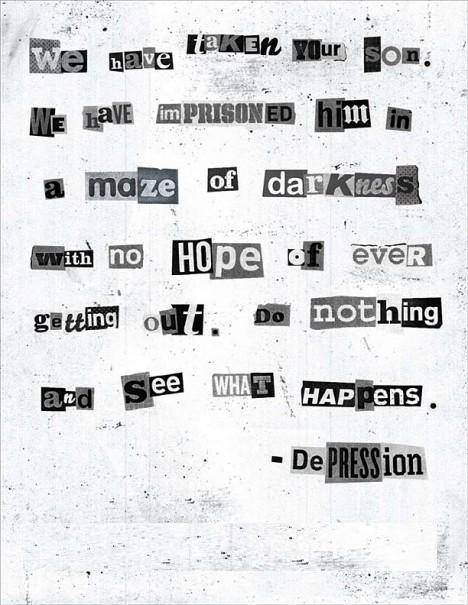
The Ransom Note

depression-note

“We collapse in the dust,
    lying face down in the dirt.
26 Rise up! Help us!
    Ransom us because of your unfailing love.”

Psalm 44:25-26, NLT

“For even the Son of Man came not to be served but to serve others and to give his life as a ransom for many.”

Mark 10:45

“God chose him as your ransom long before the world began, but he has now revealed him to you in these last days.”

1 Peter 1:20

I think that God has more or less ransacked the human language in His effort to get through to us the critical nature of what exactly has been done just for us. When it comes to our salvation and what that means to the universe, the word, “ransom” is used.

The connection for us, as we consider the implications, has mainly a connection with the crime of “kidnapping.” This is when someone is captured by other men, and held in captivity until certain terms are met. When the kidnapper feels his needs are fully met, then the hostage is released.

In the Bible sense, we should work through several verses. There are at least three Hebrew words. In the N.T. Greek just a single word to explain “ransom” is seen. And yet we can say, each word is linked back to the idea of being “helpless.” And helpless is far more than a definition, rather it is a description of a “state of being.”

We come to understand that helplessness is the natural state of human beings. We each have been captured, taken away and are being held, until terms are met for our release. I suppose that some see this helplessness easier than others. (And I’m sure a few will never acknowledge it at all). But nevertheless, it is real and it describes every single person that has ever lived.

Being completely helpless is hardly a situation we would ever choose. Having ransom demands being made to set us free is mostly awkward. And it’s an affront. Perhaps, we feel we are worth more? But the issues here are eternal, and currency concepts are never the consideration.

But there is a present need, to purchase back those who are being held as captives. The absolute clear position is that the Lord Jesus Christ, died in our place. Choosing to die for us, he was essentially tortured before his cruel death. In this decision, he himself paid my ransom. In doing this, I was set free and fully able to return home.

There are many who have been free. But there is a thing called “the Stockholm Syndrome.” This refers to those in captivity who somehow “connect” with their kidnappers through a prolonged captivity. This is to the point where they begin to act less than the victims, and more like the captor. It is confusing. They seem to go out of their way to act “pro-kidnapper”. This can get very disturbing.

We must look to our children, and closest family and our friends. They are toiling for Satan, the captor of our souls (past-tense). Many different tactics are being used– depression, addictions, lust, greed, anger, gluttony, pride, guilt and many other deceitful things. They are being held, until faith (the key) “springs” them out of their prison.

Thank you Jesus, for coming to free us. Thank you for forgiving us. We have been released, and now walk away free. You died, so we might live. We desperately want to see the others we love set free.

*

ybic, Bryan


cropped-christiangraffiti1 (3)

*

Being Lorded Over

Prasing-our-Lord-and-Savior-3-jesus-19486588-842-595

“…no one can say, “Jesus is Lord,” except by the Holy Spirit.”

1 Corinthians 12:3

“The question in salvation is not whether Jesus is Lord, but whether we are submissive to His lordship.”

  John MacArthur

Christians believe that Jesus is Lord. I suppose this really means that they regard Jesus Christ is be the supreme authority in their lives. They look to Him to be their presiding judge in all they say or do. “You were bought at a price. Therefore honor God with your bodies”(1 Cor. 6:20).

Sometimes I think that as Americans we can struggle with this “Lord idea.” We don’t understand living under a sovereign king. A king that exercises total authority and lordship over his subjects. Many believers rather think of the Kingdom of God as a democracy.

Yet when we say, Jesus is Lord (as we Christians are prone to say) we really mean that He is a savior, that He has provided His blood in order to obtain our forgiveness. But this is only half of it. If Jesus is Lord it should mean what we are completely under His rule.

“…yet for us there is but one God, the Father, from whom all things came and for whom we live; and there is but one Lord, Jesus Christ, through whom all things came and through whom we live.”

1 Corinthians 8:6

Lordship means sovereign control. It means He has the authority to do what He pleases with over the totality of our lives. We’re in His sphere of control. To relinquish this to Him is life’s biggest challenge.

“The lordship of Jesus is not simply a hope of Christians that someday might be realized; it is a truth that has already taken place.”

R.C. Sproul

This small post can not change anything. That is not the point. All I ask is that you consider anew the implications of what I’m saying here. Is there a daily acknowledgement to His sovereign control over your life? Does saying “Jesus is Lord” have ramifications of a submitted heart?

I can attest that Jesus is not only a worthy savior but a wonderful lord. His governance is one of love. He has never ever done anything that has been detrimental to me, “the Lord is my shepherd, I shall not want” (Psalm 23:1-2). He is a worthy savior.

bry-signat-1

cropped-christiangraffiti1 (2)