The Desire For a Place of Power

“But they didn’t answer, because they had been arguing about which of them was the greatest.” 

Mark 9:34, New Living Translation

As the disciples walked they talked.  There was a casualness as they followed Jesus, it was a warm day and they walked, and sometimes even stopped–keeping up in a relaxed way. They finally meander their way slowly into Capernaum.  There was a safe-house there, and a place of peace.  It is here that Jesus confronts His followers.

He wants to know what they were talking about as they walked.  “What did you say to each other?”  The disciples looked at each other, and then down at the floor.  No one spoke. I think they were ashamed.  No one would reveal what they had thought about, and then had spoken out loud.

Did Jesus really need to ask this?  I honestly don’t know, but as I think about these verses, I say yes, and no.  Jesus was bringing His disciples to a place– an opportunity for them to be critically honest, perhaps even a bit reflective and thoughtful.  And yet He knew exactly what they had been discussing.

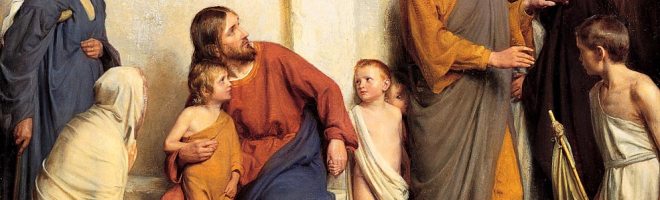
Even though the disciples knew what they had discussed on that dusty road; they don’t know that Jesus knows.  Awkward.  At this point Jesus doesn’t confront.  He shows.  As they sit down, Jesus begins to reveal their hearts.  A local street urchin, playing outside is brought into the house.  The disciples look, and think.  The child moves close to Jesus.  Jesus pulls him close.

At this point, Jesus begins to say things that elevate.  One of those crystalline moments that happen when His truth meets the human understanding.  That child is transformed into a lesson of influence.

“Anyone who welcomes a little child like this on my behalf welcomes me, and anyone who welcomes me welcomes not only me but also my Father who sent me.”  v.37

This is a clear, and powerful statement of how things operate in the kingdom.  The child is brought into ultimate significance and worth.  The disciples are diminished into a lower status.  It’s funny, but our treatment of a child describes our real relationship with our Father God, and our Savior Jesus.  That little one has now become our “litmus test.”

I encourage you to seek out and develop relationships with the children in your life.  Although this is a literal interpretation, it will adjust us to a broader application of our Lord’s lesson.  When we are altered, we will be putting others first.  Our desire for place, and the power that goes with it, is nullified and zeroed out.
1brobry-sig4 (2)


cropped-christiangraffiti1-3-1


H

Limits of Mental Illness

748

Mental illness is so limited,

It cannot cripple love, 

It cannot shatter hope.

It cannot corrode our faith.

It will never destroy peace.

It cannot.

It will never kill friendship, 

It cannot suppress memories. 

It cannot invade the soul.

It cannot steal eternal life.

It cannot conquer eternal life.

It cannot conquer your spirit.

Amen.

flourish2


 P.S. I have received some criticism over the contents of this post. The argument is that mental illness is very destructive, and that I’m misleading others by suggesting it isn’t. The thinking is that we dwell on the past and how it effects the present moment. I believe we have a mental illness. But I also believe more strongly so that Christ redeems us completely. “Because he lives,” goes the old hymn, “I can face tomorrow.”

In the “heat of the moment” the situation can seem overwhelming. Our illness can be completely devastating. However the Holy Spirit is yet to fully redeem us, yet we still must view this coming event as something triumphant and total. This life is not the end. What a relief to shed this mortal darkness!

“Behold, the dwelling place of God is with man. He will dwell with them, and they will be his people, and God himself will be with them as their God. 4 He will wipe away every tear from their eyes, and death shall be no more, neither shall there be mourning, nor crying, nor pain anymore, for the former things have passed away.”

Revelation 21:3-4

1brobry-sig4


cropped-cropped-christiangraffiti1.jpg


Please Shut the Door, [Prayer]

“When you pray, go into a room alone and shut the door. Pray to your Father in private. He knows what is done in private, and he will reward you.”

Matthew 6:6, CEV

“We are to be shut out from men, and shut in with God.”

Andrew Murray

Prayer is a deep and awesome thing.  And yet in a sense our physical life must have cheeseburgers and spaghetti.  Food powers us, and we are fueled by it’s energy.  Prayer is also necessary to propel us, for it is our spirit’s nourishment.

We cannot survive without food. We see pictures of emaciated children in some African country, and they are just  skin and bones.  It is a sick evil.  But there are Christians who are like this spiritually.  They are starving because they are not praying.

Jesus told His followers, to go into a room alone.  Then shut the door.  We must learn that God is in the secret.  If we should meet with Him, we must be as secretive.  “Shut the door,”  what happens in there is not for public display. We must be quite discrete in our times with Him.

When I was at in my first year at Bible school, I heard a guest speaker teach from Matt. 6:6.  I was pumped up by it, praying with the door shut was a new idea for me.  When I got to my dorm room, I went straight for my closet to put this new revelation into action. Kneeling there in the closet, with the door slid shut, I tried to pray.  And after a bit I fell asleep, still on my knees.

About an hour later I woke up with a start.  I had no idea where I was, and in my disorientation I slid open the closet door with a loud bang.  I tried to stand, but my legs couldn’t support me.  I lurched out in the room and fell in a pile.  My roommate was startled to say the least.  He had been in the room studying quietly by himself, when suddenly this ‘wildman’ burst out of the closet and immediately collapsed.  It was hysterical!

So much for my first attempt at praying in secret.

The quest for spiritual growth will have to lead us into the closet.

The injunction to close the door can be understood in a variety of ways.  The act of isolating ourselves is a physical one.  But we must understand we need to shut up all our social entanglements and obligations.  We isolate ourselves so we can be intimate with Him.

We just need to figure out just how we are to do this.  We shouldn’t give up when it doesn’t bring wondrous results.  We are all students in this, we will advance at times, and then retreat.  But every second in the closet can be an intimate blessing to our souls.

“He that loveth little prayeth little; he that loveth much prayeth much.” 

– Augustine


bry-signat (1)

cropped-christiangraffiti1.jpg


The Presence Makes the Difference

jesus-paralyticI once was told that depression is the inability to construct a future. Perhaps that is precisely where I’ve come to, this old despair that lies dormant until the conditions are just right— and then it explodes in burst of black dandelions.

For about three weeks, I had experienced being down. Somedays were much worse than others (and some where actually reasonable). I should of been more cautious. Afterall, I have twenty years of battling this old dragon that has been my most potent enemy. I suppose I got a bit arrogant. I know I felt immune.

I laid in bed, unable to get out for days. Obviously this was a concern, but I couldn’t find any strength to speak of. I couldn’t even pray.

 “A few days later, when Jesus again entered Capernaum, the people heard that he had come home. 2 They gathered in such large numbers that there was no room left, not even outside the door, and he preached the word to them.3 Some men came, bringing to him a paralyzed man, carried by four of them.4 Since they could not get him to Jesus because of the crowd, they made an opening in the roof above Jesus by digging through it and then lowered the mat the man was lying on. 5 When Jesus saw their faith, he said to the paralyzed man, “Son, your sins are forgiven.”

Mark 2:1-5

There maybe some who wondered about the sins of this paralyzed man. I believe I may know:

  • There were sins of despair—of God’s goodness.
  • There would’ve been despondency of an unchanging future.
  • And finally, anger at God’s decision to leave him paralyzed and a burden to his family and friends.

That paralyzed man was carried by his friends, and brought into Jesus’ presence. And that is exactly what happened to me. I’ve been astounded by those who carried me. This man had no strength on his own; he was “jello on a mat.” (I don’t mean to be crude or unfeeling).

My own tiredness lingers, I’m struggling to pray. I’m too unfocused, but I’ve been told that comes with the territory with the aftermath of a total depressive meltdown. But I know Jesus. It is His touch that I must have now.

bry-signat (1)