

Are You Depressed, Or Just Human?

rainy-day

Depression can be devastating. Its worst form, major depressive disorder, is marked by all-encompassing low mood, thoughts of worthlessness, isolation, and loss of interest or pleasure in most or all activities.

But this clinical description misses the deep, experiential horror of the condition; the suffocating sense of despair that can make life seem too arduous to bear. Here’s something else we can say confidently about depression: it is complex. The cause is often a mix of factors including genetic brain abnormalities, sunlight deprivation, poor nutrition, lack of exercise, and social issues including homelessness and poverty. Also, cause and effect can be hard to tease apart — is social isolation a cause or an effect of depression?

Unfortunately, we can make one more unassailable observation about depression: the disorder — or, more precisely, the diagnosis — has gone stratospheric. An astonishing 10 percent of the U.S. population was prescribed an antidepressant in 2005; up from 6 percent in 1996.

Why has the diagnosis become so popular? There are likely several reasons. It’s possible that more people today are truly depressed than they were a decade ago. Urbanized, sedentary lifestyles; nutrient-poor processed food; synthetic but unsatisfying entertainments and other negative trends, all of which are accelerating, may be driving up the rate of true depression. But I doubt the impact of these trends has nearly doubled in just ten years.

So here’s another possibility. The pharmaceutical industry is cashing in. In 1996, the industry spent $32 million on direct-to-consumer (DTC) antidepressant advertising. By 2005, that nearly quadrupled, to $122 million. It seems to have worked. More than 164 million antidepressant prescriptions were written in 2008, totaling $9.6 billion in U.S. sales. Today, the television commercial is ubiquitous:

  •  A morose person stares out of a darkened room through a rain-streaked window.
  • Quick cut to a cheery logo of an SSRI (selective serotonin reuptake inhibitor, the most common type of antidepressant pharmaceutical).
  • Cross-fade to the same person, medicated and smiling, emerging into sunlight to pick flowers, ride a bicycle or serve birthday cake to laughing children.
  • A voiceover gently suggests, “Ask your doctor if [name of drug] is right for you.”

The message — all sadness is depression, depression is a chemical imbalance in the brain, this pill will make you happy, your doctor will get it for you — could not be clearer. The fact that the ad appears on television, the ultimate mass medium, also implies that depression is extremely common.

Yet a study published in the April, 2007, issue of the Archives of General Psychiatry, based on a survey of more than 8,000 Americans, concluded that estimates of the number who suffer from depression at least once during their lifetimes are about 25 percent too high. The authors noted that the questions clinicians use to determine if a person is depressed don’t account for the possibility that the person may be reacting normally to emotional upheavals such as a lost job or divorce (only bereavement due to death is accounted for in the clinical assessment). And a 15-year study by an Australian psychiatrist found that of 242 teachers, more than three-quarters met the criteria for depression. He wrote that depression has become a “catch-all diagnosis.” What’s going on? It’s clear that depression, a real disorder, is being exploited by consumer marketing and is over-diagnosed in our profit-driven medical system.

Unlike hypertension or high cholesterol — which have specific, numerical diagnostic criteria — a diagnosis of depression is ultimately subjective. Almost any average citizen (particularly one who watches a lot of television) can persuade him or herself that transient, normal sadness is true depression. And far too many doctors are willing to go along. The solution to this situation is, unsurprisingly, complex, cutting across social, medical, political and cultural bounds.

But here are three major changes that are needed immediately: Medically, thousands of studies confirm that depression, particularly mild to moderate forms, can be alleviated by lifestyle changes. These include exercise, lowered caffeine intake, diets high in fruits and vegetables, and certain supplements, particularly omega-3 fatty acids. Physicians need to be trained in these methods, as they are at the Arizona Center for Integrative Medicine at the University of Arizona in Tucson. See Natural Depression Treatment for more about these low-tech methods, or the “Depression” chapter in the excellent professional text, Integrative Medicine by David Rakel, M.D. (Saunders, 2007).

Politically, if Congress — which seems hopelessly addicted to watering down all aspects of health care reform — can’t manage to ban all DTC ads in one stroke, it should start by immediately ending those for antidepressants. Personally, be skeptical of all DTC ads for antidepressants. The drugs may turn out to be no more effective than placebos. Many of them have devastating side effects, and withdrawal, even if done gradually, can be excruciating. While they can be lifesavers for some people, in most cases they should be employed only after less risky and expensive lifestyle changes have been tried.

Finally, recognize that no one feels good all the time. An emotionally healthy person can, and probably should, stare sadly out of a window now and then. Many cultures find the American insistence on constant cheerfulness and pasted-on smiles disturbing and unnatural. Occasional, situational sadness is not pathology — it is part and parcel of the human condition, and may offer an impetus to explore a new, more fulfilling path. Beware of those who attempt to make money by convincing you otherwise.

…………………………..
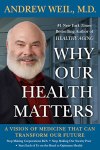
Weil's-new-book-availableAndrew Weil, M.D., is the founder and director of the Arizona Center for Integrative Medicine and the editorial director of http://www.DrWeil.com. Become a fan on Facebook. Follow Dr. Weil on Twitter. Read more at: http://www.huffingtonpost.com/andrew-weil-md/are-you-depressed-or-just_b_307734.html


The Hidden Blessings of the Long Struggle

freelancing-struggle

by Jonathan Coe

It’s a familiar story. A person has become a Christian in recent years and is engaged in spiritual practices–prayer, Bible study, meditation, church attendance, fellowship, tithing, and/or the sacraments. They have listened closely to their pastor or priest and have developed some formulas that are supposed to help them overcome the problems, sins, and weaknesses in their lives.

They’ve heard sermons and/or read books that have titles that start with “Three Steps,” “Five Keys,” and “Four Ways,” that are supposed to lead them to the abundant Christian life. They see progress in their lives but are discouraged because they still struggle with certain sins, problems, and/or weaknesses. Some feel like they can’t overcome the very deep negative legacy from the unhealthy family they grew up in.

Church leadership would do many believers a service by teaching them about how God can bring good out of their protracted struggle. No, it’s not God’s will for us to habitually sin , but God, in his tender mercies can work redemptively in this long and frustrating battle against profound sin.

One of the first good things that can come out of a long battle with a character flaw or problem is deliverance from a formulaic Christian faith. “Do these three things and your problem will go away” you learn from a best–seller, but your problem doesn’t go away. The fallen human heart is a complex and formidable thing, and these canned approaches are a little like taking a squirt gun to a forest fire.

When people experience sustained adversity, their lives feel out of control, and they will often grab on to formulas to give them a sense of righting a ship that’s taking on water. Unfortunately, they end up trusting in the formulas more than God himself.

Faith in formulas will always eclipse faith in God.

The Christian life is more about a restful trust in a Person than embracing a set of principles (no matter how spiritual those principles may sound.)

The New Testament is clear on the centrality of faith (not self–effort or formulas) in the overcoming life:

When asked by his disciples what they must do to do the works God requires, Jesus answered, “The work of God is this: to believe on the one he has sent” (John 6:2829). When describing the person who overcomes the world, the Apostle John said, “He who believes that Jesus is the Son of God” (I John 5:45).

The failure of formulas is a good experience because it drives the believer to faith in the living God. In this faith, there is a wonderful exchange: I give Christ my pitiful attempts to live the victorious Christian life and he gives me his transforming power to overcome sin. However, this exchange may not happen overnight; it may be a process that takes years.

For those of you in a long struggle, please be comforted by the mercies of God that endure forever. If he can forgive a murderer and adulterer like David, he can forgive you and me. Please take the advice that Winston Churchill gave the British people during World War II: “Never, never, never, never give up ” or listen to the lyrics from a U2 song called “Miracle Drug” : ”There is no failure here, sweetheart/ Just when you quit.”

Even better is C.S. Lewis from The Business of Heaven:

“I know all about the despair of overcoming chronic temptations. It is not serious, provided self–offended petulance, annoyance at breaking records, impatience, etc. don’t get the upper hand. No amount of falls will really undo us if we keep on picking ourselves up each time. We shall of course be very muddy and tattered children by the time we reach home, but the bathrooms are already, the towels put out, and the clean clothes in the airing cupboard. The only fatal thing is to lose one’s temper and to give it up. It is when we notice the dirt that God is most present in us: it is the very sign of his presence.”

I say Amen.

ybic,

Jonathan Coe

&

Bryan’s note: Jonathan is a very old friend. He deeply loves Jesus. He is wise and he is aware. He is a writer, blogger, and a house-painter. (He is also a Dodgers fan, which I suppose he can find forgiveness for). I am made a rich man by knowing him.

Being Still in a Restless Age–by Jonathan Coe

“There is no fear in love; but perfect love casts out fear, because fear involves torment. But he who fears has not been made perfect in love.”

1 John 4:18

As I write this my heart goes out to everyone who is struggling to find serenity in an age filled with restlessness. Been there done that. You feel the pressure on all sides. There’s too much month and not enough money. Your marriage is showing signs of fraying around the edges. You have a sullen teenager who doesn’t relate to the biblical Christianity that you have embraced. You have plenty to do but not enough time to do it. Debt seems to be piling up and the house may soon be underwater. Your job feels unsatisfying and your boss plays a big role in that. New health problems have emerged that you didn’t have in the days of your youth. In short, life hasn’t turned out like you thought it would and inner stillness and peace seem elusive.

In speaking from my heart, I just want to begin by saying that God loves you much, much more than you know. You may want inner stillness but he wants to give you that peace infinitely more than you want it.

Imagine yourself as his anxious child. He will not forbid the children to come to him. You can crawl up onto his lap and tell him all your problems. Do you see his loving eyes as you’re talking to him? Ask the Holy Spirit to show you Christ’s loving eyes, because if you can see those eyes, it will help you with fear and anxiety, because perfect love casts out all fear according to John the apostle (I John 4:18).

If you can’t do this, then think about someone you know who really loves you without any strings attached. Doesn’t God love you at least twice as much as this person? Of course he does and infinitely beyond that. This is the God whose lap you’re sitting on.

Please know that in all your prayers, there’s no guarantee that God will change your circumstances. The struggling business you run may not survive. The unhealthy marriage may not get better and the child with leukemia may not get healed despite your prayers and fasting. God may not change your circumstances, but he will give you the grace to triumph during your time of affliction. He will you give you a supernatural peace that transcends understanding. You will know it didn’t come from you, but, instead, its origin is divine. Guard your heart against offense because many Christians become offended at God when he doesn’t change their circumstances.

If your prayer life is almost non–existent, I don’t write this to condemn you. However, if you want inner stillness and serenity, some kind of quiet time with God is a must. Prayer is the context by which we give God our anxiety and he gives us his peace.

This is where we cast all our cares on him because he cares for us. It’s a salutary exchange that we can’t live without. The Holy Spirit is a gentle teacher and will lead you into a robust prayer life. Start small and don’t despise small beginnings. 5–10 minutes is okay to begin with for awhile and then add to it as God’s grace increases in your life. If you try to pray for an hour right off the bat, you’re liable to burn out. God is patient with you so be patient with yourself.

ybic,

Jonathan

Letters from Fawn CreekIf you liked this post by Jonathan, you may also like his book, Letters from Fawn Creek, that is now out on Amazon and also can be purchased at this link:

https://www.tatepublishing.com/bookstore/book.php?w=9781628542035

Explaining the Levels of Discipleship

And anyone who does not carry his cross and follow me cannot be my disciple.

(Luke 14:27 NIV)

There are various people in the world back in Jesus’ day as there are today. There were sometimes vast crowds (“multitude” In the KJV) of people numbering in the thousands. (Luke 12:1) The size of these crowds of people apparently ebbed and flowed. Sometimes there were just a few followers, and sometimes it was in the thousands.

Then there were the unnamed disciples. These apparently sometimes numbered in the hundreds. (John 6:66-67, Luke 6:17 NIV)

Then there were the twelve. (Matthew 10:1-4)

Then out of the twelve, there was an “inner circle”: Peter, who was given a promise that nobody else was given — namely that he would be the rock that Jesus would build His church upon (Matthew 16:18). Then there was James and John, the disciple that “Jesus loved” who were the only disciples present to see the transfiguration. (Mark 9:2)

Present day is little different. We all have different stations. There are evangelists, such as Billy Graham, teachers, like Joyce Meyer, and pastors of huge churches like Pastor David Yonggi Cho, and pastors of small community churches. There are elders and deacons and the congregation. There are people minister to youth, and the little old lady who brings the wonderful dishes to the pot luck dinners… All the way down to people who only go to church on Easter and Christmas.

So. How strong of a walk with Jesus do you want? It is up to you. Though God calls many, He is very polite. If you are among the called, He leaves it up to you how close you want to draw to him.

Sure it sounds great in theory – but in practice, you will find there is a cost. Sure the reward is great but so is the cost. And the devil will remind you of all the things you are “missing out on” in hopes of discouraging you.

You have to take up your cross. Not a fun task as anyone who has seen or heard about Mel Gibson’s Passion of the Christ will know. What is the “cross”? I misunderstood this for years. Your cross is not suffering for your own sins – though you will reap what you sow – everyone, believers or not, will in some fashion will reap what they sow. The cross that Jesus carried was a burden that he carried for others. If you take up burdens for other people, you are bearing your cross.

Remember Love is a choice of behavior – not a warm fuzzy emotion. Emotions go away. Love is eternal.

By this all men will know that you are my disciples, if you love one another.

(John 13:35 NIV)


*******

A.L. Howard is the founder of www.modernchristianissues.org: A Christian Apologetics Blog which attempts to provide biblical answers to tough questions — Bible Apologetics for the layman — designed to be a resource of Biblical Apologetics that you do not have to be a scholar to understand. He has been studying creation science and Bible prophecy since the early 1980s. Visit the site to explore salvation, evolution vs creation science (creationism), cults, the 12 steps and Christianity and much more.

Article Source: http://EzineArticles.com/?expert=A._L._Howard