A Permanent Slave

Body piercing is now acceptable: noses, tongues, and eye brows are the most common. There is another type of piercing, first seen in Deuteronomy 15.  

In Deuteronomy we read of slaves who are set free by their master, having served six years of service, and if they loved and were loved by their master, they could choose to remain a slave to him. 

Deuteronomy 15:12-18 

This was a decision that required elders to act as witnesses.  It was significant as well as completely binding.  I like to think of the ceremony to be kind of a cross between a wedding and a circumcision. (Sounds fun, huh?!) 

The slave would be led to a doorpost, and the master would take an awl, and push it through his ear lobe.  This designated the slave to be forever “owned” by a specific master.  Herein lies a truth, a picture of a consecrated Christian. 

Many times, in the New Testament we are called to be servants (slaves) of Christ. Peter, Paul, James, and Jude referred to themselves as “bond servants of Jesus Christ” in their epistles. This is not forced servitude. It’s a choice made in love! 

There are many believers who have done the same; they have fallen in love with their Savior.  They do not plan on life apart from Him.  So spiritually they have gone to the doorpost, the awl is pushed through their ear, and they are marked from that point on. 

Although the ear was pierced physically in the Old Testament, a different kind of piercing takes place in the New Testament. It is “spiritual piercing.” In Romans 6:16 we read, 

Romans 6:16 

 When the prodigal son returned home from the far country he fell before his father and humbly ask, “make me your servant.” (Luke 15:19,21) He, in essence, was saying to the father, “pierce my ear.” The father made him a son, but the attitude of the son’s heart had changed to the heart of a servant. So, it must be with us. 

It is then that we can live a pierced ear life, revealing to all that we are servants of Jesus Christ! 

— Jim Elliot, Missionary and Martyr

Braiding and Waiting

wait_bench_ocean

“Yet those who wait for the Lord
Will gain new strength;
They will mount up with wings like eagles,
They will run and not get tired,
They will walk and not become weary.”

Isaiah 40:31, NASB

The particular word “wait” is a vital force that must be reckoned with. It’s not used passively in the Scriptures. It does not mean to be apathetic or lazy. Sometimes we wait in line at the grocery store, or maybe we’re waiting for a phone call. We regularly wait all the time, and usually, we don’t even realize it.

It will sometimes mean to work like a fisherman who repairs his nets to get them ready for tomorrow’s task.

(There are always holes to mend after a long night’s efforts.)

When I truly wait on God, I realize that I’m actually repairing myself for His heart and for His work.

  • Seeing His face
  • Hearing His voice
  • Keeping pace with Him, whether He moves or doesn’t

It’s a fascinating way of describing something, isn’t it? Sometimes, when we think of waiting only in the context of the English language, it can become a frustrating delay. This often causes us to miss out on the true meaning of ‘wait’. I strongly believe that the Holy Spirit wants us to understand the concept of being closely connected to God. Sadly, we are often held back by our own definitions, rather than embracing the definitions found in God’s Word.

“The LORD is good to those who WAIT for him,
to the soul who seeks him.”

Psalm 27:14

For those of us who are sick – in body or mind – being told to “wait on the Lord” can be difficult to understand and accept. It is common for us to feel frustrated with this advice and the person giving it, mainly because we don’t fully grasp the true meaning of ‘waiting.’ We get close to understanding it, but we never quite reach that understanding of that word.

“WAIT for the LORD;
be strong, and let your heart take courage;
WAIT for the LORD!”

Psalm 27:14

He becomes my strength; He is now the strong cord I am braided into. (Perhaps this is how He imparts strength and might to His people?) We need this, and the Lord is quite eager to lead us into this new kind of intimacy.

“The LORD is good to those who WAIT for him,
to the soul who seeks him.”

Lamentations 3:25

The promise in Isaiah 40:31 talks about getting new strength, like an eagle’s wings, a holy energy. This verse is important for us, especially today; we need this kind of strength right now. I just want to inspire you during your prayer time to become consciously and purposefully connected to the Lord.

It’s only then can we can put our nets back together again?

“Waiting for God is not laziness. Waiting for God is not going to sleep. Waiting for God is not the abandonment of effort. Waiting for God means, first, activity under command; second, readiness for any new command that may come; third, the ability to do nothing until the command is given.”

    G. Campbell Morgan

Have a blessed day!

Simply Mary at Jesus’ Feet

Mary-Jesus-feet

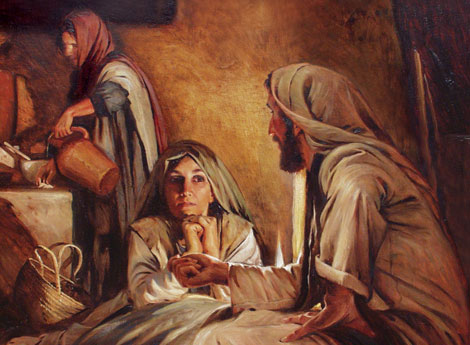
We see Mary three times in the gospels, and each time she is in the same posture — “at Jesus’ feet.” When we have our first glimpse within the Bethany home, we find Martha in her characteristic attitude– working and serving; and Mary we see sitting at the Master’s feet, sitting eagerly and listening to His words.

Our second view of Mary is when Jesus came back to Bethany after the death of Lazarus, and the sisters went out to meet Him. Again, we see her at the feet of Christ. But this time in deep sorrow, seeking comfort. And then we observe her a third time. She has come to anoint the feet of Jesus. We find her again, at Jesus’ feet, and now she is honoring her Lord.

It is her natural posture. I believe that she feels entirely comfortable in this place.  I have personally seen sparrows’ nest on a sheer cliff hundreds of feet straight up, without any apprehension at all. I have been astonished at their daring and simple confidence.  And Mary has this spunk.  She has that certain easy and confident boldness.

Martha, the oldest, obviously has the theology.  We see her taking issue with Jesus, she is questioning, and confronting.  But with Mary it seems, there is a quiet contentment and a rest.  An open readiness to receive. We don’t see that too much, but Mary was a “learner.”  She had become learned in the grace of trusting simply.

She was centered on her Master, He was the focus of her attention.  We dare not minimize this, or try to focus on something less “holy.” This is not something we can easily duplicate, because it proceeds out of a heart that is absorbed in love.  It may appear to be unseemly, and we scratch our head with nervous skepticism.  But it seems whenever Mary comes into the presence of Jesus, she works her way to the front– so she can sit with Jesus. (Interestingly, the Orthodox Church regard Mary to be the first real disciple.)

We have so much to learn from Mary.  Our Christian life can be very shallow and seem rather anemic.  We live in a culture that is racked in intellectualism and pride.  When we engage it we may end up with a bit of haughtiness and a lot of selfishness to deal with.  Mary can be our compass, and our example as we crash through these issues into authentic discipleship.  She really does deserve to be esteemed, and recognized for inspiring us to be with Jesus.

*


Fallow Ground

Today I realized that I was sick and very tired of myself. It’s really not disgust or even loathing. It’s more like weariness, exhaustion. I’ve never felt this way. In a strange way, it intrigues me. Could this definite disenchantment mean something spiritual? Does it have value, or am I just feeling self-absorbed or conceited?

There seems to exist a real rigidity to evil, something intense.

I have seen it up close– sin that hardens all who touch it, plain and simple. My growing immobility disturbs me, as I know I’m developing a “hardness of heart.” Atherosclerosis is a condition of a sick heart where arteries become blocked. It’s also known as the “hardening of the heart, or arteries.” It is a patient killer, slowly and surely making hard deposits that block the flow of blood.

The Bible speaks much about having a hard heart.

It also uses the metaphor of fallow ground that must be plowed up. Jesus used the same image in His “Parable of the Sower” in Matthew 13.

“A sower went out to sow. 4 And as he sowed, some seeds fell along the path, and the birds came and devoured them. 5 Other seeds fell on rocky ground, where they did not have much soil, and immediately they sprang up, since they had no depth of soil, 6 but when the sun rose they were scorched. And since they had no root, they withered away. 7 Other seeds fell among thorns, and the thorns grew up and choked them. 8 Other seeds fell on good soil and produced grain.”

There are really only four options.

  • The first is the seed that gets walked on.
  • The second lands on hard stones.
  • The third seed tries to grow in the thorns and thistles.
  • Only the fourth flourishes.

Heart of Stone Heart of Flesh
The Battle of the Heart

I have found that my own heart drifts. I myself struggle with a mental illness where my emotions fluctuate constantly. They gallivant around, floating here and then there. I may be depressed and suicidal in the morning, and then I can be euphoric in the evening. It’s having the identity of a “wandering star.”

But I so want my heart to soften. I want to grow. I really do.

I so want to sit with Jesus and hear His words. I need Him to share what He’s thinking about. Yet I know that any sin I entertain has a hardening effect on my spiritual heart. This scares me. But truly he still holds me close, and he keeps his steady loving hand on me. *

*