
The Joyful Necessity of Dying Daily

Eye+Fetch+Photography+Stormy+Wheat+Fields+by+Diane+Loft (1)
Photo by Diane Loft

“We know that our old sinful selves were crucified with Christ so that sin might lose its power in our lives. We are no longer slaves to sin.”

Romans 6:6, NLT

“There are two things which the Church needs: more death and more life— more death in order to live; more life in order to die.”

C.A. Fox

The need of this moment is critical. Many believers have never came to this point of ‘knowing.’ Maturity comes when one realizes that crucifixion has dealt with the old man. We died when He died, we were there when He died, we were part of that event. Romans 6 is all about a believers ‘co-crucifixion’ with Jesus Christ. Calvary was far more than a religious event— it was where our sin was terminated. It was more than just a penalty carried— it was where our old nature put to death.

“My old self has been crucified with Christ. It is no longer I who live, but Christ lives in me. So I live in this earthly body by trusting in the Son of God, who loved me and gave himself for me.”

Galatians 2:20

Sin has no power to sway a dead man. A man who is dead doesn’t respond to a girl in a leopard skin bikini. (It doesn’t matter if she is insanely gorgeous). He no longer can be tempted to sin. Why?  Because he is dead. This is not an issue of semantics, it is not poetic interpretation of a metaphor. It rings true in heaven and it is quite real here on earth.

Sin should no longer remain in power of a believer’s life. We believe that our sins have been dealt with on the cross, that Jesus took our sins from us, bearing them as a ‘sacrificial lamb.’ But the same is true to say, “My sinful nature was also crucified with him.”

“I tell you the truth, unless a kernel of wheat is planted in the soil and dies, it remains alone. But its death will produce many new kernels—a plentiful harvest of new lives.”

John 12:24

The principle is from farming. A kernel of wheat will bring an abundance. But it must be buried first. The dead seed miraculously sprouts. At the moment of death it suddenly receives a new life. The dead seed grows into a bountiful harvest. This is the New Testament principle of dying to self. A few things:

  • we are not sinless— we must deal daily with the sinful part of us,
  • this must be taken by faith, much like anything else from God, Heb. 11
  • discipline aids our quest for holiness, 1 Tim. 4:8
  • it accentuates the role of water baptism, it’s a daily reckoning, Rom. 6:4,
  • temptations can be really strong, but He enables us, 1 Cor. 10:13
  • this is a God honoring way to live.

Crucifixion should always be taken by faith in God’s Word and it will lead to resurrection. Crucifixion weakness is necessary for resurrection power. Jesus shares his life with us— his power is given to his people. He shares all that He is so we might become like him.

“Do not let sin control the way you live; do not give in to sinful desires. 13 Do not let any part of your body become an instrument of evil to serve sin. Instead, give yourselves completely to God, for you were dead, but now you have new life. So use your whole body as an instrument to do what is right for the glory of God.”

Romans 6:12-13

We’ve been given a gracious teacher in the person of the Holy Spirit. He will never condemn our feeble efforts to be holy. Be encouraged: God delights to make the weakest of us strong. He has done all He can to work holiness into our hearts.

bry-signat-1-1


cropped-christiangraffiti1.jpg


Through Difficult Times

“Even though our problems may have been brought upon us because of something done against our will, we have no excuse for allowing the problem to persist, grow and even take control over our entire life.”

–Joyce Meyer

“Do not fear the conflict, and do not flee from it; where there is no struggle, there is no virtue.”

–John of Kronstadt

“No discipline is enjoyable while it is happening—it’s painful! But afterward there will be a peaceful harvest of right living for those who are trained in this way.”

Hebrews 12:11, NLT


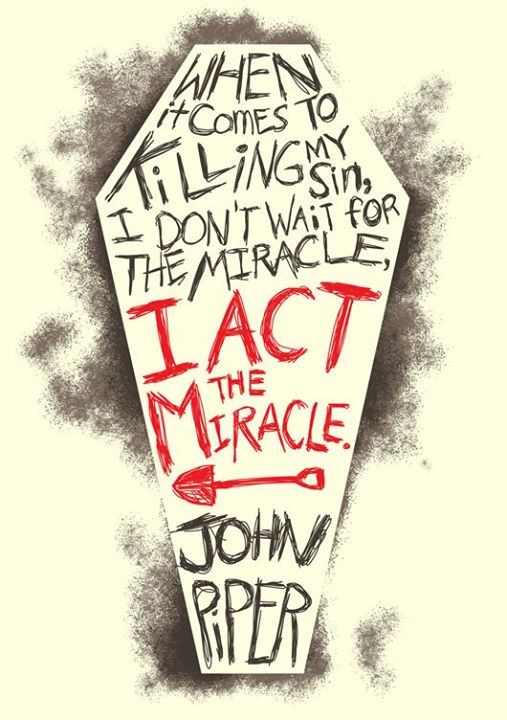
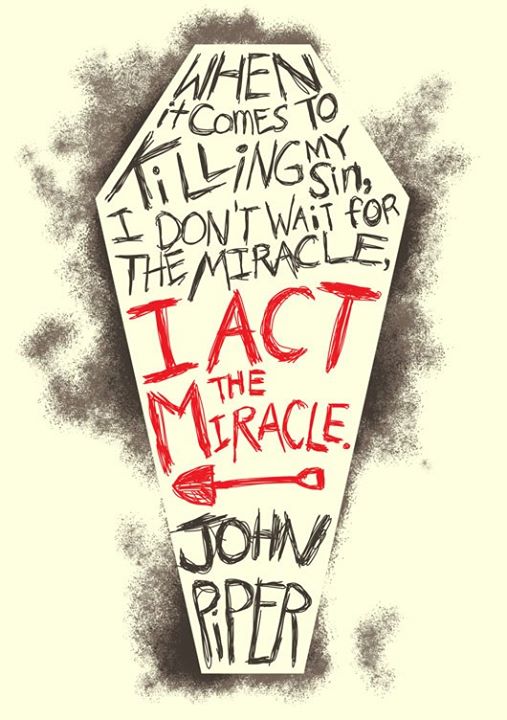
Killing My Sin, Before It Kills Me

killing-sin-act

We are for the most part anyway, eager to please God. We are Jesus’ people with the occasional brush with sin. But hey, who doesn’t? But that attitude must be questioned.

“My little children, these things I write to you, so that you may not sin.”

1 John 2:1

John hopes that his readers would make a choice— not to commit sin. After all, what soldier goes into battle with the intent of getting just a little wounded? Often we will sin just because it seems so inevitable, and we feel we can’t help ourselves. (But the reality is that we can.)

But the Holy Spirit now lives inside. Cooperation with Him is needed. Often we will work ourselves into a ‘no win scenario’ where we believe that sin rules. We can’t beat it, so we stop trying. That is common, and sad.

‘Passivity’ is defined as not participating readily or actively; inactive. When we are passive spiritually, we disengage ourselves from any effort of living holy and pure lives. Not being ‘hot’, but content to be lukewarm. At this point sin becomes, reluctantly, tolerated. “After all, I’m a sinner, what else can I do?”

Mentally ill people are often passive. We are told that we have an uncontrolled illness which dictates that we act ‘irresponsible.’ Our depression often escalates and we feel victimized by it. My experience has taught me that there are three kinds of depression:

  • organic depression, or the ‘biochemistry’ of the disease,
  • guilty depression, the kind that feels bad because of what we’ve done (or didn’t do),
  • reactionary depression, the type we feel when experiencing a loss, a loved one, or a job

Depression will almost always fall in these three categories. And passivity plays a part in all three. We  frequently feel victimized and ‘acted upon.’ When it comes to our discipleship we don’t act, we react. We are utterly convinced of the Bible— God’s truth, but we are so sporadic we can’t seem to get it to work for any length of time.

Yes, we are believers. And yes, we have issues. We’re waiting for a miracle, and hope we get a breakthrough soon.

At the base point of our lives, quite often, there is a passive attitude. Passivity aggravates our depression or mental illness. It deepens, spreading through our lives like a contagious illness. Our discipleship sputters and stalls. We no longer act on God’s Word, but we find ourselves fabricating a faith that makes allowances for our situation.

But we must ‘act the miracle.’ Everything God gives… everything… must be received by a convinced faith. We must be persuaded to give up our flawed ideas, and believe God for the real thing. I opened up this with 1 John 2:1. But there’s much more to this verse:

“My little children, these things I write to you, so that you may not sin.  And if anyone sins, we have an Advocate with the Father, Jesus Christ the righteous.”

I don’t want you to sin. Avoid sin. But even if you do— we have someone who will plead our case before God. He stands and argues our plight. He loves us that much.


bry-signat (2)

cropped-christiangraffiti1.jpg


Living Tethered to the Cross

We live in this place.

St. Francis of  Assisi once wrote, “The devil never rejoices more than when he robs a servant of God of the peace of God.” Sometimes I think I’ve made the devil dance far too many times.

I confess that peace has never been real high on my list. Love, joy, kindness and even goodness are clear priorities. Peace–well… not so much. Until it’s not there. And then I get frantic by its absence, and look for it with manic bewilderment.

I’m panting for some sign that God still loves me. Anxiety eats at me. I beat myself up by my last failure. The guilt of my latest sin grows until it looms larger than the blood that saved me. Sometimes religious people have the most neurosis.

I’m afraid that we are taking “the present tense’ out of the Gospel. The past tense is far preferable to us as we manage the Christian life. We like to make check marks on our list. Repentance– check. Baptism– check. Bible study– check. I think it gives me a definite feeling of ‘maturity.’

But truth has a way of punching through. I haven’t arrived, and it seems I’m still the hideous sinner I always was. I cannot pretend otherwise, even with a truck load of cosmetics at my disposal. I know, I’ve tried. And I’m still ‘ugly.’ I do know forgiveness, and I do walk in its wonderful light (by grace.)

I read Luther 30 years ago. (And Bonhoeffer would say something similar.)  “When our Lord and Master Jesus Christ said, ‘Repent,’ he willed the entire life of believers to be one of repentance.” – Martin Luther (this is the first of his 95 Theses.) There is a present tense here we can’t ignore. I don’t just repent over smoking, or fornication, or of hypocrisy, once and done. But my entire way of living is to be one of repenting.

Repentance is a ‘moment-by-moment’ grace.

As I read the Beatitudes I cannot evade the sense that they are present tense. Read them, they’re obviously not a spiritual checklist. Each verse seems to speak of the time being, the present moment. No list here, guys. It will never be ‘one-and-done.’

“God blesses those who are poor and realize their need for him,
    for the Kingdom of Heaven is theirs.
4 God blesses those who mourn,
    for they will be comforted.
5 God blesses those who are humble,
    for they will inherit the whole earth.
6 God blesses those who hunger and thirst for justice,
    for they will be satisfied.
7 God blesses those who are merciful,
    for they will be shown mercy.
8 God blesses those whose hearts are pure,
    for they will see God.
9 God blesses those who work for peace,
    for they will be called the children of God.
10 God blesses those who are persecuted for doing right,
    for the Kingdom of Heaven is theirs.

Matthew 5:3-10, NLT

All of the Christian life is repentance. Turning from sin and trusting in the good news that Jesus saves sinners aren’t merely a one-time inaugural experience but the daily substance of Christianity. The gospel is for every day and every moment. Repentance is to be the Christian’s continual posture.”

–John Piper

Luther’s last words, on his deathbed wrote on a scrap of paper these words, “We are beggars! This is true.” Thirty years before, he was only echoing his first thesis. It seems dear ones, we are to live at the foot of the cross. Everyday. Because we desperately need to.

And perhaps the biggest reason is this: Jesus only comes for ‘sinners.’

&

bry-signat (1)

cropped-christiangraffiti1.jpg
