Two O’ Clock in the Morning Poetry, #3

Collector_Trench

Middle Parts of Fortune, by Frederic Manning

“The air was alive with the rush and flutter of wings; it was ripped by screaming shells, hissing like tons of molten metal plunging suddenly into water, there was the blast and concussion of their explosion, men smashed, obliterated in sudden eruptions of earth, rent and strewn in bloody fragments, shells that were like hell-cats humped and spitting, little sounds, unpleasantly close, lie the plucking of tense strings, and something tangling his feet, tearing at his trousers and puttees as he stumbled over it, and then a face suddenly, an inconceivably distorted face, which raved and sobbed at him as he fell with it into a shell-hole.”

(Accounts of The Great War) 
R
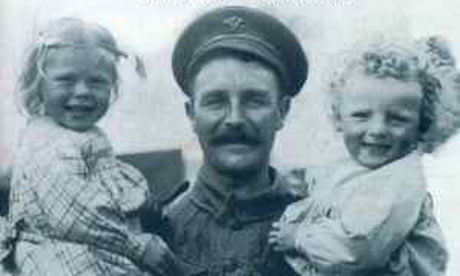
FredricmanningManning was an Australian aspiring intellectual, already in his mid-30s when he enlisted as a private soldier in 1915. His prewar existence in England was dogged by unfulfilled literary hopes and emotional confusions. He served for only a few months in France, and his military career ended in alcoholism and disgrace. But in 1929 he composed a novel, obviously autobiographical, about three soldiers’ experience of the trench nightmare, which is outstanding. Almost certainly the finest work of its kind to emerge from the war. (Penguin)
&

Manning continued to write. In 1917 he published a collection of poems under the title Ediola. This was a mixture of verse predominantly in his former style alongside war poems heavily influenced by the imagism of Pound, which deal introspectively with personal aims and ideals tempered in the crucible of battle. He contributed to anthologies, for example, The Monthly Chapbook which appeared in July 1919 edited by Harold Monro, containing twenty-three poems by writers including John Alford, Herbert Read, Walter De La Mare, Osbert Sitwell, Siegfried Sassoon, D. H. Lawrence, Edith Sitwell, Robert Nichols, Rose Macaulay and W. H. Davies alongside Manning and Aldington. He wrote for periodicals, including The Criterion, which was produced by T. S. Eliot.

&&&

Poetry did not pay, and so in 1923 Manning took a commission from his publisher John Murray to write The Life of Sir William White, a biography of the man who, as Director of Naval Construction, led the build-up of the Royal Navy in the last years of the nineteenth century. Galton had died in 1921, which not only left Manning effectively homeless, but also lacking a forceful directing influence in his life. He lived for much of the time at the Bull Hotel in Bourne, apart from a short spell when he owned a farmhouse in Surrey. At this time he was friendly with T. E. Lawrence, then serving in the Royal Air Force at RAF Cranwell, some twenty miles (a motorcycle ride) from where Manning was living. In 1926 he contributed the introduction to an edition of Epicurus’s Morals: Collected and faithfully Englished by Walter Charleton, originally published in 1656, published in a limited edition by Peter Davies. — from Wikipedia and Penguin

&

Bonus–

wwi13
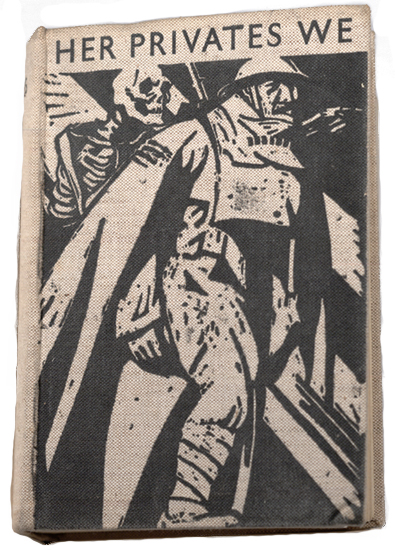
“Her Privates We” 1930, Cover art

Nothing New Under the Sun

sun1This post is one that I posted at my own blog over three years ago, but watching Pr. Lowe share his story so honestly here reminded me of it, and so I decided to share it. I know his story is one that has blessed others; I know because I am one of those people who have been blessed by his honesty and faith.

What’s your story? I know you have one; we all do. But a more important question is: Have you shared your story with anyone? So often we don’t. Even when someone asks, “How are you?” or “What’s going on with you?”, we answer with platitudes like, “I’m fine” or “Not much.” We do this even when it is not true, even when we are not fine or a multitude of stressful situations are plaguing us.

A Facebook friend posted as her status one day that everyone lies, and the biggest lie we tell is “I’m fine.” But why do we do that? Why don’t we share our story with others? I believe there are two reasons, both rooted in fear to some extent.

First, we think our story is ordinary. We are afraid that others will be bored by what we have to say about what’s going on in our lives. Sometimes this might be true, sometimes the person we are speaking with won’t really care enough to truly listen or will be bored. Dwight Yoakam sings a song called “Sorry You Asked” that exemplifies this concern:

You’ll be sorry you asked
me the reason
That she’s not here with
me tonight
And I know you were
probably just acting polite
But you’ll be sorry you
ever asked why

We think people are just acting polite when they ask how we are, and don’t really want to know the truth. But often that is not the case, at least not if you are hanging out with people who care about you.

Second, we think we are the only ones going through whatever difficulty we are experiencing. We are afraid that others will look down on us for the situation we are in or the trial we are experiencing. We are afraid they will think we are weird or worse. But seldom are we the only ones who have experienced the trial we are currently experiencing or have gone through in the past. “What has been will be again, what has been done will be done again; there is nothing new under the sun.” Ecclesiastes 1:9.

The truth is our shared stories are what bring us together in community. I believe God allows us to experience trials that He knows we can handle so that we can then be an encouragement to others in a similar situation. If you have had a miscarriage, chances are at least one of the other women in your circle of friends has had one, too, and could use some support and encouragement. If you have suffered from depression and recovered, odds are you will encounter someone else who is struggling with this problem who could benefit from your understanding. If you have lost a loved one, I would venture that many of the people you know have lost someone, too, and could find hope in the fact that you have survived this ordeal. (As a side note, all three of these circumstances are part of my story.)

I could go on and on with examples, but the specific examples are not the point. It is the fact that we are all the same in so many ways. We are not alone and need not feel alone. In Ecclesiastes 4:9-12, Solomon wrote:

9 Two are better than one,
because they have a good return for their work:

10 If one falls down,
his friend can help him up.
But pity the man who falls
and has no one to help him up!

11 Also, if two lie down together, they will keep warm.
But how can one keep warm alone?

12 Though one may be overpowered,
two can defend themselves.
A cord of three strands is not quickly broken.

So go ahead, just like the character in Dwight’s song, share your story. Tell your friends how you really are, the genuine struggles you are facing, and the frustrations you are dealing with. Who knows, you just might help them feel less afraid and alone about their own trials, or you might encounter someone who is willing to share with you their story of hope and healing that you desperately need to hear.

aasignLinda

88

Profound and Certain Issues

Walking through a wasted world

As stumbling and struggling believers in God’s grace, we gather in a simple circle and wonder out loud.  There are many things that perplex us.  We share notes and try to make sense of our Father’s sovereignty and grace.  Sometimes, it seems He is out to get us.  I remember reading a saint, she said something like, “[God] no wonder you have so many enemies, when you treat your friends so shoddily.” (You can tell that I’m working on my attitude here.)

But it isn’t that he is out to “get” us.  It is more like he is out to “make” us.  A distraught woman who just lost her children in a house fire sobbed bitterly. It was obvious that she was completely broken and shattered. She turned to a close friend,  “What is God doing to me?”  Her dear friend, an older saint, quietly spoke with a profound wisdom. “Honey, He has just now started to make  you.”

Beware of giving counsel.  As I age, I’m starting to see how stupid that really is.  The human heart has pain that only God, the Father can discern.  I really think it is more  important to love, than to be right.  It has taken me decades to come to this place, and I’m still not sure I’ve settled into this. (But isn’t something God might come up with?)

We can guide, but we can’t direct.  We can give out a road map, but honestly it seems that is the best we can do.  I’m of the opinion that Job’s friends have a real need within themselves– to be “counselors.”  They seem to fulfill a selfish interest when the give their friend directions.  They want so much it seems, to be regarded as perceptive and astute.  They seem to be like Boy Scouts trying to get their “merit badges.” Often people in ministry are this way.  It’s like it is an occupational hazard, that pastors, elders and counselors must be aware of.

We live in a twisted world, and we are all trying to make our way through it. We often are clumsy and bumbling. But there is an acquired humility and a gentleness that drips slowly on our own hearts. This how wisdom is secured. This is a wonderful work of God’s grace that ends up changing us.  Surely He is making us, and the promise is that when it is all said and done–we will be like Jesus.

“And I am certain that God, who began the good work within you, will continue his work until it is finally finished on the day when Christ Jesus returns.”

Philippians 1:6, NLT

%

ybic, Bryan

A Mighty Fortress, Understood

martin_luther2 (1)Martin’s Depression

The hymn A Mighty Fortress Is Our God gloriously celebrates God’s power. It was penned by the great 16th-century reformer Martin Luther, who believed God’s power could help believers overcome great difficulties — even depression. Given his pastoral heart, he sought to bring spiritual counsel to struggling souls. His compassion for those souls shines in numerous places, including his sermons, lectures, Bible commentaries and ‘table talks’. In addition, he devoted many letters to counseling troubled folk.

Luther’s writings reveal his knowledge of various emotional difficulties. For example, in August 1536 he interceded for a woman named Mrs. Kreuzbinder, whom he deemed insane. He described her as being “accustomed to rage” and sometimes angrily chasing her neighbor with a spear.

In addition, Luther’s wife, Kate, struggled with pervasive and persistent worry indicative of generalized anxiety disorder. Prince Joachim of Anhalt, to whom Luther often wrote, exhibited signs of obsessive-compulsive disorder, and he believed he had betrayed and crucified Christ. Conrad Cordatus, a pastor and frequent guest at Luther’s table, exhibited signs of hypochondriasis, a disorder involving preoccupation with fears of having a serious disease.

Besides observing mental difficulties in others, Luther had a compelling reason to affirm their reality. Luther himself endured many instances of depression. He described the experience in varied terms: melancholy, heaviness, depression, dejection of spirit; downcast, sad, downhearted. He suffered in this area for much of his life and often revealed these struggles in his works. Evidently he did not think it a shameful problem to be hidden.

Satan as the “accuser of the brethren,” causes Christians to dwell on past sins. Such thoughts induce melancholy and despair. Concerning a friend’s depressive thoughts, Luther wrote, “Know that the devil is tormenting you with them, and that they are not your thoughts but the cursed devil’s, who cannot bear to see us have joyful thoughts.”   Luther recognized a spiritual truth about depression. One can expect Satan’s persistence until faith is destroyed, but in the midst of depression God is with us. He never leaves us alone. In the midst of trouble He draws near to us.

Sometimes the invisible God draws near through visible people, and they become the bearers of God’s comforting and strengthening words to troubled souls.  What’s more, God seeks to assure us of His love and esteem. And through His Word, He counters Satan’s lies with His truth.

Some Martin Luther Quotes

Luther's Seal
Luther’s Seal

“All who call on God in true faith, earnestly from the heart, will certainly be heard, and will receive what they have asked and desired.”

“Faith is a living and unshakable confidence, a belief in the grace of God so assured that a man would die a thousand deaths for its sake.”

“Christ took our sins and the sins of the whole world as well as the Father’s wrath on his shoulders, and he has drowned them both in himself so that we are thereby reconciled to God and become completely righteous.”

*

“A Mighty Fortress is Our God,” by Luther

1. A mighty fortress is our God,
a bulwark never failing;
our helper he amid the flood
of mortal ills prevailing. 
For still our ancient foe
doth seek to work us woe;
his craft and power are great,
and armed with cruel hate, on earth is not his equal.  

2. Did we in our own strength confide,
our striving would be losing,
were not the right man on our side,
the man of God’s own choosing.
Dost ask who that may be? 
Christ Jesus, it is he;
Lord Sabaoth, his name,
from age to age the same,
and he must win the battle.  

3. And though this world, with devils filled,
should threaten to undo us,
we will not fear, for God hath willed
his truth to triumph through us. 
The Prince of Darkness grim,
we tremble not for him;
his rage we can endure,
for lo, his doom is sure;
one little word shall fell him. 

*

ybic, Bryan

Quotes from, http://christian-quotes.ochristian.com/