The Awful Pain of Job

job-and-his-friends

“Oh, why give light to those in misery,
    and life to those who are bitter?
21 They long for death, and it won’t come.
    They search for death more eagerly than for hidden treasure.
22 They’re filled with joy when they finally die,
    and rejoice when they find the grave.
2Why is life given to those with no future,
    those God has surrounded with difficulties?”

Job 3:20-23, NLT

Job begins to curse his existence and his words are saturated with frustration. He grieves for all of his dead children and is sickened by his afflictions. Job is a man pushed beyond the edge.

Job is the “poster child” of human suffering. He is completely without pretense as he openly grieves. He voices exactly what is in his heart.

Let us be clear about this; He is devastated, ravaged by Satan’s grim ministry. Job to his credit, is oblivious to Satan’s wager with the Almighty God. He has no clue that he has been chosen by God in this matter. The Lord keeps His secrets.

All Job knows is the pain, and there is the endless grief that even his tears can’t help.

In Job’s first speech he asks some basic questions:

  • Why is light given to those who are full of pain?
  • Why does life unfold to the one who rather not live anymore?

Death has a powerful influence in this three verses, He wants to die, and end the charade. He wishes for non-existence and laments that he can not die fast enough.

People with disabilities and chronic pain can understand Job’s desire for release. Once they were “whole” people. Death was something to be avoided at all costs. But now it is seen as an escape.

Hurting people will often turn to drinking and drugging as a way of coping. We’ll try anything to numb our thinking. It’s what gets us through the day. Oblivion has become my best friend.

For Job (the patron saint of pain) finds that nothing will fix him. His friends have come, but they seem to only accuse and confuse job. Honestly he is better when they just sat with him in silence.

“God wants us to choose to love him freely, even when that choice involves pain, because we are committed to him, not to our own good feelings and rewards. He wants us to cleave to him, as Job did, even when we have every reason to deny him hotly.”

–Philip Yancey

“Come quickly, Lord, and answer me, for my depression deepens. Don’t turn away from me, or I will die. Let me hear of your unfailing love each morning, for I am trusting you. Show me where to walk, for I give myself to you.”

Psalm 143:7-8

ybic, Bryan


cropped-christiangraffiti1 (3)


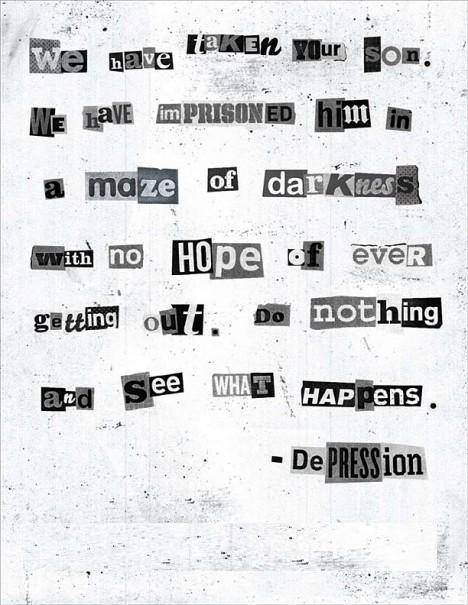
The Ransom Note

depression-note

“We collapse in the dust,
    lying face down in the dirt.
26 Rise up! Help us!
    Ransom us because of your unfailing love.”

Psalm 44:25-26, NLT

“For even the Son of Man came not to be served but to serve others and to give his life as a ransom for many.”

Mark 10:45

“God chose him as your ransom long before the world began, but he has now revealed him to you in these last days.”

1 Peter 1:20

I think that God has more or less ransacked the human language in His effort to get through to us the critical nature of what exactly has been done just for us. When it comes to our salvation and what that means to the universe, the word, “ransom” is used.

The connection for us, as we consider the implications, has mainly a connection with the crime of “kidnapping.” This is when someone is captured by other men, and held in captivity until certain terms are met. When the kidnapper feels his needs are fully met, then the hostage is released.

In the Bible sense, we should work through several verses. There are at least three Hebrew words. In the N.T. Greek just a single word to explain “ransom” is seen. And yet we can say, each word is linked back to the idea of being “helpless.” And helpless is far more than a definition, rather it is a description of a “state of being.”

We come to understand that helplessness is the natural state of human beings. We each have been captured, taken away and are being held, until terms are met for our release. I suppose that some see this helplessness easier than others. (And I’m sure a few will never acknowledge it at all). But nevertheless, it is real and it describes every single person that has ever lived.

Being completely helpless is hardly a situation we would ever choose. Having ransom demands being made to set us free is mostly awkward. And it’s an affront. Perhaps, we feel we are worth more? But the issues here are eternal, and currency concepts are never the consideration.

But there is a present need, to purchase back those who are being held as captives. The absolute clear position is that the Lord Jesus Christ, died in our place. Choosing to die for us, he was essentially tortured before his cruel death. In this decision, he himself paid my ransom. In doing this, I was set free and fully able to return home.

There are many who have been free. But there is a thing called “the Stockholm Syndrome.” This refers to those in captivity who somehow “connect” with their kidnappers through a prolonged captivity. This is to the point where they begin to act less than the victims, and more like the captor. It is confusing. They seem to go out of their way to act “pro-kidnapper”. This can get very disturbing.

We must look to our children, and closest family and our friends. They are toiling for Satan, the captor of our souls (past-tense). Many different tactics are being used– depression, addictions, lust, greed, anger, gluttony, pride, guilt and many other deceitful things. They are being held, until faith (the key) “springs” them out of their prison.

Thank you Jesus, for coming to free us. Thank you for forgiving us. We have been released, and now walk away free. You died, so we might live. We desperately want to see the others we love set free.

*

ybic, Bryan

 

cropped-christiangraffiti1 (3)

*

An Armored Response

tank-wallpapers-8

When the Holy Spirit talks we listen. What He shares is usually pretty relevant, and typically mandates our action. He is into change, and guides us into Christlikeness.

In my prayer time I saw a man climbing into the turret of a tank. He was sheltered there, protected by the tank’s armor. He seemed to be discovering the capabilities of the tank. He slowly began to grasp the potential of it, and soon began to turn the massive gun. He played around, not so much as a soldier, but as a child would. It was fun to spin the turret around. He could go places on its tracks. He could run over trees.

But slowly he realized that this was much more than a shelter, but it was an offense weapon as well. The tank could be quite formidable, as well as safe and secure. Surrounded by the armor, he at last began to understand exactly what this tank was capable of, and his role as driver/gunner. Using the gun, he could go up against enemy strongholds.

We come into a certain maturity when we begin to obey. God-given tasks become a joy. We start to see not just the defensive perspective, but the offensive as well. God’s ability is given to anyone who asks. His power can’t be diminished. He alone is the force to be reckoned with.

We are often stunted by our vision, we simply don’t grasp the enormity of what has been given to us.

I also pray that you will understand the incredible greatness of God’s power for us who believe him. This is the same mighty power that raised Christ from the dead,”

Ephesians 1:18-19

“For the Kingdom of God is not just a lot of talk; it is living by God’s power.”

1 Corinthians 4:20

1brobry-sig4

cropped-christiangraffiti1 (1)

Good Medicine

medicine

“A joyful heart is good medicine,
    but a crushed spirit dries up the bones.”

Proverbs 17:22, ESV

We have from ‘King Solomon’s mines’ a truth regarding joy. Whether we acknowledge its truth, or not, we find its effects on us to be binding. “A joyful heart” is like medicine for our souls. There are many issues that afflict us, many things that trouble us. I find within myself a veritable zoo. But there is a sure and ready relief.

“Worry, fear, distrust, care-all are poisonous! joy is balm and healing, and if you will but rejoice, God will give power. He has commanded you to be glad and rejoice, and He never fails to sustain His children in keeping His commandments. Rejoice in the Lord always, He says. This means no matter how sad, how tempted, how sick, how suffering you are, rejoice in the Lord just where you are-and begin this moment. The joy of the Lord is the strength of our body, The gladness of Jesus, the balm for our pain, His life and His fullness, our fountain of healing, His joy, our elixir for body and brain.”

A.B. Simpson


For those among us who struggle so, we find a  treatment plan that will work. There is an active ingredient within a joyful heart that heals and protects our souls. Real joy— applied frequently to our aching souls— provides something quite  like medicine to someone quite ill. I’m no snake oil salesman. Nor am I into herbs and vitamins. (I suppose I could be a little more aware.) But I know that this principle is true.

“A crushed spirit dries up the bones.” We know first-hand that this is true. There is a ‘crushing’ wound that can breakdown our spirits and bodies. We are simply overwhelmed by life and we experience a crumbling and mashing of our personalities. We are as sick in our ‘bones’ as we might be physically. Now there is a huge difference between a physical illness and a spiritual one, but the factual principles are the same. The pain is different, but is it not similar?

A joyful heart is the pharmaceutical of choice for treating diseases of the personality and spirit. Sometimes we are unwell because we ignore the prescription.  “The joy of the Lord is your strength.”  (Nehemiah 8:10) Joy in the deepest part of us is almost always:

  1. transforming,
  2. God-honoring, and
  3. contagious.

If this is true, then we do well to ‘give it a whirl.’

“The joyless Christian reveals himself by having negative thoughts and talk about others, in a lack of concern for others welfare, and a failure to intercede on others behalf. Joyless believers are self-centered, selfish, proud, and often vengeful and their self-centeredness inevitably manifests itself in prayerlessness.”

John MacArthur

bry-signat (1)

cropped-christiangraffiti1.jpg