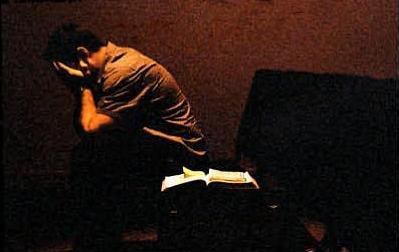
Make the Decision to Be Weak


Our society has pretty much embraced the American cultural icon of the cowboy.  We revere those who ride alone and hard. We are rugged individualists and hardened men making our own way.  Our society reflects this in subdued ways.  No matter what happens, we are fiercely free and independent.  We are ‘desperadoes’–we do whatever we think is best.

John Wayne, the ‘Alamo,’ and the biker with his Harley-Davidson on Route 66 have been our inspiration.  Each are distinctly heroic and carry our hopes and dreams.

We must understand that the Bible is not an American book.

It belongs to every tribe, race, and nation. 

A cowboy did not die for our sins (which are countless).  The way of discipleship does not take us through Luckenbach, Texas. We’re not desperados. We are Jesus’ disciples.

His Words to us are bold and entirely challenging in an amazingly fresh and different direction.  We are told to wash feet, to repeatedly turn the other cheek, to surrender all our rights, and then take the lowest place there is in every situation.

Our lives truly begin when we come under the Lordship of Jesus Christ.

Humility is to become the way we think and how we act, we have become slaves to righteousness.  Our vaunted independence has been toppled. This selfish crown has slipped. My willfulness still wants to stand instead of kneeling. We discover this has been the truth all along.  We have never ever been in control. 

He has been the King since before time, and will always be, for an eternity.

“Many Christians have what we might call a “cultural holiness”. They adapt to the character and behavior pattern of Christians around them. As the Christian culture around them is more or less holy, so these Christians are more or less holy. But God has not called us to be like those around us.

He has called us to be like Himself. Holiness is nothing less than conformity to the character of God”.

Jerry Bridges

Our churches often struggle over our personal issues of pride and stubbornness. 

I pose the following questions.  Are we honestly in a condition of being weak?  Can you serve with a basin and towel?  Is your heart that of a child? Do we see the world through the ‘lens’ of a soft and broken spirit?

I write these things surveying my own life. 

Self will and my hard heart fit ‘hand-and-glove’ with being that desperado.  I ride alone, making my own way, and I don’t make any disciples. I jettison my cross— my cross of discipleship.  I serve no one, unless it suits me.  Am I His disciple, or am I a man of my own?  Is He my Lord, or have I decided to claim that right for myself?

I only hope I have spoken the truth today. Forgive me if I offended.

“Lord, I am willing to receive what You give, to lack what You withhold, to relinquish what You take, to suffer what You inflict, to be what You require.”  Amen.


I’m Tethered to His Cross

We live in this place.

St. Francis of  Assisi once wrote, “The devil never rejoices more than when he robs a servant of God of the peace of God.” 

Sometimes I think maybe I’ve made the devil dance far too many times.

I confess that peace has never been really high on my list. Love, joy, kindness, and even goodness are clear priorities. Peace… not so much. Until it’s not there. And then I get frantic by its absence and look for it with manic bewilderment.

Sometimes I don’t understand why God still loves me. At times like this anxiety eats at me. I beat myself up by my last failure. The guilt of my latest sin grows until it looms larger than the blood that saved me. Sometimes I suppose, religious people have the most neurosis.

I’m afraid that we are taking “the present tense’ out of the Gospel. The past tense is far preferable to us as we manage the Christian life. We like to make check marks on our list. Repentance– check. Baptism– check. Bible study– check. I think it gives me a definite feeling of ‘maturity.’

But these matter little without intimacy with Jesus.

I certainly haven’t arrived, and it seems at times I’m still the hideous sinner I always was. I cannot pretend otherwise, even with a truckload of cosmetics at my disposal. I know, I’ve tried. And I’m still ‘ugly.’ I do know forgiveness, and I do walk in its wonderful light (by grace.)

I read Luther 30 years ago. (And Bonhoeffer would say something similar.)

“When our Lord and Master Jesus Christ said, ‘Repent,’ he willed the entire life of believers to be one of repentance.”

Martin Luther

This is the first of his 95 Theses nailed to the door of Wittenburg. There is a present tense here we can’t ignore. I don’t just repent over smoking, beer drinking, fornication, or hypocrisy, once and done. But my entire way of living is to be one of repenting.

Repentance is your key to open up the door of grace.

“All of the Christian life is repentance. Turning from sin and trusting in the good news that Jesus saves sinners aren’t merely a one-time inaugural experience but the daily substance of Christianity. The gospel is for every day and every moment. Repentance is to be the Christian’s continual posture.”

John Piper

Luther’s last words, on his deathbed, was found written on a scrap of paper words, “We are beggars! This is true.” Thirty years before, he was only echoing his first thesis.

It seems dear ones, we are to live at the foot of the cross.

Everyday. Because we desperately need to.

Pastors Who Can Pastor

PASTORING

“The authority by which the Christian leader leads is not power but love, not force but example, not coercion but reasoned persuasion. Leaders have power, but power is safe only in the hands of those who humble themselves to serve.”

    John Stott

I think that most of us fail to get a real grip on what pastoring is all about. And that is spiritually dangerous. Not only do we stunt our pastor’s growth, but we cripple ourselves, and we all flunk some important spiritual lessons. I want to share three basic things (there are more, believe me).

1) Our pastors are sinners.

Surprise! They are just like you and me– definitely not superheroes and certainly not always saintly. They will have their moments and struggles. We really need to understand this to fully receive their gifts. Just knowing this about them, prepares us to receive deeply and sincerely from their ministries.

It seems that their own battles are necessary to do a work of brokenness inside of them. Humility happens inside, and it often happens deep within.

2) Our pastors need to be prayed for.

What they do is probably one of the hardest, most challenging work on planet Earth. Deep down the good pastors know this. But they still wade courageously into the thick of things. Our real prayers can buttress and stabilize their lives. Pastors substantially encounter the darkness and do warfare for us.

Most have a family to pray for, but they also have a Church they must cover too. A local pastor must have solid elders and active intercessors, or they will certainly stumble and fall. Pastors need your grace, not your gripes–prayer, and certainly not your complaints.

(For a background read the story of Moses and his intercessors.)

3) Our pastors must be empowered by the Holy Spirit.

God’s work must be done His way. And the Lord repeatedly insists His leaders be filled with the Spirit. They receive power right from the true source. Again, Jesus, the True Shepherd gives power and wisdom and grace for each singular moment. A good pastor, over time and much prayer– develops discernment and an awareness for his flock. He learns to love them as he watches over them.

Much, much more could be written. There are so many facets to consider. I only want to encourage you to love and honor your pastor. When you do this, it will probably activate his gift, and fresh ministry will become available.

I suppose that the main thing is make sure you find a way to encourage them.

Real work will be done inside of you, and inside your pastor as well.

“Then I will appoint responsible shepherds who will care for them, and they will never be afraid again. Not a single one will be lost or missing. I, the Lord, have spoken!”

Jeremiah 23:4

ybic, Bryan

My own pastor–David and Karen Taylor, CCC, Homer Alaska

Explaining True Humility

“But among you, it will be different. Those who are the greatest among you should take the lowest rank, and the leader should be like a servant.” Luke 22:26, NLT Jesus Christ turned everything upside down. I know of no other teaching that might disturb his disciples as “humility.” I’m sure that they shook their […]

Jesus Christ turned everything upside down. I know of no other teaching that might disturb his disciples as “humility.” I’m sure that they shook their heads and replayed what Jesus had said.

(Maybe they were looking for a loophole?)

This is not something you just “click into place,” and move on to the next thing. Rather it’s a complete overhaul of living as a disciple. Humility is a process, not an event. We will never move beyond it.

“So anyone who becomes as humble as this little child is the greatest in the Kingdom of Heaven.”

Matthew 18:4

We may think children are wonderful, but honestly, they’re hardly the stuff of the Spirit. And then Jesus shows up and we’re suddenly schooled even further. Generally, the attitude of a child can be seen as innocent, simple, kind, eager, curious, relying on others, and enjoying simple things.

As a bonafide broken believer, I find I’m quite consumed with “me.” Life can revolve around me. The awful nature of my depression, my mental illness is I get absorbed with it, and it is all I think about. And I hate this. It isn’t right. It isn’t healthy. It doesn’t honor God.

“If thou wouldst find much favor and peace with God and man, be very low in thine own eyes. Forgive thyself little and others much.”

     Robert Leighton

The following list was written by Mother Teresa. It sheds further light for us. Her discipleship was radically different from mine, and although I have much– I still have very much to learn.

These are the few ways we can practice humility:

  • To accept being slighted, forgotten and disliked.
  • To be kind and gentle even under provocation.
  • Never to stand on one’s dignity.
  • To choose always the hardest.
Mother Teresa, “The Joy in Loving: A Guide to Daily Living”