The Sinning Servant

St Elijah FBol

God responds to our personal falterings in an amazing way. The prophet Elijah had experienced considerable fireworks in his ministry. One could easily dismiss an incident when he failed big time.

“Ahab told Jezebel all that Elijah had done, and how he had killed all the prophets with the sword. 2 Then Jezebel sent a messenger to Elijah, saying, “So may the gods do to me and more also, if I do not make your life as the life of one of them by this time tomorrow.” 3 Then he was afraid, and he arose and ran for his life and came to Beersheba, which belongs to Judah, and left his servant there.”

1 Kings 19:1-3, ESV

Up to this time:

  1. Elijah was coming off Mt. Carmel having witnessed fire from heaven.
  2. The 450 prophets of Baal had been executed.
  3. Rain was coming through his prayer, the long drought was ending.

Things seemed right on track for a nationwide revival. Life was good for Elijah, and for the Kingdom of Israel. “Laissez les bons temps rouler.”

But Queen Jezebel wasn’t about to give up her stranglehold on the kingdom. She threatens Elijah. A messenger is dispatched to him; and Elijah is completely intimidated. He reacts by running as fast as he can to get away. The prophet known for boldness and miracles flees for his life into the wilderness.

What was it about Jezebel that caused such a frantic and irrational move? Why didn’t Elijah’s faith stand this test? He had been in stickier places.

“But he himself went a day’s journey into the wilderness and came and sat down under a broom tree. And he asked that he might die, saying, “It is enough; now, O Lord, take away my life, for I am no better than my fathers.”

1 Kings 19:4

Fear and fatigue were working on Elijah’s mind. This is a fact, if you’re acting unscripturally you will behave irrationally.

God ministers to his sinning servant with a powerful and formidable gentleness. It takes awhile for Elijah to react to this tenderness. But there is a no condemnation, no recrimination, no words of rebuke; all we hear is God’s still small voice. God doesn’t chide, but quietly asks his prophet to consider. All Elijah does is accept a certain grace. That’s it.

“And when Elijah heard it, he wrapped his face in his cloak and went out and stood at the entrance of the cave. And behold, there came a voice to him and said, “What are you doing here, Elijah?” 

1 Kings 19:13

Fear, defeat, and self-pity were real issues for Elijah (the man of God). Scripture tells us that, “Elijah was a man with a nature like ours” (James 5:17). We are not machines, but mere men who falter and trip. That is good to remember.

In 2 Corinthians 12:10 Paul comments, “For when I am weak, then I am strong.” The Gospel is predicated on human weakness and flaws. It reaches us consistently where we need it most. The God of Elijah still whispers to broken hearts.

aabryscript


cropped-christiangraffiti1 (3)

Elijah Had Issues as Well

elijah
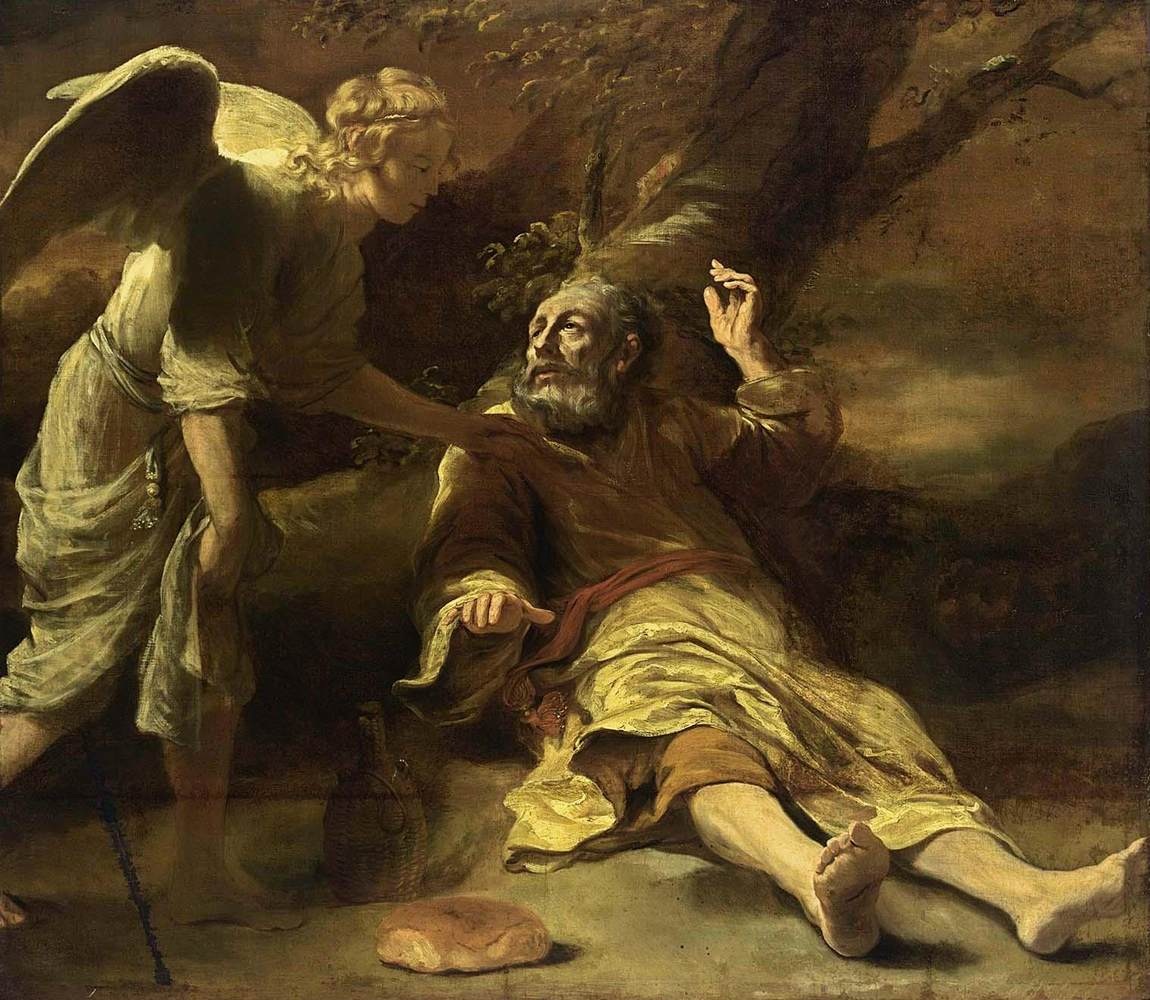
Elijah and the Angel

“Then Elijah walked for a whole day into the desert. He sat down under a bush and asked to die. “I have had enough, Lord,” he prayed. “Let me die. I am no better than my ancestors.”

1 Kings 19:4

Poor Elijah.  He was bold and heroic, taking on the enemy at Mt. Carmel.  A mighty victory was wonderously won, but here he is, completely defeated and overpowered by his own fear and doubt.  How defeated was he?  We hear him begging to be allowed to die.  He had become overwhelmed.

You could say that Elijah was saturated with fear.  He could not resist taking on the conflict.  It seemed to him that everything was now directed at him.  He couldn’t take one step forward.  So, he folded.  Everything was affecting him on a personal level, and he was not built to take the load. Many of God’s children come to this point.

He was shorting out.  His circuits were not designed for this.  He crumbles under the weight.  As we read the text, it all seems to be a bit off.  We shake our heads and wonder about strange Elijah.  We see him incapacitated by his doubt and fear.  But it doesn’t seem to us to be an issue.  The prophets of Baal wouldn’t deceive the Israelites anymore. After all, he had just achieved a fantastic victory that should propel him to the next encounter.

“Elijah was a human being just like us.” –James 5:17

The servants of the Lord are vulnerable.  As we step into the flow of God’s presence we will come “face-to-face “with things that are beyond us.  Often we will find ourselves pushed beyond our limits, backed in a corner and stripped of our weaponry.  Our enemies now turn to face us without fear of reprisal.

Our Father deals gently with a wounded servant.

Elijah had been crippled.  He had nothing more to give.  We can shake our head, and pass him by as a casualty of a spiritual war. But the funny thing is that God tells his story, he has been added to the narrative of scripture.  His falterings, and failings has become our focal point.  Elijah, with all his issues must be faced, and we must look at him.  We see the tenderness and gentleness of God as He deals with His bruised servant. God loves His broken believers. (1 Kings 19:12-13).

His Spirit is oh so gentle.  He comes whispering.  He lifts Elijah at Elijah’s pace.  A painful rebuke, and a harsh word of correction is not in His vocabulary, it is not even considered.  Our Father deals carefully with a wounded servant.  Elijah would go on to serve Jehovah.  Elijah would be a changed man.  God had mended him.

bry-signat (1)

cropped-christiangraffiti1.jpg

Working God’s Night Shift

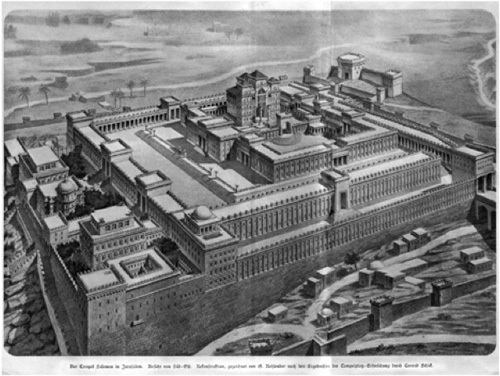
temple-etching
Solomon’s Temple in Jerusalem
A song for going up to worship.

134 “Praise the Lord, all you servants of the Lord,
    you who serve at night in the Temple of the Lord.
Raise your hands in the Temple
    and praise the Lord.

May the Lord bless you from Mount Zion,
    he who made heaven and earth.”

Psalm 134, NCV

This remarkable Psalm is part of an elite group known as “the Psalms of Ascent.” These 15 were sung as the congregation of Israel went up the steps of the temple in Jerusalem. They would sing each in “rounds” with each other. As you can well imagine, this made the ascent slow, but meaningful.

As you read the three verses, I get a picture of worshipers turning back and blessing the Levites. This takes place at the very end of the day. The Levites, and other godly ones who lived in the Temple, (remember Anna and Simeon, in Luke 2?) They were the support staff for the priests.

Commentary

V. 1, “Praise the Lord, all you servants of the Lord,
you who serve at night in the Temple of the Lord.”

The first significant thought is “Lord” mentioned three times. The word is the recognition of someone’s status and standing. We call Him Lord, because He is that (and more).

The second has to deal with the Levitical “night shift.” They served and guarded the Temple during the wee hours of the night. They probably cleaned, stacked wood, sharpened knives and maintained the Holy Place with its needs.

There was no real glory working the night shift. There were no people to serve. The crowds were for the day shift. (Here’s a weird thought– think “Disneyland at 2:00 a.m.”) There was also a contingent of non-Levite people ministering to the Lord as well. They had no duties, and only the priests could serve through their work.

The Levites working at night were not ‘second best.’ At least, not in the eyes of the Holy Spirit. They were integral in both presence and service to the Lord. To despise them is to reveal one’s ignorance. They definitely mattered.

V. 2 “Raise your hands in the Temple
and praise the Lord.”

I’ve worked nights before. It’s a real adjustment. You never feel like you’ve had enough sleep, and it is really hard to be positive and cheerful.  I could get pretty grouchy at times.

But an exhortation is given, a shout and a blessing as the crowds leave. “Raise up your hands– and praise Him!” It is as the work, although necessary, would be secondary. The worship however, was primary. We need to hear that.

V. 3, “May the Lord bless you from Mount Zion,
he who made heaven and earth.”

To be blessed (literally, made “lucky”) by our Creator and Lord is pretty profound. As a kid who read a lot, I think of ‘fairy dust.’ I know better now, but to be blessed by God is deeply significant.

To summarize, I believe this Psalm is speaking of those in the church who are doing “hidden service.” No one sees them really. They go about there duties quietly, and purposefully. The only recognition is from God– who sees all.

I must encourage you to keep on. There are many more than you think who see your hidden ministry to the Father. You are His ‘night shift.’ You’re seen by few, but Him. He knows what you do.

aabryscript

cropped-christiangraffiti1-2

Pressed Roses

“I have said these things to you, that in me you may have peace. In the world you will have tribulation. But take heart; I have overcome the world.”

John 16:33, ESV

This world is not our friend. And then we often face issues that create ugly things–  a fight with a spouse, poor choices, money problems– a lengthy list that seems that we’re always adding new entries. And as we each of us work through our tears, as we face sickness, loneliness, fear and misunderstanding.

In this world of woe and trouble, we discover that life is itself often brutal. Myself, I must deal with clinical depression, paranoia and physical pain. It is constant, a barrage of challenging things. Sometimes they swallow me up, and I lose my way.

I was thinking this morning, of a recent find in the pages of an old book– pressed rose petals! The book had been many years on the shelf. When I opened the book they I found them.  Typically, they are fairly well preserved. They still have color and shape. And most of all, they still have a fragrance.

I really don’t know what I’m supposed to do when this happens. Do I just “read” around them, or do I physically remove them? I almost feel that they are sacred or something. Do I find an old jar and store them? But no matter what I do, I always pause and think. Sometimes though, I can even remember the incident that they were given. An anniversary or a birthday maybe? Or sometimes they are given, “just because.”

Two distinct thoughts work in me. I look at the hard, hard things that I have had to process through my past, and present, and most likely, my future. I have to believe, from all that I have read and the preaching I have heard over the years that my pain gets turned into gold (or into roses!) This is exclusively a work of God. The second thought is a little bit harder to think through. But Jesus is the rose. He is the beauty and the fragrance of heaven come to earth.

There is an old fable kept by the believers of the first century; it was said that wherever Jesus stepped while on earth, roses would spring up in His footprints. This is only a legend of course, but that doesn’t mean that it is all false. Some of these stories have more truth in them than we think.


Coming to Him is such pleasant thing. It shouldn’t be an agonizing ordeal. It is not a painful or real sacrifice. After all, He is the rose. Roses are beautiful, they have a definite fragrance. There is a symmetry to them, and they are special, people will cultivate them for their beauty. Roses are never a hassle, for some reason we can never send or get too many.

“I am the rose of Sharon, a lily of the valleys.”

Songs 2:1, ESV

“A discipleship without flowers, probably isn’t worth having.”

cropped-christiangraffiti1 (2)