Blind From Birth

John 9:1-7

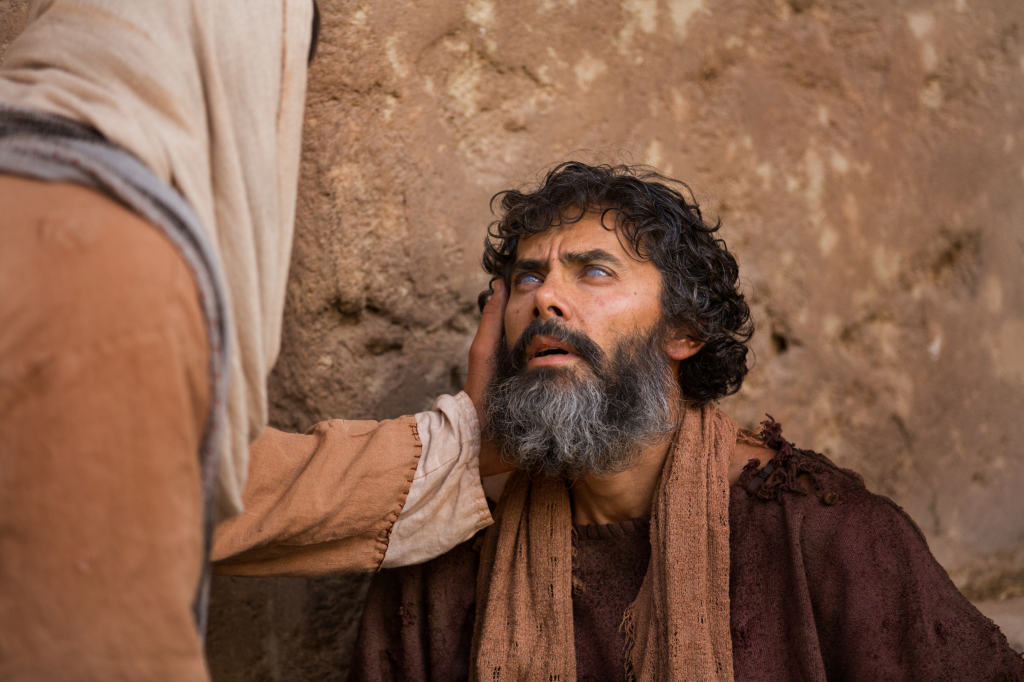
As he was walking along, he saw a man blind from birth.

“Master,” his disciples asked him, “why was this man born blind? Was it a result of his own sins or those of his parents?”

“Neither,” Jesus answered. “But to demonstrate the power of God. All of us must quickly carry out the tasks assigned us by the one who sent me, for there is little time left before the night falls and all work comes to an end. But while I am still here in the world, I give it my light.”

Then he spat on the ground and made mud from the spittle and smoothed the mud over the blind man’s eyes, and told him, “Go and wash in the Pool of Siloam” (the word Siloam means “Sent”). So the man went where nd washed and came back seeing!

Up to now I’ve tried to approach these posts from the first person viewpoint. Ihoped to understand those who met face-to-face with Jesus. I wanted to grasp what they were seeing through their own eyes. But I intend with this post to revert back to a more traditional approach to this passage.

First, we’re introduced to a man who is blind from birth.

I can’t even imagine what that would be like (just as he probably could imagine having sight). I’ve been told that he probably didn’t have a “dream” life–that requires having seen images (a dog, a tree, a mean person) and this wasn’t available to him. He never saw the color red, or seen a mountain. (He didn’t have the circuitry.)

I suppose we can only imagine what blindness like this would be.

Somehow I’ve come to an idea that this represents fallen men–we’re spiritually blind to the workings and truths of Jesus’ Kingdom. It seems a pretty good explanation of each of us–“blind from birth.”

Secondly, notice the response of the disciples who first met this unfortunate man. They don’t see his needs, rather they want to know the theology behind this. Perhaps that’s how we respond much of the time–we don’t see the needs, we only want to know the reasons. We’re not wise or discerning enough to see what’s going on–in short we’re not equipped to love or show mercy. (We haven’t got the circuitry.)

Perhaps this is how we operate as immature Christians.

We don’t engage the need, but rather we like having great theology over understanding compassion. If we really don’t love needy people, we miss so much. We don’t ever grow up. It’s easy to philosophize–it’s hard to get down and serve and really love others.

It’s funny but Jesus declares Himself to be the light of the world while speaking to the man who is born blind.

Third, we discover the gentle mercy that Jesus has when He meets needy people. Now the Lord does accommodate His followers, but not at the expense of engaging the need of the moment. Jesus is full of compassion–most especially when He meets broken people–and as His followers, we must grasp this.

Good theology is not the primary calling of Jesus’ followers.

As I mature in Christ I’m learning (slowly) that people are His real focus. He has come, not to theologize or philosophize, but to meet needs! Sure the reasons why become clearer, but that really isn’t Jesus’ primary goal. People are, not having impeccable theology.

Classes in systematic theology are good, but soup kitchens are better.

The miracle happens, and Jesus’ love and desire to restore this man is ‘front and center.’ The Lord’s methodology is interesting. Spit and mud, wiped on the blind man’s eyes. In Genesis we discover that God made man out of dirt and dust of the ground. Perhaps what He’s doing here mirrors that work.

And it’s also important to understand that Jesus never performs the exact same healing in the exact same way. For some reason He ‘tailors’ His work to the individuals deepest need. I suppose He doesn’t want us to grab a hold of a formula, as that’s what we want to have.

The story is primarily about a blind man’s healing.

It’s not theology, and it certainly isn’t about what is proper and acceptable. We really must understand this, and we really need to understand the tremendous mercy and power of God to both heal and restore.

Image: MCCC. Text from the “Living Bible,” published by Tyndale House

Standing With Her in the Rain

standingaloneintherain1

“Share each other’s burdens, and in this way obey the law of Christ.”

Galatians 6:2, NLT

By Lisa Schubert, Guest Author

Samantha issued commands to the person on the other end of the line. When she hung up, the rant continued against our church, our staff, the weather, and this meal that would serve as her Thanksgiving dinner. I had to let her go mid-rant, but not before reminding her that I would keep her in my prayers.

Samantha approached me outside the church on Thanksgiving morning with her hair disheveled and her coat covered with dirt smudges and raindrops. She demanded to borrow my cell phone to find if the Thanksgiving dinner she had requested from a charitable organization would be ready for pick-up in an hour. I was in a hurry. I needed to be inside preparing to lead worship. I begrudgingly let her borrow my phone, but I insisted on dialing the number myself and standing with her in the gentle rain.

Cross-in-the-Rain-

My encounters with Samantha have continued over the past few months. She’s almost always confused, angry, and paranoid. She tells stories about growing up with another member of our staff, who never met her until recently. It’s hard to know how to respond to Samantha.

A friend called me recently to ask if our church had any resources for helping congregations to welcome those who struggle with mental illness. I pointed her in a few directions, including the National Alliance on Mental Illness (NAMI) at www.nami.org. Even as I offered her the information, I felt uneasy. Connecting with those who have mental illnesses is a complex, difficult journey.

It was raining again on Monday when I saw Samantha. She was sitting in the front lobby of the church. She shouted at me as I walked out the door, “Be careful out there! Two guys tried to kidnap me, and I wouldn’t want that to happen to you.” Unwilling to believe her, I replied, “Samantha, I’m sorry you had a rough morning. I’ll be thinking of you. Hope your day gets better.” I continued out the church doors and opened my umbrella.

I later discovered that Samantha was mugged that morning. Thankfully, the police believed her while I had blown her off. They arrested the alleged perpetrators that afternoon.

I’m embarrassed by my lack of gentleness and compassion toward Samantha, and I know I’m not alone. I wonder what it means for the Church to embrace, accept and listen to those who have mental illnesses. I wonder how church leaders like myself can grow and help others to deepen their care for people like Samantha.

There are no simple answers, but I think the answer starts in a simple place:

We stand with them in the rain.

Lisa Schubert is Associate Pastor of Discipleship and Formation of North United Methodist Church, Indianapolis.

A Friend of Sinners and the Ungodly

Anthony van Dyck – Christ Healing the Paralytic, 1619

“No matter how low down you are; no matter what your disposition has been; you may be low in your thoughts, words, and actions; you may be selfish; your heart may be overflowing with corruption and wickedness; yet Jesus will have compassion upon you. He will speak comforting words to you; not treat you coldly or spurn you, as perhaps those of earth would, but will speak tender words, and words of love and affection and kindness. Just come at once. He is a faithful friend – a friend that sticketh closer than a brother.”

–D.L. Moody

“The Son of Man has come eating and drinking, and you say, ‘Look at him! A glutton and a drunkard, a friend of tax collectors and sinners!’”

Luke 7:34

Bethesda, 31 A.D.

healing-the-lame

“Afterward Jesus returned to Jerusalem for one of the Jewish holy days. Inside the city, near the Sheep Gate, was the pool of Bethesda, with five covered porches. Crowds of sick people—blind, lame, or paralyzed—lay on the porches.One of the men lying there had been sick for thirty-eight years. When Jesus saw him and knew he had been ill for a long time, he asked him,“Would you like to get well?”

“I can’t, sir,” the sick man said, “for I have no one to put me into the pool when the water bubbles up. Someone else always gets there ahead of me.”

Jesus told him, “Stand up, pick up your mat, and walk!”

Instantly, the man was healed! He rolled up his sleeping mat and began walking! But this miracle happened on the Sabbath,

John 5:1-9, NLT

We were following Jesus and He led us to the pool of Bethesda. A crowd gathered quickly, but I jostled myself right up front. We stood waiting, we pretty much knew something big was going to happen. And it did. I can never be the same, after what I saw. This is my simple story.

So much was happening, and as I watched I realized that so much escapes me. I can’t take it all in. But when I decide to watch Jesus, I quickly become aware of what is important, what is real. It starts to make sense. The chaos of the moment becomes calm. At least it does when He takes charge.

There were hundreds of sick people camped out. They are laying under the roofs, with their thin mats. The smell alone was really bad, all were unwashed and some with putrid and festering sores. Dirty bandages are used over and over, and shared with all.

Finally, all are watching Jesus, they become quiet wondering what He will say. We’re all pretty curious. We see Jesus as He walks directly into this ugly field of suffering people. He doesn’t hesitate or flinch.

It is almost like He is at home in this dreadful place.

Just to have a religious teacher visit Bethesda is rare. They never come. And today is the Sabbath (and a special feast day at that) and that alone makes it impossible. And yet Jesus is here, and that somehow is wonderful.

Jesus stops to talk with a man who is an ‘old-timer’ here in this horrible place of pain. This man had been sitting here for almost 40 years, and that is a long, long time. Jesus speaks. “Do you want to get well?” Jesus waits quietly.

“Sir, when the water is stirred, I don’t have anybody to put me in the pool. By the time I get there, somebody else is already in.” The man explains. He has an excuse that seems like a reason. Nothing has ever gone right– ‘I always miss out, and I can’t find anyone to help me.’ And I suppose that this is the world of the blind, the crippled, the paralyzed in Israel. They are confined to Bethesda, with the weak hope of finally being healed. I don’t think that this is how it was meant to work.

This man was horribly discouraged.  It was then Jesus said, “Get up, take your bedroll, start walking.” And this very crippled man was healed on the spot. No ‘hocus-pocus’, no incantations, no magic dust or rubbing of sacred bones. Nothing.

He was healed by a few spoken words.

I cannot emphasize my own astonishment enough. It shook all of us to the core. We were all stunned, and undone. The crowds, and all the sick and the paralyzed just stopped and stared. There are so few moments in life, just like this. We just looked at each other sort of stunned.

The ramifications of what we all had witnessed were staggering. Shocked, we turned to each other, and a great fear fell on us like a heavy blanket. The crowd did not disperse, we were completely shocked, and pretty much speechless.

For years that sense of awe has never left me.

I don’t really listen to the scorners anymore– they simply have no idea. It completely changed my life. I was never the same after that.

“For the Son of Man came to seek and save those who are lost.”

Luke 19:10

Kyrie elesion,  (Lord, have mercy on us.)

Bryan
 cropped-christiangraffiti1 (1)