A Permanent Slave

Body piercing is now acceptable: noses, tongues, and eye brows are the most common. There is another type of piercing, first seen in Deuteronomy 15.  

In Deuteronomy we read of slaves who are set free by their master, having served six years of service, and if they loved and were loved by their master, they could choose to remain a slave to him. 

Deuteronomy 15:12-18 

This was a decision that required elders to act as witnesses.  It was significant as well as completely binding.  I like to think of the ceremony to be kind of a cross between a wedding and a circumcision. (Sounds fun, huh?!) 

The slave would be led to a doorpost, and the master would take an awl, and push it through his ear lobe.  This designated the slave to be forever “owned” by a specific master.  Herein lies a truth, a picture of a consecrated Christian. 

Many times, in the New Testament we are called to be servants (slaves) of Christ. Peter, Paul, James, and Jude referred to themselves as “bond servants of Jesus Christ” in their epistles. This is not forced servitude. It’s a choice made in love! 

There are many believers who have done the same; they have fallen in love with their Savior.  They do not plan on life apart from Him.  So spiritually they have gone to the doorpost, the awl is pushed through their ear, and they are marked from that point on. 

Although the ear was pierced physically in the Old Testament, a different kind of piercing takes place in the New Testament. It is “spiritual piercing.” In Romans 6:16 we read, 

Romans 6:16 

 When the prodigal son returned home from the far country he fell before his father and humbly ask, “make me your servant.” (Luke 15:19,21) He, in essence, was saying to the father, “pierce my ear.” The father made him a son, but the attitude of the son’s heart had changed to the heart of a servant. So, it must be with us. 

It is then that we can live a pierced ear life, revealing to all that we are servants of Jesus Christ! 

— Jim Elliot, Missionary and Martyr

Simply Mary at Jesus’ Feet

Mary-Jesus-feet

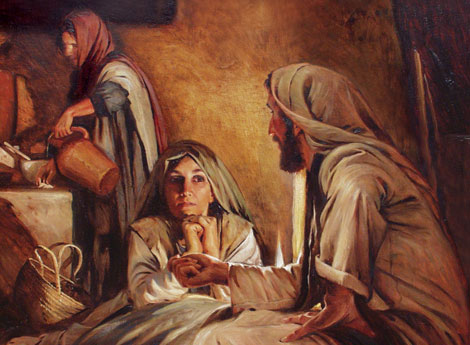
We see Mary three times in the gospels, and each time she is in the same posture — “at Jesus’ feet.” When we have our first glimpse within the Bethany home, we find Martha in her characteristic attitude– working and serving; and Mary we see sitting at the Master’s feet, sitting eagerly and listening to His words.

Our second view of Mary is when Jesus came back to Bethany after the death of Lazarus, and the sisters went out to meet Him. Again, we see her at the feet of Christ. But this time in deep sorrow, seeking comfort. And then we observe her a third time. She has come to anoint the feet of Jesus. We find her again, at Jesus’ feet, and now she is honoring her Lord.

It is her natural posture. I believe that she feels entirely comfortable in this place.  I have personally seen sparrows’ nest on a sheer cliff hundreds of feet straight up, without any apprehension at all. I have been astonished at their daring and simple confidence.  And Mary has this spunk.  She has that certain easy and confident boldness.

Martha, the oldest, obviously has the theology.  We see her taking issue with Jesus, she is questioning, and confronting.  But with Mary it seems, there is a quiet contentment and a rest.  An open readiness to receive. We don’t see that too much, but Mary was a “learner.”  She had become learned in the grace of trusting simply.

She was centered on her Master, He was the focus of her attention.  We dare not minimize this, or try to focus on something less “holy.” This is not something we can easily duplicate, because it proceeds out of a heart that is absorbed in love.  It may appear to be unseemly, and we scratch our head with nervous skepticism.  But it seems whenever Mary comes into the presence of Jesus, she works her way to the front– so she can sit with Jesus. (Interestingly, the Orthodox Church regard Mary to be the first real disciple.)

We have so much to learn from Mary.  Our Christian life can be very shallow and seem rather anemic.  We live in a culture that is racked in intellectualism and pride.  When we engage it we may end up with a bit of haughtiness and a lot of selfishness to deal with.  Mary can be our compass, and our example as we crash through these issues into authentic discipleship.  She really does deserve to be esteemed, and recognized for inspiring us to be with Jesus.

*


Am I Like Peter?

66 After this many of his disciples turned back and no longer walked with him. 67 So Jesus said to the twelve, “Do you want to go away as well?” 68 Simon Peter answered him, “Lord, to whom shall we go? You have the words of eternal life.”

John 6:66-68, ESV

To be an authentic follower of Jesus can be really hard sometimes. There doesn’t seem to be any contingency plan for anyone who is looking to escape. Jesus either is, or He isn’t our Lord. The question is posed daily, “Do you also want to leave?”

That’s a question that will be asked to every disciple–I will hear it every morning for the rest of my life.

These are moments when I must make a decision. Will I take up my cross and go with Him? I’ve looked around and there doesn’t seem to be any room in Jesus’ band for ‘almost’ disciples. But Jesus loves Peter, and Jesus loves me. I believe this.

Being obedient to Jesus is far from easy these days. Today’s cross is waiting for me as my feet hit the floor each morning. I’m afraid at times that I won’t be able to take the next step as a true follower. Am I just fooling myself? Will Jesus keep helping and holding me? (Matthew 11:28-30.)

All of heaven seems to stand on tiptoe to watch and see what I’m going to do next.

“The question in salvation is not whether Jesus is Lord, but whether we are submissive to His lordship.”

John MacArthur

“Whom have I in heaven but you? I desire you more than anything on earth.”

Psalm 73:25, NLT

The Prodigal Son of the Old Testament

God’s temple was now filled with an evil darkness. King Manasseh made the Lord’s holy place a fountain of sin and filth. Instead of holiness, it was an evil place.

He brought in dark things that were twisted, perverted and clearly forbidden.

“Manasseh led Judah and the inhabitants of Jerusalem astray, to do more evil than the nations whom the Lord destroyed before the people of Israel.”

2 Chronicles 33:9, ESV

His own darkness was now encouraged by others, it became accessible, available and promoted:

  • The high places were rebuilt throughout the land.
  • Altars to Baal rebuilt, using images of wood.
  • In the holy temple, altars to the “starry host,” astrology, plain and simple.
  • Human sacrifice of his own sons to Molech, a false god. Murder.
  • He practiced soothsaying, used witchcraft and sorcery, and consulted mediums and spiritists.

Evil was being encouraged and something wicked was replacing all that was good and true. The analysis of Manasseh’s policies was way beyond disturbing. Of all the kings of Judah, he was the most sinful and the most corrupt. He was at the bottom of the barrel.

The Hebrew word for “led astray” can be translated seduced.

Manasseh was an incredibly immoral man, a king who ruled for 40 years. “He did all he could to pervert the national character, and totally destroy the worship of the true God; and he succeeded.” (Clarke)

It’s believed that he put Isaiah to death by cutting him in two.

Moreover Manasseh shed very much innocent blood, till he had filled Jerusalem from one end to another, besides his sin by which he made Judah sin, in doing evil in the sight of the LORD.

1 Kings 21:16

But then something happened.

And the LORD spoke to Manasseh and his people, but they would not listen. Therefore the LORD brought upon them the captains of the army of the king of Assyria, who took Manasseh with hooks, bound him with bronze fetters, and carried him off to Babylon.

2 Chronicles 33:10-11

Assyria came knocking on Manasseh’s door. I think there was a certain mercy here, but also discipline. Manasseh had “hooks,” inserted through his jaw and out of his mouth. Like a fish he was led to Babylon, a trophy of the power of the army of Babylon.

It was from a dark dungeon that Manasseh cried out to the Lord and repented.

(2 Chronicles 33:12-13.)

There’s a Jewish fable that when Manasseh cried out to God the angels boarded up the windows in heaven. They wanted to block out his prayer so God wouldn’t be able to hear. But God, rich in mercy, bored a hole in front of His throne to hear Manasseh’s desperate cry.

The Lord’s intention was to forever show His kindness and grace given to the most awful repentant sinner.

I believe that Manasseh was the “Prodigal Son” of the Old Testament.

God is not at a loss when He moves to bring us back to Himself. He can woo or whip. He can draw or drive. He can work rapidly or slowly, as He pleases. In other words, He is free to be God! And in His own way, at His own pace, He brings us back.

     Tom Wells

God is wildly in love with you. Yes, the sin you’ve committed is awful, but the Lord wants you to come back. He may discipline you, but He forgives everything if you’ll turn and repent.

No matter how awful your sin, He forgives and restores. Manasseh is proof of that.

Sources:

2 Chronicles 33:1-20

2 Kings 21:1-18

Enduring Word commentary