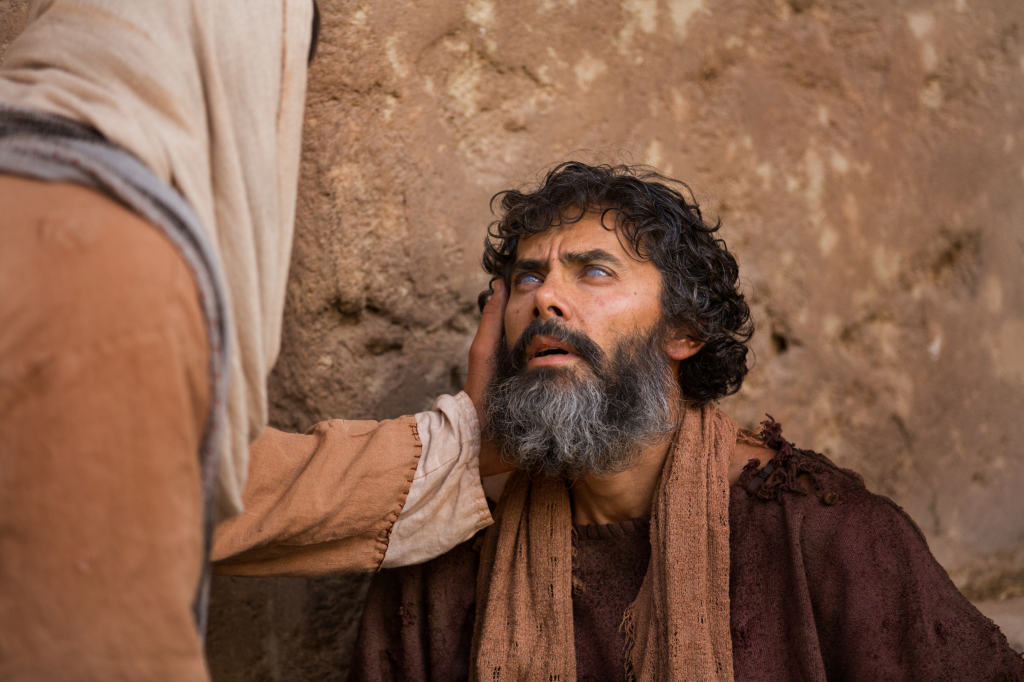
Blind From Birth

John 9:1-7

As he was walking along, he saw a man blind from birth.

“Master,” his disciples asked him, “why was this man born blind? Was it a result of his own sins or those of his parents?”

“Neither,” Jesus answered. “But to demonstrate the power of God. All of us must quickly carry out the tasks assigned us by the one who sent me, for there is little time left before the night falls and all work comes to an end. But while I am still here in the world, I give it my light.”

Then he spat on the ground and made mud from the spittle and smoothed the mud over the blind man’s eyes, and told him, “Go and wash in the Pool of Siloam” (the word Siloam means “Sent”). So the man went where nd washed and came back seeing!

Up to now I’ve tried to approach these posts from the first person viewpoint. Ihoped to understand those who met face-to-face with Jesus. I wanted to grasp what they were seeing through their own eyes. But I intend with this post to revert back to a more traditional approach to this passage.

First, we’re introduced to a man who is blind from birth.

I can’t even imagine what that would be like (just as he probably could imagine having sight). I’ve been told that he probably didn’t have a “dream” life–that requires having seen images (a dog, a tree, a mean person) and this wasn’t available to him. He never saw the color red, or seen a mountain. (He didn’t have the circuitry.)

I suppose we can only imagine what blindness like this would be.

Somehow I’ve come to an idea that this represents fallen men–we’re spiritually blind to the workings and truths of Jesus’ Kingdom. It seems a pretty good explanation of each of us–“blind from birth.”

Secondly, notice the response of the disciples who first met this unfortunate man. They don’t see his needs, rather they want to know the theology behind this. Perhaps that’s how we respond much of the time–we don’t see the needs, we only want to know the reasons. We’re not wise or discerning enough to see what’s going on–in short we’re not equipped to love or show mercy. (We haven’t got the circuitry.)

Perhaps this is how we operate as immature Christians.

We don’t engage the need, but rather we like having great theology over understanding compassion. If we really don’t love needy people, we miss so much. We don’t ever grow up. It’s easy to philosophize–it’s hard to get down and serve and really love others.

It’s funny but Jesus declares Himself to be the light of the world while speaking to the man who is born blind.

Third, we discover the gentle mercy that Jesus has when He meets needy people. Now the Lord does accommodate His followers, but not at the expense of engaging the need of the moment. Jesus is full of compassion–most especially when He meets broken people–and as His followers, we must grasp this.

Good theology is not the primary calling of Jesus’ followers.

As I mature in Christ I’m learning (slowly) that people are His real focus. He has come, not to theologize or philosophize, but to meet needs! Sure the reasons why become clearer, but that really isn’t Jesus’ primary goal. People are, not having impeccable theology.

Classes in systematic theology are good, but soup kitchens are better.

The miracle happens, and Jesus’ love and desire to restore this man is ‘front and center.’ The Lord’s methodology is interesting. Spit and mud, wiped on the blind man’s eyes. In Genesis we discover that God made man out of dirt and dust of the ground. Perhaps what He’s doing here mirrors that work.

And it’s also important to understand that Jesus never performs the exact same healing in the exact same way. For some reason He ‘tailors’ His work to the individuals deepest need. I suppose He doesn’t want us to grab a hold of a formula, as that’s what we want to have.

The story is primarily about a blind man’s healing.

It’s not theology, and it certainly isn’t about what is proper and acceptable. We really must understand this, and we really need to understand the tremendous mercy and power of God to both heal and restore.

Image: MCCC. Text from the “Living Bible,” published by Tyndale House

“Go and Learn” [Discipleship]


“When Jesus heard this, he said, “Healthy people don’t need a doctor—sick people do.” 13 Then he added, “Now go and learn the meaning of this Scripture: ‘I want you to show mercy, not offer sacrifices.’ 

“For I have come to call not those who think they are righteous, but those who know they are sinners.”

Matthew 9:12-13

This passage can be a bit of a challenge. But these two verses fit together like an old watch mechanism, small gears and wheels in precise motion, keeping time in a treasured grace.  My father had an old one, used once by a train conductor.  It was made of gold, and had been used for almost 100 years.

The complexity of these verses were never meant to confuse the disciples.  But for them it is simple, to go and learn.”  Certainly, there are times we will be ‘schooled’ in what we learn.  And really the only way to approach this is in humility.  Trying to extract the truth will take patience and a broken heart.

Jesus states the truth of being a doctor, and there is a singular work that a doctor does.  It is serving all who come to him with sickness or injury.  Jesus clarifies a truth that has to be in place.

“Go and learn what the Scriptures mean when they say, `Instead of offering sacrifices to me, I want you to be merciful to others.’ I didn’t come to invite good people to be my followers. I came to invite sinners.” v.13, CEV

“Go and learn!” This implies that there are lessons for us, classes that we need to take in order to grow-up, how to touch sick and desperate people.  Funny, but it’s all about mercy, and nothing to do with “sacrifices.”  Mercy is what matters. I want you to be merciful to others.”

I admit that I’d rather be right than to be merciful. (It’s good to be both.)  But mercy– and gentleness should be our driving impulse.  These attitudes assist us to move us forward. “Go and learn.”

The last verse reveals the thinking that Jesus has.  He has come to help those of us in trouble.  The good people don’t understand, after all, isn’t their ‘sparkly goodness’ enough?  As his disciples, we share our faith to all; but maybe we should consider the weak, poor and the sick already prepared for the words of Jesus? “Go and learn.”

“Discipleship is a lifelong process and journey rooted in a relationship with Jesus, whereby we become more like Christ.”

Greg Atkinson

1brobry-sig4


cropped-christiangraffiti1 (1)

(

Standing With Her in the Rain

standingaloneintherain1

“Share each other’s burdens, and in this way obey the law of Christ.”

Galatians 6:2, NLT

By Lisa Schubert, Guest Author

Samantha issued commands to the person on the other end of the line. When she hung up, the rant continued against our church, our staff, the weather, and this meal that would serve as her Thanksgiving dinner. I had to let her go mid-rant, but not before reminding her that I would keep her in my prayers.

Samantha approached me outside the church on Thanksgiving morning with her hair disheveled and her coat covered with dirt smudges and raindrops. She demanded to borrow my cell phone to find if the Thanksgiving dinner she had requested from a charitable organization would be ready for pick-up in an hour. I was in a hurry. I needed to be inside preparing to lead worship. I begrudgingly let her borrow my phone, but I insisted on dialing the number myself and standing with her in the gentle rain.

Cross-in-the-Rain-

My encounters with Samantha have continued over the past few months. She’s almost always confused, angry, and paranoid. She tells stories about growing up with another member of our staff, who never met her until recently. It’s hard to know how to respond to Samantha.

A friend called me recently to ask if our church had any resources for helping congregations to welcome those who struggle with mental illness. I pointed her in a few directions, including the National Alliance on Mental Illness (NAMI) at www.nami.org. Even as I offered her the information, I felt uneasy. Connecting with those who have mental illnesses is a complex, difficult journey.

It was raining again on Monday when I saw Samantha. She was sitting in the front lobby of the church. She shouted at me as I walked out the door, “Be careful out there! Two guys tried to kidnap me, and I wouldn’t want that to happen to you.” Unwilling to believe her, I replied, “Samantha, I’m sorry you had a rough morning. I’ll be thinking of you. Hope your day gets better.” I continued out the church doors and opened my umbrella.

I later discovered that Samantha was mugged that morning. Thankfully, the police believed her while I had blown her off. They arrested the alleged perpetrators that afternoon.

I’m embarrassed by my lack of gentleness and compassion toward Samantha, and I know I’m not alone. I wonder what it means for the Church to embrace, accept and listen to those who have mental illnesses. I wonder how church leaders like myself can grow and help others to deepen their care for people like Samantha.

There are no simple answers, but I think the answer starts in a simple place:

We stand with them in the rain.

Lisa Schubert is Associate Pastor of Discipleship and Formation of North United Methodist Church, Indianapolis.

Under Quarantine

quarantine

Quarantines are a real possibility, even to this day. A quarantine is imposed when a disease is contagious enough that it would harm a society: Measles, Smallpox, and the recent COVID-19 are just a few physical diseases where isolation must be imposed.

It can be severe— an epidemic, with desperate consequences if not adhered to; in some rare cases, the use of deadly force has been authorized to maintain a quarantine until the disease is no longer communicable.

This may surprise you, but there are examples of ‘quarantines’ in the Bible.

The term ‘unclean’ was used for ‘leprosy.’ Those afflicted had to isolate themselves; they had to ‘announce’ their presence when in contact with society. Lepers lived in groups away from the general populace, as a result of their disease.

In Paul’s epistle to the Corinthians, he addresses another kind of ‘quarantine.’ The situation was dire; the church had advocated a Christian living with his father’s wife.

“I have already passed judgment on this man in the name of the Lord Jesus. You must call a meeting of the church. I will be present with you in spirit, and so will the power of our Lord Jesus. Then you must throw this man out and hand him over to Satan so that his sinful nature will be destroyed and he himself will be saved on the day the Lord returns.”

1 Corinthians 5:3-5, NLT

Understanding the Principle of Usefulness

Now in a large house, there are not only gold and silver vessels, but also vessels of wood and of earthenware, and some to honor and some to dishonor.”

2 Timothy 2:20, NASB

Found in God’s pantry are lots of pots and pans of various uses.  Paul writes Timothy about the ‘large house’ which is the Church inclusive. Look around Timothy, there are gold ones, and there are silver ones. They have a noble purpose fitting for such a great house. These are the ones the guests will use; they befit the significance of the Lord himself. These vessels have great value for they are made of precious metals.

There are vessels of different categories. These are the ones made of wood, and of clay. These are part of the household, make no mistake about it. But their use is one of function, they’re utilized in common and ignoble ways. (A clay ‘bed-pan’ perhaps?!)

21 “Therefore, if anyone cleanses himself from these things, he will be a vessel for honor, sanctified, useful to the Master, prepared for every good work.”

2 Timothy 2:21

Paul, the author of the New Testament doctrine of grace emphasizes the place of personal holiness. We are to ‘cleanse’ ourselves to become a vessel of honor. There is good news here:

  • All are vessels in the Father’s house. Each of us belongs to Him. He alone determines their use.
  • Things are not yet in their final state. Changes in status can be experienced. In God’s economy, clay pots can become ‘golden.’ Silver can become ‘wood.’

Some sin is contagious.

It affects believers, and the Church becomes compromised by what we’ve done. And then sometimes we are quarantined by the Holy Spirit–until the contagion passes. This spiritual disease must not be permitted.

I have experienced this several times in my own discipleship. These are not pleasant times, but there is no condemnation. I’m still His servant, His love for me stays outrageously constant. He has never turned away a sinning child who repents of their sin.

“Yes, I am His servant, but I must wait out in the hall. I haven’t been faithful. So I sit in His waiting room, waiting for His call. This is for my good. And my Father knows what is best.”