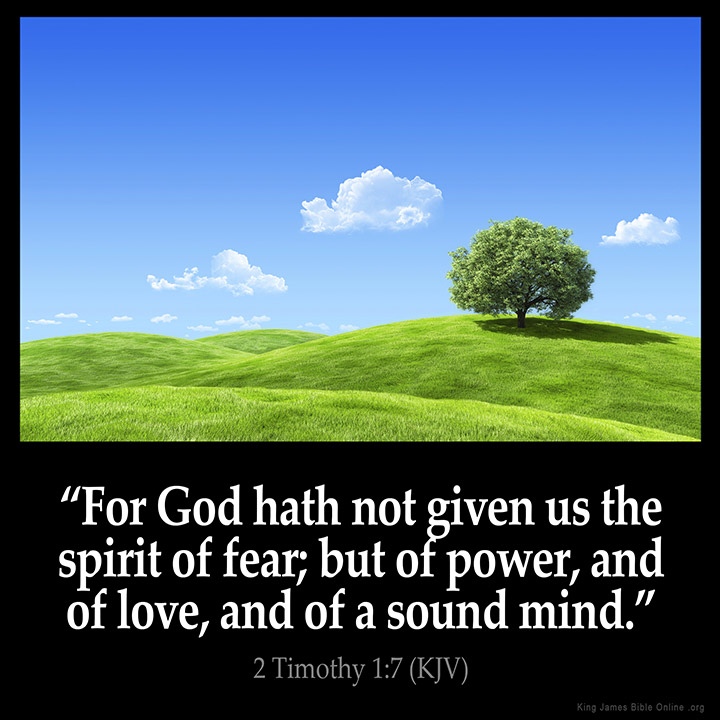
“A sound mind.” For some of us that doesn’t seem remotely possible. We’ve come to believe this is only true for others, maybe, but not me. As mentally ill people we seem to think that we shouldn’t be this way. Given enough time our illness becomes fused to our spirit and soul. We buy the lie and choose to live defeated. Only the Lord Jesus can break this chain.
Healthy thinking is a wonderful gift. That’s important to note. I can’t earn it; nor can I fabricate it. It must be simply acknowledged and received as a bonus. We must come humbly and broken. I suppose that is where we become the happiest and healthiest.
In 1 Timothy 1:7 we’re told that we have a salvation that includes:
incredible power,
love,
and a sound (healthy) mind.
These three are a gift from God. You don’t buy a gift, nor do you earn it. Rather it comes from Someone who loves you (!) and only wants to restore you. We may have issues, but the Spirit is sound and lucid. He speaks so we understand.
Afflicted people will find what they need from the Holy Spirit of God. Mental illness isn’t a death sentence. Rather it’s a grand opportunity for God to teach us about His power in the middle of our pain.
The healthy mind is one that is clear and life-giving. It is without any sick or crippling deficiencies. It’s a mind that is vigorous and robust. Those of us who struggle with a mental illness this is fantastically good news. And it maybe that you’re certainly impaired but even then you’re given a strength to use in service in the body. Everyone has a gift and calling.
There is nothing worse than fighting through muddled thinking when you’re having mental issues. Names, dates and memories disappear in the fog. It can be frightening. I know what it’s like to be afraid of one’s own mind. It seems like it’s trying its best to kill me. (Some of you can ‘read-between-the-lines’ and understand exactly what I am saying.)
My own experience is that the Holy Spirit is working, with my meds, to hold me in a good place. Just as a diabetic must take insulin, so I need to take my antidepressants. The brain is an organ that can get sick also. We live in a fallen and broken world. We are human and therefore vulnerable just like anyone else. (Somehow, we imagine better.)
Grace does heal many, but there are some who will find ‘weakness’ becoming their real strength.
The very presence of the Holy Spirit is what enables. Broken believers are coming to see that their illnesses are helping them to be weak enough for God to use. It’s not how strong you are, but it’s how weak. “It is not that we think we are qualified to do anything on our own. Our qualification comes from God,” 2 Cor. 3:5, NLT.
— Michael Yaconelli
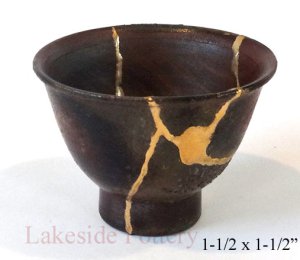
“When the Japanese mend broken objects, they aggrandize the damage by filling the cracks with gold [‘kintsukuroi’]. They believe that when something’s suffered damage and has a history it becomes more beautiful.”
“I waited patiently for the Lord to help me, and he turned to me and heard my cry. 2 He lifted me out of the pit of despair, out of the mud and the mire. He set my feet on solid ground and steadied me as I walked along.”
3″He has given me a new song to sing, a hymn of praise to our God. Many will see what he has done and be amazed. They will put their trust in the Lord.”
Psalms 40:1-3, NLT
Psalm 40 is jam packed with great and wonderful truth. It contains freedom for the Christian– a way out for the broken believer. We do well when we use it, and that’s what it’s there for. The deep pit has been used over many centuries as the way God teaches us to sing certain songs. But that doesn’t make it easier, does it?
Verse 1
I waited patiently for the Lord to help me, and he turned to me and heard my cry.
Waiting is a critical word, it should not be regarded as trivial. In our daily walk we must be patiently seeking the Lord, that comes first. Admitting you need help is the first step. And guess what? You need help. 😁
The word ‘wait’ is special, it’s kawvah in Hebrew. It can mean ‘to bind together by twisting.‘ It can be used with the idea of braiding strands of rope together. It is never a passive act that just happens. Waiting on God is to be done with intentional purpose.
Remember that the Lord is not some distant deity on a hill far away.
He’s not hiding from you. It’s really quite the opposite.
He is closer to you than you think. He is responsive and aware. He hears your cries and wants to act; He is not deaf, but our patience is critical. Waiting on Him is crucial to being free. We must bind and twist our hearts and live our life to His desires.
Verse 2
He lifted me out of the pit of despair, out of the mud and the mire. He set my feet on solid ground and steadied me as I walked along.
The seeable terrain can be awful, with muddy paths and mucky pits. Things that pull you down and suck you in. They’ll trap the traveler. But the Holy Spirit is quite able to lift us out. He picks us up and secures us. He uses the rope of God’s Word.
He is way more willing to save us, than we are to being saved.
Solid ground is where we are meant to be. It’s become a place of firm standing and secure footing. He makes us steady and He keeps us safe. The Holy Spirit now has intimate care over your soul.
Verse 3-4
“He has given me a new song to sing, a hymn of praise to our God.
“Many will see what he has done and be amazed. They will put their trust in the Lord.“
Some of the greatest songs are the ones that come from those just delivered from the pit.
These are ‘pit songs,’ offered to God from sincere and true hearts that have once been trapped. There’s something solid heard from the hearts of those redeemed from disaster.
These songs no longer sound religious or contrived.
“YOU CAN SEE GOD FROM ANYWHERE IF YOUR MIND IS SET TO LOVE AND OBEY HIM.”
A.W. Tozer
From our deepest pits come our greatest praises.
There is a passionate quality that saturates these ‘pit praises’ that is highly treasured by God, and esteemed and valued by the Church– a sense of authenticity starts to be finally heard. We can finally start to see that our pits become ‘launching pads’ of true songs of deliverance.
Here are things I’ve heard over the years that we must take a second look at. Here are some possible answers.
“There must be something wrong with your spiritual life.”
Yes, depression CAN be a result of sin. BUT depression is NOT always a result of sin! If it is, God will tell you loud and clear what the problem is. This saying piles on the guilt for the depressed Christian. It’s unlikely that their depression has a spiritual cause, and this implies that they are not good enough spiritually.
“Repent and ask forgiveness for your sin!”
Depression is a result of sin, in that if there was no sin in the world depression wouldn’t exist. But then, neither would diabetes, cancer, or any other illness… Sin caused the world to be not-perfect, therefore illness exists. It’s a sin to be depressed, any more than it is to have any other illness. Depression can be used by God to encourage repentance, but in that case, it will be crystal clear exactly what sin you should repent of. If you don’t know or have just a vague sense of guilt, your depression is not the result of sin.
“You need to have more faith.” or “Have faith in God.”
Hebrews 11:1, “Now faith is the substance of things hoped for, the evidence of things not seen.” How much faith does it take to hold onto the Christian faith when emotions scream at you daily to give up, get out and turn against God? Very often a depressed Christian will be hanging onto faith by their fingernails in something that requires a ton of faith.
“Taking antidepressants is playing God, He can heal you.”
Yes, God can heal. Sometimes he doesn’t just flick a switch to make the illness vanish, sometimes the healing comes through the conventional ways of doctors, psychiatrists, counselors, therapists, and medication. By persuading someone not to take their medicines in preference for a quick, supernatural healing that God may not have in store for them, the sufferer is being denied something that will help them, right now.
“Scripture says everything that happens is for your own good!”
The actual verse found in Romans 8:28, “And we know that in all things God works for the good of those who love him, who have been called according to his purpose.” This verse in no way implies that the sufferer should sit back and accept the illness for the rest of their life. It also does not say that illnesses are not to be fought with the intention of a cure. While God may well have things to do with a depressed person, the illness is not a good thing itself, and it may take years before you see positive results from it.
“You’ve been prayed for, why has nothing changed?”
This can be expressed in several ways and spoken by one of two different groups of people: either the person who asked for prayer or those who prayed for them. We’ll break the underlying situation into two areas: something definite was experienced in the prayer time: chains were obviously broken and new freedom gained, or, nothing apparently happened at all. That is, “I know God set you free,” why aren’t you free yet?
“Depression is a self-discipline problem.”
Self-discipline is important to a Christian. We have to be disciplined enough not to break the laws of the land, and to obey our God. But no amount of discipline will get rid of a medical problem. This statement implies that the sufferer is lazy and could become better by sheer force of will. This is not possible and causes a lot of guilt.
“You’re depressed because you choose to be.”
Why would anyone choose depression? It is hell on earth. It destroys everything it touches. Families, marriages, jobs, churches, and ministries- faith, peace, hope, and love. Depression corrodes all that it touches.
Does a diabetic or cancer patient choose their disease? Does the blind or the deaf person wake up in the morning and decide they aren’t going to keep being handicapped? These are the questions I would ask.
“You just need to rebuke that spirit of depression and tell it to leave you. Don’t let Satan steal your joy.”
There are two problems with this statement. One problem is the assumption that depression is caused by demonic oppression. The other problem is the assumption that joy and happiness are the same things. Blaming a “spirit of depression” can be a wonderful cop-out. Just cast out the spirit and you’re cured! No need for long-term support, prayer, counseling, or anything at all! And with this statement comes the implicit assumption that once again it’s your fault you’re depressed, this time because you’re not “spiritual” enough to get rid of the troublesome spirit yourself.
Yes, it is possible that demonic oppression can cause depression. No, demons are not responsible for every case of depression. Imagine what would happen if this statement was directed at someone with cancer, hemophilia, or osteoporosis (“Just cast out that demon attacking your bones and be strong again! God wants to see you running marathons!”).
The second problem with this statement is that joy is equated with happiness. People with depression are not going to be the happiest souls in the church. I’ve heard it said that happiness depends on what happens, whereas joy can exist in very unhappy situations.
“There’s no such thing as mental illness, it’s all in your mind”
Saying this denies that there is anything actually wrong with the depressed person, and implies that they are just making it up. This piles on the guilt again! A mental illness can be defined as one that affects the mind; the brain is allowed to get ill, just as the liver and lungs are.
“It’s your own fault you’re depressed”
This is the kind of thing that Job’s “comforters” said, and it didn’t help then either. Bad things can happen to good people. Denying this hurts the sufferer.
“Pull yourself together”
If you’ve been trying, someone saying this to you comes across as “You haven’t been trying hard enough, do more, and more, and more until you get it right.” So back you go, pushing more and more, and still getting nowhere because you cannot pull yourself out of depression by your bootstraps, and you can’t fix a medical problem by force of will.
“Thank you for making me so wonderfully complex! Your workmanship is marvelous—how well I know it.”
Psalm 139:14
“God is not a duplicator, He is a Creator. You are an original.”
-Reinhard Bonnke
The Bible states many wonderful things. One of them is that we are created in the image of God, and I’m quite certain that each of us are shaped completely different. I recently read that an estimated 117 billion people have lived on earth. That’s amazing; and to think we are all unique.
Sometime ago I found my Grandmother’s Bible.
I was somewhat intrigued, and I supposed that it might just ‘impart’ some special spiritual blessing to me. I sat down on the couch, and reverently opened it up. It was filled with wonderful handwritten notes.
As I sat down to read it though, I slowly began to realize that it was exactly like my own! The verses and the promises were the same, they had not changed. What was true for my grandma was true for me. That amazed me, and it kind of sent me spinning. But I suddenly started thinking.
Each of us struggles differently.
We endure depression, PTSD, schizophrenia, even suicidal thoughts. We struggle with different addictions and lonely divorces. There are those believers who are epileptics or disabled. There are some of us who have been raped or molested. I have a paralyzed right arm, and am typing this with my left hand. I also struggle with depression and anger.
Each of us are the same in a basic sense, and yet we are all distinctly different. We all have gone through things, some good, some quite awful. These issues are uniquely our own. Our “personal” testimony with God is unlike someone else’s. We respond to our different circumstances in different ways.
We are “snowflakes’ that have been artistically crafted. Our circumstances are individually tailored by God, who is the ultimate Artist. I opened this post with the idea that God creates “snowflakes,” and I’ve been told that every one of them is unique.
I do believe that when we stand before God we will all have these fantastically different stories. Each of us have found forgiveness, mercy and grace that the Lord freely gives us. As “grace-walkers” our life can be mixed with His love, filtered through a myriad of circumstances.
And they mix exceedingly well.
Reading the Word we must realize that each man or woman who walked with God had a different story to tell. We rightly consider them in amazement. And yet none of them knew they were special at the time, all they understood was “the daily grind.”
We can trust Him. We slowly begin to see, and understand, that there are implications of being ‘snowflakes.’ God took Joseph and ‘molded’ him by His unique circumstances, he went from prison to the Prime Minister overnight. Each of us has testimony of His incredible care.
“People are special, and human life is sacred, whether of not we admit it. Every person is worth fighting for, regardless of whether he is young or old, sick or well, child or adult, born or unborn, or brown, red, yellow, black or white.”