Listening to God’s Voice 101

mastersvoic

“But blessed are your eyes, for they see, and your ears, for they hear.”

Matthew 13:16, ESV

There is a vast audio ocean that surrounds us.  Did you know that in the room where you are reading this, that there are “voices” going on? You just don’t see or hear them unless you have your radio or television tuned in to the right frequency, or they’re just too far away. We live in this golden age of Bluetooth, and cell phones. ( I suppose that they have positives, but also negatives.)

There is a frequency that we must lock into, where we can hear important things (or block-out confusing sounds.) But the Holy Spirit really wants to talk with us.  We soon understand that He wants us to communicate with Him. He yearns for a dialogue with us,  just like He had once a long time ago in the early chapters of Genesis. (Gen. 3:9)

“Prayer is not monologue, but dialogue. Gods voice in response to mine is its most essential part.”

Andrew Murray

Knowing that I’ve been created in His image I can ponder the visible, which is a shadow of the real world. Mankind in general, creates and communicates–this is what we do–because it’s how God acts. After all, we are in His image. Just look at a mountain or an apple tree, in a way they explain God, if we can listen with our hearts. We will hear Him.

He is always speaking, but we’re not always listening.

The attribute of listening is amazingly profound.  Forty years ago, I listened to my local radio station while I’m driving. When I moved away from the radio tower, the signal got weaker and weaker. But if I turned the car around and drive back into town, the signal becomes stronger and I can hear it again.

In the same way, we stop hearing God when we drift away from Him. But if we will turn around and come back to Him, we’ll hear His voice again. The closer we are to God, the clearer we can hear Him. “Draw near to God and He will draw near to you” (James 4:8).

Dear one, if you foster listening to Him you’ll be really hearing, and that is why God created you. Hey. Read your Bible, and ponder a passage, and then prepare to hear Him.
 

1brobry-sig4


His Oil, Your Head

Back by Popular Demand

I have to admit, I always wondered what this verse in Psalm 23 meant. I thought “He anoints my head with oil” was a nice poetic phrase for God blessing David. But as I delved deeper into the context and explored different interpretations, a beautiful and profound meaning unfolded before my eyes.

First of all the act of anointing with oil holds significant cultural and spiritual symbolism in biblical times. It was a practice to anoint guests as a sign of honor and welcome, especially in lavish feasts and celebrations.

Anointing with oil also had medicinal purposes, as it could soothe and heal various ailments. (Now that’s interesting, I thought.)

In the context of Psalm 23, the phrase “He anoints my head with oil” takes on a deeper metaphorical meaning. It signifies God’s abundant blessings, His provision, and His care for His people. Just as a host anoints the head of a guest as an act of honor and hospitality, God lovingly anoints us with blessings and favor.

Moreover, the act of anointing with oil has spiritual connotations. In ancient religious rituals, anointing with oil was a sign of consecration, setting apart someone or something for a holy purpose.

This verse also portrays a practical picture of medicinal shepherding.

In biblical times, shepherds used oil to treat and protect the sheep’s wounds and keep insects away from their heads. By anointing our heads with oil, God brings healing and comfort to our brokenness, soothing our hurts and protecting us from the turmoil of life.

Sheep often can do harmful things to themselves as they try to find relief from flies and ticks.

Their ears and eyes can be targets for tormenting insects as well.

Sheep have been known to bash their heads against rock walls to dislodge flies from their ears, noses, and eyes. A good shepherd watches closely over his flock. He watches over them carefully.

A good shepherd knows that poured out oil forms a barrier of protection against these things that would try to destroy the sheep.

Have you ever asked God to anoint your head with oil?

Psalm 23 as a whole beautifully paints a picture of God as our loving and caring Shepherd, guiding us, providing for us, and protecting us. The imagery of anointing with oil further illuminates the depth of His love and the extent of His care. It reminds us that we are chosen and cherished by God, and that His blessings are abundant and unending.

But ask yourself these questions. Do you have times of mental torment? Do the worrisome thoughts invade your mind over and over? Do you beat your head against a wall trying to stop them?

The Holy Spirit can come with His endless supply of oil!

“You prepare a table before me
    in the presence of my enemies;
you anoint my head with oil;
    my cup overflows.”

Psalm 23:5, ESV

Oh how He loves you!

The Micro and the Macro: An Understanding

10piper
John Piper, Pastor of Bethlehem Baptist Church, Minneapolis. Writer and Speaker, DesiringGod.org

Originally dated, July 14, 2008 | By: John Piper 

One of the reasons God rarely gives micro reasons for his painful providences, but regularly gives magnificent macro reasons, is that there are too many micro reasons for us to manage, namely, millions and millions and millions and millions and millions. God says things like:

  1. These bad things happened to you because I intend to work it together for your good (Romans 8).
  2. These happened so that you would rely more on God who raises the dead (2 Corinthians 1).
  3. This happened so that the gold and silver of your faith would be refined (1 Peter 1).
  4. This thorn is so that the power of Christ would be magnified in your weakness (2 Corinthians 12).

But we can always object that there are other easier ways for God to accomplish those things. We want to know more specifics: Why now? Why this much? Why this often? Why this way? Why these people?

The problem is, we would have to be God to grasp all that God is doing in our problems. In fact, pushing too hard for more detailed explanations from God is a kind of demand that we be God.

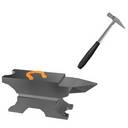
horseshoe-anvil-clipartThink of this, you are a blacksmith making horseshoes. You are hammering on a white hot shoe and it ricochets off and hits you in the leg and burns you. In your haste to tend to your leg you let the shoe alone unfinished. You wonder why God let this happen. You were singing a hymn and doing his will. Your helper, not knowing the horseshoe was unfinished gathered it up and put it with the others.

Later there was an invasion of your country by a hostile army with a powerful cavalry. They came through your town and demanded that you supply them with food and with shoes for their horses. You comply. Their commander has his horse shod by his own smith using the stolen horseshoes, and the unfinished shoe with the thin weak spot is put on the commander’s horse.

In the decisive battle against the loyal troops defending your homeland the enemy commander is leading the final charge. The weak shoe snaps and catches on a root and causes his horse to fall. He crashes to the ground and his own soldiers, galloping at full speed, trample him to death. This causes such a confusion that the defenders are able to rout the enemy and the country is saved. Now you might say, well, it would sure help me trust God if he informed me of these events so that I would know why the horseshoe ricocheted and burned my leg. Well maybe it would help you. Maybe not.

God cannot make plain all he is doing, because there are millions and millions and millions and millions of effects of every event in your life, the good and the bad. God guides them all. They all have micro purposes and macro purposes. He cannot tell you all of them because your brain can’t hold all of them.

Trust does not demand more than God has told us. And he has given us immeasurably precious promises that he is in control of all things and only does good to his children. And he has given us a very thick book where we can read story after story after story about how he rules for the good of his people. Let’s trust him and not ask for what our brains cannot contain.


http://www.desiringgod.org/Blog/1307_why_god_doesnt_fully_explain_pain/

Need Immediate Help? Call 1-888-NeedHim

The Art of Being Seen

Jesus entered Jericho and made his way through the town. 2 There was a man there named Zacchaeus. He was the chief tax collector in the region, and he had become very rich. 3 He tried to get a look at Jesus, but he was too short to see over the crowd. 4 So he ran ahead and climbed a sycamore-fig tree beside the road, for Jesus was going to pass that way.

5 When Jesus came by he looked up at Zacchaeus and called him by name.“Zacchaeus!” he said. “Quick, come down! I must be a guest in your home today.” 6 Zacchaeus quickly climbed down and took Jesus to his house in great excitement and joy. 7 But the people were displeased. “He has gone to be the guest of a notorious sinner,” they grumbled.

8 Meanwhile, Zacchaeus stood before the Lord and said, “I will give half my wealth to the poor, Lord, and if I have cheated people on their taxes, I will give them back four times as much!” 9 Jesus responded, “Salvation has come to this home today, for this man has shown himself to be a true son of Abraham. 10 For the Son of Man came to seek and save those who are lost.”

Luke 19:1-10, NLT

Zacchaeus was a resourceful man.  Jericho was a prime toll center in the entire area, and Zacchaeus would’ve been the richest man in the entire region. He was very wealthy, being an overseer of other tax collectors (the region with a major export of balsa wood.) He was well on his way to becoming a millionaire at least, the ancient Judean version of it.

We should know two things about Zacchaeus:
  1. His Hebrew name meant “pure.” This was an ironic moniker for a despised man who had sold out to the Roman tax business. (Perhaps he had had a ‘godly mother?)
  2. He was very short in stature. I suppose we could call him ‘vertically challenged’?

I suppose there is one other thing, my guess is it’s the main one. He simply wanted to see Jesus. He was so short that he couldn’t see over the crowds. Perhaps he could’ve bribed his way to the curb, but apparently, there wasn’t enough time. Jesus was coming this way! He must make a decision.


He looks and sees a tree. It grew on the side of the road, its branches hanging over the well-traveled path. He clumsily climbs up (in a robe!) and finds a clear spot to get a good look at Jesus. He is a simple man, and this is all he wants is just to see Jesus!

Within the Christian faith over the many centuries, there has always been a heart’s desire to get closer to Jesus. Many of the established ‘disciplines’ such as:

  • prayer
  • the study of scripture
  • fasting
  • evangelism
  • simplicity
  • solitude
  • service
  • confession
  • worship
Think of this list as simply branches of the tree.
Each discipline comes as one of several. But they are futile, or worse if they don’t lead us to Jesus Christ. 

It is critical to grasp the end result; they are merely the methods we use to see Jesus clearer. Its folly to climb the tree, just for the sake of climbing. No. The branch we are sitting on is just a means to an end. To behold our Lord, to somehow get closer to Him is priceless.

For example, I usually don’t pray for ‘prayers sake.’ I must pray like Zacchaeus climbed;  I just to see Jesus. I know He is always watching and yet I want Him to see me.

But we also are not to build tree houses. Rather we’re meant to see Jesus, come down, and have a wonderful time with Him in close fellowship.

aabryscript

Flourish-61