Very Close to the Kingdom

heart-hands

Jesus, looking at the man, loved him and said, “There is one more thing you need to do. Go and sell everything you have, and give the money to the poor, and you will have treasure in heaven. Then come and follow me.”  Mark 10:21

We must understand exactly how deeply that Jesus Christ loves us.  There is no diminishment, no reluctance in how He He handles each of us.  But in Mark 10 we see that there was a man whom Jesus picked out.  He was special because of the special work that was being done in him.

This man in particular became the focus of His concentrated love.  It drills into his heart with an intensity, a laser beam of happy holiness that penetrated and exploded inside.  However– the love of Jesus wants this man to take things deeper.  It’s funny but God loves us so much, that He refuses to leave us alone.

Obedience to Jesus becomes the step in which this man must take.  He hears the words, and evaluates the next step for himself.  Jesus tells him, that he must sell everything, and he must take every penny and give it to the poor.  Perhaps you think there should be gradients in grace?  But there are none.  We must make the stand, alone.

He was very sad to hear Jesus say this, and he left sorrowfully, because he was rich. Mark 10:22

For me, there is a disconnect someplace.  I think he was so close, and that he had a whole lot working for him.  And he turns away, unable, or unwilling to do was Jesus had ordered.  This young man was not far from the Kingdom of God– so close, and yet so far.

There was pain in his heart.  But he knew what he was doing.  The unique love that Jesus had for him should’ve acted as an anesthetic, and eased him through this pain of letting loose of his possessions, his credit, his wealth.  The love of God must always take us to a place far beyond ourself.

It is necessary for us to know exactly how deeply Jesus loves us.  That love is the only thing that will enable us to step out of our closest attachments.  His love is necessary for us to accept the things that are closest to our hearts that we must sacrifice.  Perhaps that is the word that sums all of this up–sacrifice. We must give up the things which are closest to us.  Only this can touch us where we are most tenderest.

4

ybic, Bryan

kyrie elesion.

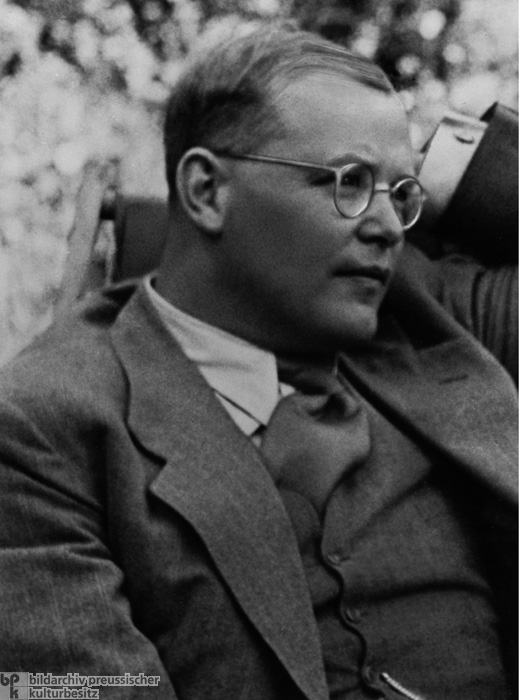
Dietrich Bonhoeffer, A Saint for Today

Dietrich Bonhoeffer (1906-1945) is known for his leadership role in the Confessing Church, efforts on behalf of peace and justice, opposition to antisemitism, and writings on theology and ethics that have been influential far beyond his German Lutheran context. He was was hanged by the Nazis on April 6, 1945 in the Flossenburg concentration camp.

Dietrich Bonhoeffer quotes:

In normal life we hardly realize how much more we receive than we give; life can be rich only with such realization. source: Letters and Papers from Prison

To be silent does not mean to be inactive; rather it means to breathe in the will of God, to listen attentively and be ready to obey. Meditating on the Word

It is not necessary that we should discover new ideas in our meditation. It is sufficient, and far more important, if the Word, as we read and understand it, penetrates and dwells within us. Life Together

When we come to a clearer and more sober estimate of our own limitations and responsibilities, that makes it possible more genuinely to love our neighbor. Letters and Papers…

There is not a place to which the Christian can withdraw from the world, whether it be outwardly or in the sphere of the inner life. Any attempt to escape from the world must sooner or later be paid for with a sinful surrender to the world. Ethics

You have granted me many blessings; let me also accept what is hard from your hand. Prayers from Prison

The first call which every Christian experiences is the call to abandon the attachments of this world. The Cost of Discipleship

Earthly possessions dazzle our eyes and delude us into thinking that they can provide security and freedom from anxiety. Yet all the time they are the very source of anxiety. The Cost of Discipleship

The first service that one owes to others in the fellowship consists of listening to them. Just as love of God begins with listening to his word, so the beginning of love for our brothers and sisters is learning to listen to them. Life Together

From God we hear the word: “If you want my goodness to stay with you then serve your neighbor, for that is where God comes to you.” In the anthology, No Rusty Swords

Judging others makes us blind, whereas love is illuminating. By judging others, we blind ourselves to our own evil and to the grace which others are just as entitled to as ourselves. The Cost of Discipleship

I can no longer condemn or hate a brother [or sister] for whom I pray, no matter how much trouble he causes me. His face that hitherto may have been strange and intolerable to me is transformed through intercession into the countenance of a brother for whom Christ died. Life Together

We have learned a bit too late in the day that action springs not from thought but from a readiness for responsibility. Letters and Papers from Prison

Which of us has really admitted that God’s goodness can also lead us into conflict. In the Anthology, No Rusty Swords

Our enemies are those who harbor hostility against us, not those against whom we cherish hostility… As a Christian I am called to treat my enemy as a brother and to meet hostility with love. My behavior is thus determined not by the way others treat me, but by the treatment I receive from Jesus. The Cost of Discipleship

So long as we eat our bread together, we shall have sufficient even for the least. Not until one person desires to keep his own bread for himself does hunger ensue. Life Together

In a world where success is the measure and justification of all things, the figure of him who was sentenced and crucified remains a stranger. Ethics

 A Prayer written by Bonhoeffer

In me there is darkness,

but with you there is light;

I am lonely, but you do not leave me;

I am feeble in heart; but with you there is help;

I am restless, but with you is peace.

In me there is bitterness, but with you there is patience;

I do not understand your ways, but you know the way for me.

Amen.

Scare the Bullies: Psalms 86

14 O God, insolent men have risen up against me;
    a band of ruthless men seeks my life,
    and they do not set you before them.
15 But you, O Lord, are a God merciful and gracious,
    slow to anger and abounding in steadfast love and faithfulness.
16 Turn to me and be gracious to me;
    give your strength to your servant,
    and save the son of your maidservant.
17 Show me a sign of your favor,
    that those who hate me may see and be put to shame
    because you, Lord, have helped me and comforted me.

Ps. 86:14-17, ESV

This the last of three parts, and we should be impressed with its diversity. There are vista points here, where we can stop and wonder. I remember lounging in the California redwoods, just meandering and soaking it in. It basically undid me. And after awhile, I found it hard to speak. (Itself a minor miracle!)

But scripture can do this as well. When we really start looking, and praying, and meditating we start to appreciate all the Father has done for us. And it’s not just “deep thinkers,” who can do this.  Actually, deep thinking is a liability. It is the simple, the humble, the slow, those who have absurd patience– they are the ones who can do some serious reflecting. Children do it best I think.

Commentary

V. 14, is pretty much David’s reality. He is on Satan’s “hit list.” He has a “contract’ on his life. He must deal with this as he moves through his day. I can imagine that this could be quite corrosive and detrimental to your soul; your heart and your mind. He must have thought, ‘Can I really trust this person, does he have a dagger?’ I would have been a mess, twisted up with paranoia and fear.

V. 15, each word used in this verse is quite precise, each phrase carefully used. This is not David flattering God, it is not “boot-licking” mush. Rather, this verse is an accurate portrayal of the Lord God’s character. It is David’s appraisal of how he has experienced God, the things he has found out about Him. David has a long history with the Father, and he reminds himself of how good God really was.

V. 16, in this verse we see David appealing to God on the basis of relationship. Also, David speaks of a kind of “future grace.” Yes, good things have happened in his life, God things. But that isn’t enough for the present moment, and the future. David needs freshness, a grace tailored just for today, custom built.

David’s source for his survival is in God’s cupboards. He knows this, and boldly steps up and asks for it. Interestingly David doesn’t come as an anointed king, having a majestic aura. When he refers to himself, it is as ”the son of your maidservant.”

V. 17, “The Message” Bible is interesting in how it translates this particular verse:

“Make a show of how much you love me 
      so the bullies who hate me will stand there slack-jawed, 
   As you, God, gently and powerfully 
      put me back on my feet.”

ybic, Bryan

kyrie elesion. (Lord, have mercy.)

_________________

I wrote this on Feb. 21, 2012 and it was posted on my second website, “Psalmslife.com.” If you happen to like this kind of teaching, there is a “whole boatload” on that site, 70-80 posts just on the Psalms. I would be honored if you would check it out.  –B.

Who Am I? by Dietrich Bonhoeffer

bonhoeffer-ins1

From the Journal of Dietrich Bonhoeffer

Dietrich Bonhoeffer (1906-1945)

Dietrich Bonhoeffer was a German Lutheran pastor and theologian. He was also a participant in the German Resistance movement against Nazism, a founding member of the Confessing Church. His involvement in plans by members of the Abwehr (the German Military Intelligence Office) to assassinate Adolf Hitler resulted in his arrest in April 1943 and his subsequent execution by hanging in April 1945, shortly before the war’s end.

Protestant theologian Dietrich Bonhoeffer stands out among the Christian leaders during the Nazi era, for he was one of the few to actively resist the racist actions of the Nazi regime. In addition to his legacy of courageous opposition to Nazism, Bonhoeffer’s theological writings are still widely read in Christian communities throughout the world. “At the place of execution, he again said a short prayer and then climbed the steps to the gallows, brave and composed. His death ensued after a few seconds. In almost fifty years that I worked as a doctor, I have hardly ever seen a man die so entirely submissive to the will of God.” Source: Prison doctor witness to Bonhoeffer’s death  

From His Writings–

Who am I? They often tell me

I stepped from my cell’s confinement

Calmly, cheerfully, firmly,

Like a squire from his country-house.

Who am I? They often tell me

I used to speak to my warders

Freely and friendly and clearly,

As though it were mine to command.

Who am I? They also tell me

I bore the days of misfortune

Equally, smilingly, proudly,

Like one accustomed to win.

Am I then really all that which other men tell of?

Or am I only what I myself know of myself?

Restless and longing and sick, like a bird in a cage,

Struggling for breath, as though hands were

compressing my throat,

Yearning for colors, for flowers, for the voices of birds,

Thirsting for words of kindness, for neighborliness,

Tossing in expectation of great events,

Powerlessly trembling for friends at an infinite distance,

Weary and empty at praying, at thinking, at making,

Faint, and ready to say farewell to it all?

Who am I? This or the other?

Am I one person today and tomorrow another?

Am I both at once? A hypocrite before others,

And before myself a contemptibly woebegone weakling?

Or is something within me still like a beaten army,

Fleeing in disorder from victory already achieved?

Who am I? They mock me, these lonely questions of mine.

Whoever I am, Thou knowest, O God, I am Thine!

–July 18, 1944

cropped-cropped-cropped-christiangraffiti1-11.jpg
