“The bridge of grace will bear your weight, brother. Thousands of big sinners have gone across that bridge, yea, tens of thousands have gone over it. Some have been the chief of sinners and some have come at the very last of their days but the arch has never yielded beneath their weight. I will go with them trusting to the same support. It will bear me over as it has for them.”
CH Spurgeon
Quite often many of us deal with guilt and condemnation. We live in sinful bodies, and it seems that we actually cherish things that God has told us are wrong, and not part of an authentic Christian walk.
We’ve got an enemy that condemns and accuses. Our sin can be compared to “hooks” that Satan can latch on and pull us toward dark things. I personally don’t believe that a Christian can be demon-possessed. The Holy Spirit resides in the believer–He protects us with His presence.
The believer can be oppressed but never possessed.
Life can be very challenging when we choose sin over holiness. Often we really don’t have a fear of God. A healthy believer knows that he or she will stand and give an account of the way we live. Rewards will be given, and judgment will be passed on all that we’ve done.
When God saves a person He really does save a person.
We need not feel condemnation or guilt, Jesus was punished for our sin. His poured out blood is sufficient for everyone. He died so we won’t. He was risen to give us power over all of these nasty dark things. He becomes the bridge that holds our weight.
Be encouraged saint, as His holiness is given to each of us. We must choose it.
Every now and then, I come across something that will not fit into the scope of Brokenbelievers. This is one of those times. I share it with my brothers and sisters who serve Jesus in any leadership capacity in the Church. I think it’s fitting that this be shared as we step into 2022. These are challenging times to serve him; but not dangerous–at least not yet.
The Prayer of a Minor Prophet was originally written on August 18, 1920. It still means a lot to ordained/non-ordained serving in the ministry. I suppose it still speaks to every leader in every Church. You may want to copy and keep this for those hard times that will come to each of us.Could it be that you might want to share this word with the leaders of your local fellowship?
The article was written on the day of Tozer’s ordination into the ministry.
O Lord, I have heard Thy voice and was afraid. Thou has called me to an awesome task in a grave and perilous hour. Thou art about to shake all nations and the earth and also heaven, that the things that cannot be shaken may remain. O Lord, my Lord, Thou has stooped to honor me to be Thy servant. No man taketh this honor upon himself save he that is called of God as was Aaron. Thou has ordained me Thy messenger to them that are stubborn of heart and hard of hearing. They have rejected Thee, the Master, and it is not to be expected that they will receive me, the servant.
1897-1963
My God, I shall not waste time deploring my weakness nor my unfittedness for the work. The responsibility is not mine, but Thine. Thou has said, “I knew thee – I ordained thee – I sanctified thee,” and Thou hast also said, “Thou shalt go to all that I shall send thee, and whatsoever I command thee thou shalt speak.” Who am I to argue with Thee or to call into question Thy sovereign choice? The decision is not mine but Thine. So be it, Lord. Thy will, not mine, be done.
Well do I know, Thou God of the prophets and the apostles, that as long as I honor Thee Thou will honor me. Help me therefore to take this solemn vow to honor Thee in all my future life and labors, whether by gain or by loss, by life or by death, and then to keep that vow unbroken while I live.
It is time, O God, for Thee to work, for the enemy has entered into Thy pastures and the sheep are torn and scattered. And false shepherds abound who deny the danger and laugh at the perils which surround Thy flock. The sheep are deceived by these hirelings and follow them with touching loyalty while the wolf closes in to kill and destroy. I beseech Thee, give me sharp eyes to detect the presence of the enemy; give me understanding to see and courage to report what I see faithfully. Make my voice so like Thine own that even the sick sheep will recognize it and follow Thee.
Lord Jesus, I come to Thee for spiritual preparation. Lay Thy hand upon me. Anoint me with the oil of the New Testament prophet. Forbid that I should be come a religious scribe and thus lose my prophetic calling. Save me from the curse that lies dark across the modern clergy, the curse of compromise, of imitation, of professionalism. Save me from the error of judging a church by its size, its popularity or the amount of its yearly offering. Help me to remember that I am a prophet – not a promoter, not a religious manager, but a prophet. Let me never become a slave to crowds. Heal my soul of carnal ambitions and deliver me from the itch for publicity. Save me from bondage to things. Let me not waste my days puttering around the house. Lay Thy terror upon me, O God, and drive me to the place of prayer where I may wrestle with principalities and powers and the rulers of the darkness of this world. Deliver me from overeating and late sleeping. Teach me self-discipline that I may be a good soldier of Jesus Christ.
I accept hard work and small rewards in this life. I ask for no easy place. I shall try to be blind to the little ways that could make life easier. If others seek the smoother path I shall try to take the hard way without judging them too harshly. I shall expect opposition and try to take it quietly when it comes. Or if, as sometimes it falleth out to Thy servants, I should have grateful gifts pressed upon me by Thy kindly people, stand by me then and save me from the blight that often follows. Teach me to use whatever I receive in such manner that will not injure my soul nor diminish my spiritual power. And if in Thy permissive providence honor should come to me from Thy church, let me not forget in that hour that I am unworthy of the least of Thy mercies, and that if men knew me as intimately as I know myself they would withhold their honors or bestow them upon others more worthy to receive them.
And now, O Lord of heaven and earth, I consecrate my remaining days to Thee; let them be many or few, as Thou wilt. Let me stand before the great or minister to the poor and lowly; that choice is not mine, and I would not influence it if I could. I am Thy servant to do Thy will, and that will is sweeter to me than position or riches or fame and I choose it above all things on earth or in heaven.
Though I am chosen of Thee and honored by a high and holy calling, let me never forget that I am but a man of dust and ashes, a man with all the natural faults and passions that plague the race of men. I pray Thee, therefore, my Lord and Redeemer, save me from myself and from all the injuries I may do myself while trying to be a blessing to others. Fill me with Thy power by the Holy Spirit, and I will go in Thy strength and tell of Thy righteousness, even Thine only. I will spread abroad the message of redeeming love while my normal powers endure.
Then, dear Lord, when I am old and weary and too tired to go on, have a place ready for me above, and make me to be numbered with Thy saints in glory everlasting. Amen.
AMEN.
Written in 1950, Aiden Wilson Tozer was 23 years old when he was called to pastor a new church in Clarksburg, West Virginia. On August 18, 1920 at a campground a few miles outside Cleveland, Ohio, leaders of the Christian and Missionary Alliance scheduled an ordination service.
After the formal ceremony, Tozer slipped away from the crowd and found a quiet place to be alone with God. He never forgot what he prayed that evening and years later as the new editor for the Alliance Weekly, Tozer published his prayer in an article “For Pastors Only: Prayer of a Minor Prophet” (May 6, 1950).
Being a Christian is not having better ideas, but having new eyes, a new heart. And God’s heart is broken over the sin and rebellion of men and women. Where’s the Church? Most never read their Bibles, they don’t pray or fast anymore. Instead, we listen to preachers who insist that political engagement is the solution.
This is not biblical.
The Church no longer has a passionate and all-consuming love and passion for Jesus (Rev. 2:4). We consult the internet and watch our favorite TV shows. We think that this is appropriate considering the evil we see. This is not the way.
Satan rejoices when we the Church capitulate like this. Most of us are not seeking the Lord. Churches are now a political force, and not a spiritual one. We don’t pray, and we seldom read our Bibles. We never fast or intercede. Our pastors never talk this way.
I heard recently a large church supported a chant, “Lets go Brandon.” (f**k Joe Biden). What a grief. We should be praying, “Let’s go Jesus.” (Or “lets go Church!) We’re no longer emphasizing the Kingdom of God. Statistics now tell us that only 20% of believers pray, and only 10% of us pray and intercede. Instead, we’re turning to the internet, and our favorite network commentaries.
Satan is rejoicing.
I believe we must be salt, we must be light. But we can’t adopt the world’s approach or techniques. We must pray. We must fast. We must read the Word again. We must become passionate about Jesus. Don’t allow yourself to be seduced.
“But I am afraid that, as the serpent deceived Eve by his trickery, your minds will be led astray from sincere and pure devotion to Christ.”
2 Cor. 11:1-3
This is my view. Others may believe differently. Please forgive me if I offend. That’s not my intention.
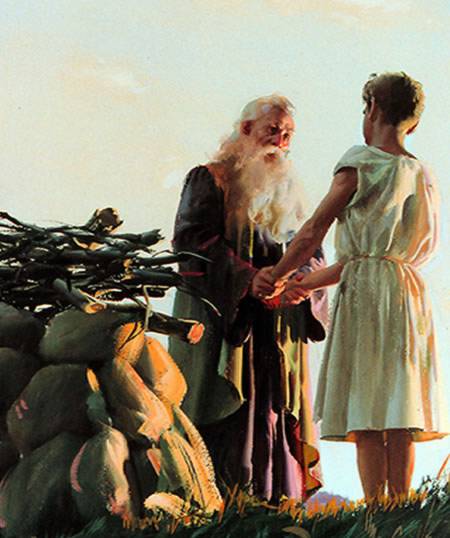
“It was by faith that Abraham offered Isaac as a sacrifice when God was testing him. Abraham, who had received God’s promises, was ready to sacrifice his only son, Isaac,18 even though God had told him, “Isaac is the son through whom your descendants will be counted.”[ 19Abraham reasoned that if Isaac died, God was able to bring him back to life again. And in a sense, Abraham did receive his son back from the dead.”
Hebrews 11:17-19, NLT
The faith of Abraham is understood by believers everywhere. This simple man followed God to a obscure mountain in Judea. He came fervently, and yet logically to the command of the Lord. Abraham’s confident assurance would carry him to Mt. Moriah were he would sacrifice his son. He would prefigure God’s own sacrifice of Jesus Christ, His only Son.
There were many steps Abraham had to take: the knife, the rope, the firewood, the donkey. There was a dozen details to arrange. Abraham would have had to plan ahead of time to prepare. I’m relatively certain he had ample time to consider what he was doing. The enormity of it all would’ve been staggering.
Hebrews reveals that ‘faith’ was what enabled Abraham. It was faith followed by a dozen little obediences that strengthened him to follow God’s instructions. Abraham would obey God, through faith, by doing many little things. All would lead up to the ‘big thing,’ the offering up of his only son.
I believe that no act is too small. Heavy doors swing on small hinges. Tiny obediences make for big ones. And sometimes we can’t tell them apart. It seems that several times during our daily grind we face little choices that often determine a far greater meaning. I’ve been told that there are flowers in alpine valleys that no man will ever see. Their sole beauty is visible only to God. Obedience is often like this. But the Lord knows.
God meets every act of obedience to Him with a smiling grace.
Hebrews 11 is known as the believer’s ‘hall of fame’. In its verses we’re pounded by the idea that the faith is visible only through obedience. What we do is as significant as what we believe. It has always been so.
“…but the people who know their God shall be strong, and carry out great exploits.”
Daniel 11:32, NKJV
Little obediences prepare us for big ones. If we won’t obey in the small ones, how will we in the big ones? The prophet Daniel spoke of a remnant that would do astonishing things, and that the core of their fame would come from knowing God. This is faith made visible. The ‘great exploits’ spring out of a faith in a strong God. To be regarded in this way would be wonderful, but faith needs those little obediences to be able to do the great ones.
We must reclaim the reality that the details of our lives are not trivial.