An Armored Response

tank-wallpapers-8

When the Holy Spirit talks we listen. What He shares is usually pretty relevant, and typically mandates our action. He is into change, and guides us into Christlikeness.

In my prayer time I saw a man climbing into the turret of a tank. He was sheltered there, protected by the tank’s armor. He seemed to be discovering the capabilities of the tank. He slowly began to grasp the potential of it, and soon began to turn the massive gun. He played around, not so much as a soldier, but as a child would. It was fun to spin the turret around. He could go places on its tracks. He could run over trees.

But slowly he realized that this was much more than a shelter, but it was an offense weapon as well. The tank could be quite formidable, as well as safe and secure. Surrounded by the armor, he at last began to understand exactly what this tank was capable of, and his role as driver/gunner. Using the gun, he could go up against enemy strongholds.

We come into a certain maturity when we begin to obey. God-given tasks become a joy. We start to see not just the defensive perspective, but the offensive as well. God’s ability is given to anyone who asks. His power can’t be diminished. He alone is the force to be reckoned with.

We are often stunted by our vision, we simply don’t grasp the enormity of what has been given to us.

I also pray that you will understand the incredible greatness of God’s power for us who believe him. This is the same mighty power that raised Christ from the dead,”

Ephesians 1:18-19

“For the Kingdom of God is not just a lot of talk; it is living by God’s power.”

1 Corinthians 4:20
1brobry-sig4

cropped-christiangraffiti1 (1)

Just A Small Obedience

10417544_10152762915733385_4932160745836047965_n

Dear one, in spite of what you’ve heard, obedience is NOT a four letter word. (Some would suggest otherwise.) Pastors and teachers who are ‘old school’ remember when we heard much on obedience. But biblical obedience is not the same as legalism, and it is not the opposite of grace. It is however, an integral part of our daily walk with God. Obedience is essential if you’re going to follow Him.

“We destroy every proud obstacle that keeps people from knowing God. We capture their rebellious thoughts and teach them to obey Christ.

2 Corinthians 10:5, NLT

We have done so much with so little that when we finally initiate some bit of obedience we go into shock. God seriously delights in us when we move toward it. I believe that he waits for it, and grieves when we disobey His Word. We do not nullify grace by requiring obedience, rather we fortify our faith when we obey.

Oh saint, the Lord can’t hardly wait to pour heaven over your soul, and your home. He is ready to lavish Himself on you.

I’ve been reading the book of Jeremiah the last few days. One of the things that is striking is God’s faithfulness to His people under the ‘old covenant.’ He remained faithful even when they walked in disobedience. Jeremiah insists that we serve a holy God who seeks an obedient people. How much more is He under the ‘new covenant’ which was brought about by the blood of Jesus?

We are standing in a blessed place. When we make the choice to obey, all of heaven stands up and takes notice. (Let us not sell obedience short.) You see, greatness in God’s kingdom is always measured in terms of obedience.

“Our Lord told His disciples that love and obedience were organically united. The final test of love is obedience.”   

A.W. Tozer

We show our love by obedience; that is the ‘acid test’ of authenticity. We might insist that there are other ways to prove we are real: worship, witnessing, tithing or even prayer. All of these are great, but none can be a substitute for ‘everyday’ obedience. Heaven is seeking disciples who are compliant. The other things are wonderful, no doubt about it. But just the willingness to obey opens up heaven.

“Lord Jesus, make me willing to be willing to obey you.”

bry-signat (2)

cropped-christiangraffiti1.jpg

The Melancholy of Edvard Munch

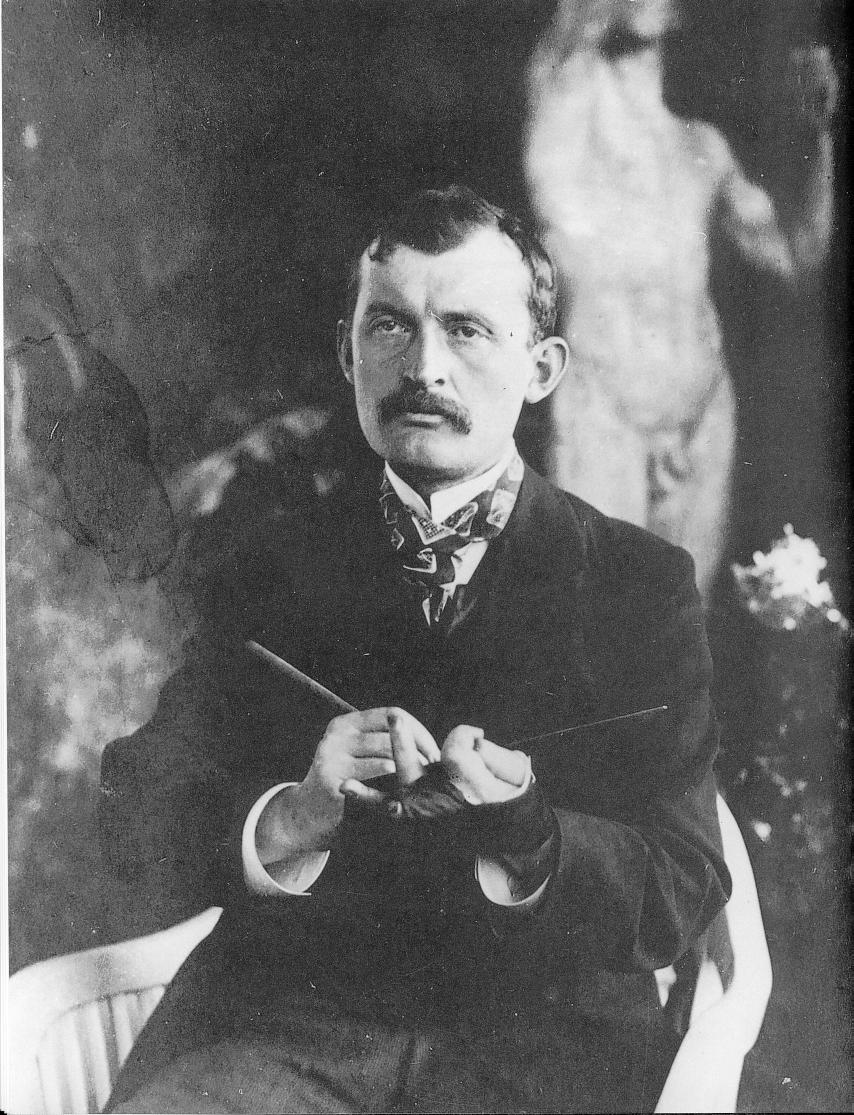
munchDecember 2, 1863 – January 23, 1944, he was a Norwegian painter. He is regarded as a Symbolist and a forerunner of expressionism. He focused on themes of fear, anxiety, melancholy, and death. He did not believe in heaven, or other Christian themes or doctrines, as far as I know.

My intention is to reintroduce you to an artist that I highly esteem.  The challenge I suppose is to understand the issues that Munch discovers in his work. He clearly taps into the ‘angst’ of the modern man, and what he does perpetuates a mindset for our generation.

Obviously these paintings are just an introduction, and I understand that they are selective. I have refrained from any kind of interpretation, other than laying down a general principle–  to Munch, color is everything.

Munch was probably not a cheery person. He essentially was driven by anxiety through his whole life. It seems that he could be very ambitious. His classic work was “The Scream” which he made several versions to sell. He used different mediums to do this– tempera, lithograph and pastel. Interestingly, “The Scream” is a favorite target for art thefts. It captures the minds of every modern thinker.

Within our culture, “The Scream” is iconic. Warhol, Gary Larson, Dr. Who and even “The Simpsons” have cashed in on a parody of it.

Quotes

“I painted the picture, and in the colors the rhythm of the music quivers. I painted the colors I saw.”

“Painting picture by picture, I followed the impressions my eye took in at heightened moments. I painted only memories, adding nothing, no details that I did not see. Hence the simplicity of the paintings, their emptiness.”

“For as long as I can remember I have suffered from a deep feeling of anxiety which I have tried to express in my art.”

“Disease, insanity, and death were the angels that attended my cradle, and since then have followed me throughout my life.”

munch-thescream
The Scream, 1893
Munch’s best known painting ^


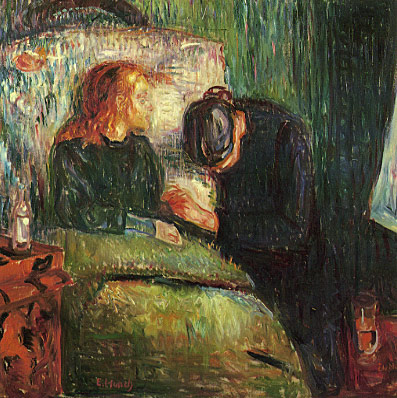
The Sick Child (1885)
Melancholy, 1894
Melancholy, 1894
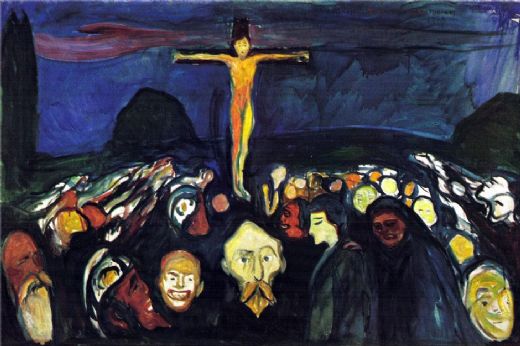
Golgotha, 1900
Golgotha

Disciples Who Can Stay Afloat

22 “Immediately Jesus told his followers to get into the boat and go ahead of him across the lake. He stayed there to send the people home.23 After he had sent them away, he went by himself up into the hills to pray. It was late, and Jesus was there alone.24 By this time, the boat was already far away from land. It was being hit by waves, because the wind was blowing against it. 25 Between three and six o’clock in the morning, Jesus came to them, walking on the water.26 When his followers saw him walking on the water, they were afraid. They said, “It’s a ghost!” and cried out in fear.

27 But Jesus quickly spoke to them, “Have courage! It is I. Do not be afraid.”28 Peter said, “Lord, if it is really you, then command me to come to you on the water.” 29 Jesus said, “Come.” And Peter left the boat and walked on the water to Jesus. 30 But when Peter saw the wind and the waves, he became afraid and began to sink. He shouted, “Lord, save me!”

31 Immediately Jesus reached out his hand and caught Peter. Jesus said, “Your faith is small. Why did you doubt?” 32 After they got into the boat, the wind became calm.33 Then those who were in the boat worshiped Jesus and said, “Truly you are the Son of God!”

Matthew 14:22-33, New Century Version

flourish15

When I am in the storm, when the waves are breaking into my boat, my faith is shaky, and I feel abandoned, I turn to Matthew 14.

Jesus sees his disciples in mortal danger.  The overloaded boat has been caught in a ferocious storm.  It is 3 a.m., and the darkness just makes their situation that more desperate. The idea of imminent drowning has passed through their thoughts. They are terribly afraid.

Suddenly Jesus comes near, he is walking on the water!  Their fear turns to stark terror, they want to bolt but there is no place to go.  They are thinking that Jesus is a ghost, and that he is coming to escort them to the grave.  So Jesus calls out through the raging storm, “It is just me.  Do not fear!  Have courage.”

Brash Peter (bless him, Lord) yells to Jesus, “If it is you, really you, let me come to you, on the water!”  The word ‘if’ is very telling, and it explains much. Peter is soon on the edge of frantic hysteria when he begins to sink while walking to Jesus.

If it was me, I would have let Peter drown.  (What an object lesson to teach the 11 sitting in the boat.  “See what happens when you have weak faith, you drown!”)

But Jesus is not teaching here, He is loving.  He grabs Peter and pulls him out.  I find it interesting that the rock on whom Jesus is to build his Church upon sinks like a stone. Peter shows his faith for a brief shining moment, and when he falters and sinks, Jesus catches him.

aabryscript