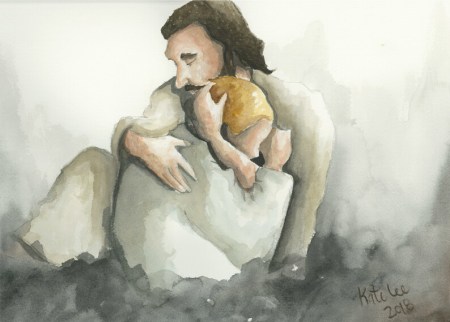
He Wears the Crown

He Wears the Crown

“A Christian is not a person who believes in his head the teachings of the Bible. Satan believes in his head the teachings of the Bible! A Christian is a person who has died with Christ, whose stiff neck has been broken, whose brazen forehead has been shattered, whose stony heart has been crushed, whose pride has been slain, and whose life is now mastered by Jesus Christ.”

John Piper

No longer do I call you servants, for a servant does not know what his master is doing; but I have called you friends, for all things that I heard from My Father I have made known to you.”

John 15:15

It seems that the purpose of life is not to find our freedom,  it is really meant to find our Master.

The idea of being a slave to anyone is repugnant–a blow to our pride. We chafe at this, and yet man was never meant to be separated from the Lordship of Jesus. We’re instructed repeatedly with the New Testament idea that “our life is not our own”  Over and over God proclaims Himself as the King.

That really can trouble us somewhat.

Not so much when life is fairly good, granted, but in those hard moments when a decision must be made between enjoying the titillating “lusts of the flesh,” or accepting the fruits of the Spirit. This is one of those “lordship moments.” They come and go, and they show us exactly who we are. We cannot escape this–it’s part of our faith.

If you’re really going to be authentic–that is to be a legitimate and real disciple, then you must determine who is going to be in charge, and this isn’t one of those casual decisions. Your decision must become a settled issue.

You must fix your decision in your heart.

The thief on the cross knew salvation, he was promised an eternity with God simply by faith. But I submit to you that he had put himself under the Lordship of Jesus, simply by recognizing the sign, “the King of the Jews.” I believe he saw and understood its implications. Jesus was King! He knew and understood.

This is a very hard word for some, but so many of our personal issues hinge on this

I know this first-hand. It’s a monumental struggle. You must admit to not only having Jesus as your Savior, but you also must put your life under His total Lordship.  You need to pick up your cross daily in order to follow.  You need to learn how to kneel in total surrender to  Him.

I’ve chosen a crown to open up this post–it’s done on purpose.  I simply want you to understand the supreme call He has on your life.

You must learn here and now how to kneel before the Sovereign King

Your resistance to His lordship will end up bringing total pain. You MUST bow and accept Jesus’ crown– to recognize His lordship over every area of your life.

 If you look up into His face and say, “Yes, Lord, whatever it costs,” at that moment He’ll flood your Life with His presence and power.

     Alan Redpath

This image has an empty alt attribute; its file name is bryan-refuge.jpg

When God Doesn’t Heal You

Mike Mason

God heals. Of that I have no doubt. We have many promises and see so much actual healing in Scripture. Jesus’ ministry would connect with hundreds of people who would be physically touched. The Lord would pass the baton on to His Church. We’re called to “lay hands on the sick,” (James 5:14-15).

But not everyone who is sick will receive physical healing. Even those who were active in ministry knew sickness.

In the second episode of season 3 of “The Chosen,” Little James, who we’ve seen walks with a limp, comes to Jesus after He commissions the Apostles. He tells him he finds it hard to believe that he will be healing people, given that Jesus hasn’t healed him.

“Do you want to be healed?” asks Jesus.

“Yes, of course,” James says, “if that’s possible. Why haven’t you?” he asks Jesus—again, a question some of us would’ve asked.

“Because I trust you,” Jesus says. “Little James. Precious Little James. I need you to listen to me very carefully, because what I am going to say defines your whole life to this point and will define the rest of your life. Do you understand?”

Jesus tells James that he will heal many people, and they will have a good story to tell.

“To know how to proclaim that you still praise God in spite of this—to know how to focus on all that matters, so much more than the body—to show people that you can be patient with your suffering here on Earth, because you know you’ll spend eternity with no suffering—not everyone can understand that. How many people do you think the Father and I trust this with? Not many.”

“But the others,” James says, “they are so much more … stronger, better at this.”

“James, I love you,” Jesus says, “but I don’t want to hear that ever again.”

“I know how easy it is to say the Psalm of David, that I am beautifully and wonderfully made, but it doesn’t make this any easier,” says James, begins to weep. “It doesn’t make me feel like any less of a burden.”

“When you pass from this earth,” Jesus says to James, “and you meet your Father in Heaven, where Isaiah promises you will leap like a deer, your reward will be great. So hold on a little longer. And when you discover yourself finding true strength because of your weakness, when you do great things in my Name in spite of this, the impact will last for generations. Do you understand?”

James cries, and says, “Yes. Thank you, Master.”

I believe that there are two truths that every Christian can count on. These are solid, and completely trustworthy. They are forever fixed and will never change.

“Fear not, for I am with you; be not dismayed, for I am your God; I will strengthen you, I will help you, I will uphold you with my righteous right hand.” Isaiah 41:10

“He will wipe away every tear from their eyes, and death shall be no more, neither shall there be mourning, nor crying, nor pain anymore, for the former things have passed away.” Revelation 21:4

     John Henry Newman  

The Extraordinary Breath of Jesus

“Jesus said to them again, “Peace be with you. As the Father has sent me, I also send you.” 22 After saying this, he breathed on them and said, “Receive the Holy Spirit. 23 If you forgive the sins of any, they are forgiven them; if you retain the sins of any, they are retained.”

John 20:21-23 (19-23)

This is the second “peace be with you” in this passage. So why the duplication of this peace proclamation? The disciples are sequestered and scared in the upper room (v. 19; and Luke 24:36. Having peace is being emphasized–the disciples were afraid of the Pharisees, but they also were undone by Jesus’ surprise visit.

Peace was definitely a precious commodity for them.

Jesus gives his disciples a mission to do, and they must be as ‘familiar’ with Jesus just as Jesus is with God. The disciples had followed him for three years–seeing incredible miracles, and hearing profound teaching, they’re ready, they just need power.

In track and field, there’s a relay race where a baton is passed from runner to runner, and maybe that’s how it’s working here? We see the same idea in John 17:18.

The baton has now been passed to the disciples.

The breath of the risen Jesus is necessary (and yes, he’s breathing.) What went down here, I don’t know exactly. But Jesus recognizes that his 12 followers will need this to do his work. Also, we might consider Adam in Genesis 2:7 where God’s breath brought him to life, which is pretty awesome when you think of the parallels.

The Holy Spirit energizes these men to do this new work.

The disciples were pretty much observers, but now they are to take up the ‘mantle’ of Jesus’ work. This is a definite duplication, which connects with the idea of one seed producing many others (John 12:24.) That’s how the Kingdom will come to people.

Verse 23 intrigues me. It seems that our life comes from the breath of Jesus. And it’s the Holy Spirit that gives both power and the authority that’s needed to function like Jesus. We now have the ability to pronounce forgiveness to the new believer, and yet that doesn’t seem a function of the Church today.

I wonder why this is so?

This entire passage as a doozy. It clearly declares the Churches new role as we follow in his footsteps. Disciples are to do exactly what Jesus does–with his breath and authority–filled with the Holy Spirit.

If we neglect these things (it seems anyway) we’re going to fall flat on our face.

“The work of Jesus for His disciples on resurrection Sunday gives an ongoing pattern for His work among His people. Jesus wants to continue this fourfold ministry of assurancemission, the Holy Spirit and authority to His people today.”

From David Guzik’s website

Making a List

This is a scary list. We’re told repeatedly that love is the evidence that disciples are to be identified. Love is the blood of the body. It’s that necessary. It’s critical. We’re called to love (one another) that proves we’re real and authentic.

Some of us are handicapped, either mentally or physically. Our issues are truly formidable, very few understand.

I pretty much live in physical pain now. I struggle with depression. I have some battles that few understand. And I get terribly self-absorbed by all of it. If love is the blood of the Christian then I absolutely need a transfusion. I’m anemic. I’m the proverbial 95 pound spiritual weakling! 😁

“Love one another.” I believe I’m missing this in my spiritual walk. For the most part I operate as “to tolerate one another.” It’s easy to love those who love me, but that’s not how discipleship to Jesus works. He wants us to find enemies to love. (At least I think it does.)

Our Teacher, the Holy Spirit, knows how ignorant we really are. But He is patient and oh so very kind. He has lessons that fit us and our needs. I want to love (usually) and I’m counting on Him to tutor me. How do I do this?

You learn to love by loving.

A few things (I know it’s a terribly incomplete list):

  • To love you must walk in discernment. Learn to “see” the needs of specific people. Contrary to church opinion, discernment is not to pass judgement on another, rather it’s all about seeing needs. Not everyone can do this.
  • To love takes availability. You need to be “ready for use.” This takes a certain amount of skill. I’m a terrible kind of introvert. Sometimes I won’t answer the phone or go to a home group. I sorta resent it. The Spirit keeps putting me in spots that require interaction with others, and I hate it.
  • Love creates humility in us (which takes some doing). As I learn to love I find myself stripped down and washing somebody’s feet. I become a servant who is learning to scrub between the toes if that’s what it takes.
  • To love you must love others just like Jesus loves you. (Yikes!) “The extra mile,” all of that. So tell me, how much has He loved you? Isn’t that supposed to teach you something? Remember, love is a fruit of Him living inside of you.
  • To love creates growing joy. This joy will protect us from legalism. When joy is operational every burden is light–we do our tasks smiling. I heard a preacher speak about J.O.Y. Jesus, Others, and You. In order of importance.
  • To love is to learn how to pray. Intercession is like oxygen to a fire. It’s like one of those old fashioned bellows to a sputtering flame. It pumps air into the pile of twigs and wood to spread the fire and ignite a blaze. We pray and love starts spreading.

To live with hard mental and physical issues as an authentic Christian is profoundly difficult. We get so self-absorbed at times. But being a disciple of love isn’t just for healthy believers, it’s also for us who struggle.

Grace is increased exponentially to those of us with deep physical problems.

I totally believe this. God takes special care as He works on and in us. We can count on Him to give us the extra attention we need as we learn love.

I’ve found that suffering is like learning another language. Changed by His love we are speaking to others in a way they understand. We can communicate with others because we’ve learned how to “speak their language.” We have been taught by God to speak into broken lives because we’ve been broken too.

1 John 4:19