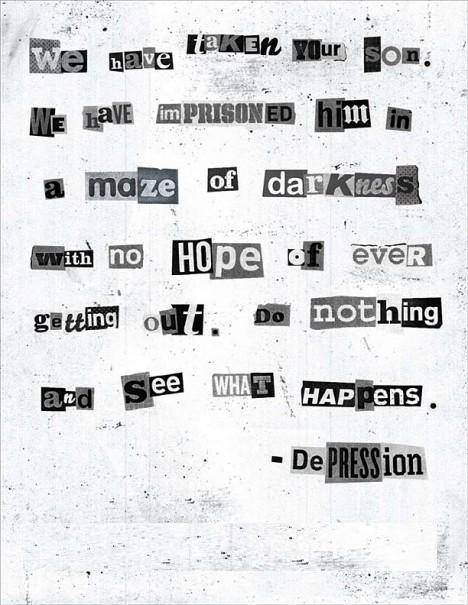
The Ransom Note

depression-note

“We collapse in the dust,
    lying face down in the dirt.
26 Rise up! Help us!
    Ransom us because of your unfailing love.”

Psalm 44:25-26, NLT

“For even the Son of Man came not to be served but to serve others and to give his life as a ransom for many.”

Mark 10:45

“God chose him as your ransom long before the world began, but he has now revealed him to you in these last days.”

1 Peter 1:20

I think that God has more or less ransacked the human language in His effort to get through to us the critical nature of what exactly has been done just for us. When it comes to our salvation and what that means to the universe, the word, “ransom” is used.

The connection for us, as we consider the implications, has mainly a connection with the crime of “kidnapping.” This is when someone is captured by other men, and held in captivity until certain terms are met. When the kidnapper feels his needs are fully met, then the hostage is released.

In the Bible sense, we should work through several verses. There are at least three Hebrew words. In the N.T. Greek just a single word to explain “ransom” is seen. And yet we can say, each word is linked back to the idea of being “helpless.” And helpless is far more than a definition, rather it is a description of a “state of being.”

We come to understand that helplessness is the natural state of human beings. We each have been captured, taken away and are being held, until terms are met for our release. I suppose that some see this helplessness easier than others. (And I’m sure a few will never acknowledge it at all). But nevertheless, it is real and it describes every single person that has ever lived.

Being completely helpless is hardly a situation we would ever choose. Having ransom demands being made to set us free is mostly awkward. And it’s an affront. Perhaps, we feel we are worth more? But the issues here are eternal, and currency concepts are never the consideration.

But there is a present need, to purchase back those who are being held as captives. The absolute clear position is that the Lord Jesus Christ, died in our place. Choosing to die for us, he was essentially tortured before his cruel death. In this decision, he himself paid my ransom. In doing this, I was set free and fully able to return home.

There are many who have been free. But there is a thing called “the Stockholm Syndrome.” This refers to those in captivity who somehow “connect” with their kidnappers through a prolonged captivity. This is to the point where they begin to act less than the victims, and more like the captor. It is confusing. They seem to go out of their way to act “pro-kidnapper”. This can get very disturbing.

We must look to our children, and closest family and our friends. They are toiling for Satan, the captor of our souls (past-tense). Many different tactics are being used– depression, addictions, lust, greed, anger, gluttony, pride, guilt and many other deceitful things. They are being held, until faith (the key) “springs” them out of their prison.

Thank you Jesus, for coming to free us. Thank you for forgiving us. We have been released, and now walk away free. You died, so we might live. We desperately want to see the others we love set free.

*

ybic, Bryan

 

cropped-christiangraffiti1 (3)

*

What Do I Really Need?

“The depressed don’t simply need to feel better. They need a Redeemer who says, “Take heart, my son, my daughter; what you really need has been supplied. Life no longer need be about your goodness, success, righteousness, or failure. I’ve given you something infinitely more valuable than good feelings: your sins are forgiven.” 

Elyse M. Fitzpatrick

 “And this same God who takes care of me will supply all your needs from his glorious riches, which have been given to us in Christ Jesus.”

Philippians 4:19

It really does come down to “needs” after all.  I don’t need to feel better, and I don’t need a to take another Zoloft.  Do I believe in psych drugs? Yes, most definitely.  I do need to control my moods. But when we talk about need (its really an emphatic word, it needs to be drawn out) I have discovered I really have very few needs.

I’ll tell you what I need.  I need to follow Jesus with my cross.  I need to pray and worship in His presence.  I need to love my wife and children.  I need to love my neighbor.  I need the Word, both ‘rhema’ and ‘logos.’  I need a good pastor, and I need to fellowship with other believers more than I do.

Its good to go through this sifting process.  I do not need to feel happy, healthy, wealthy, content, strong, moral or helpful.  I do need God however. Yes, I am “mentally” ill.  I do take meds to keep me from burning down our house and shooting our dog.  I’ve been listening to music in my head that others can’t hear.  I see things, astonishing things.  I sometimes have to deal with paranoid feelings that would curl your hair.

But what do I really need?  I desperately need God.

I need his love.  I need to know all my sins are forgiven.  I need to know that I will be with him forever and ever.  I guess the challenge is now yours, sort out these issues.  It doesn’t matter what flavor of mental illness you have.  You need Him.  Everything else is mostly froth and scum.

“I will answer them before they even call to me. While they are still talking about their needs, I will go ahead and answer their prayers!”

Isaiah 65:24

bry-signat

flourish18


Q & A: Will I need to stay on my depression meds forever?

Asked by Ally, Washington

“I am 26 years old and have had four major depressive episodes. I did not seek treatment until the last (and worst) episode and have since been taking two different antidepressants.

My question is this: Will I ever get off these meds?

To be honest, my last episode was so bad that I am not too keen on the idea of going without. However, I am aware that the more episodes of depression a person has makes the person that much more likely to have another one and that the severity of the depression gets progressively worse with each episode. I shudder to think what a worse episode would be but at the same time do not want to take medications that I do not need.

Expert Bio PictureMental Health Expert
Dr. Charles Raison Psychiatrist,
Emory University Medical School

Expert answer

Dear Ally, let me start by applauding your very accurate understanding of depression, terrible illness that it is. Your question is an interesting one because, of course, you could get off the medications any time you like simply by ceasing to take them. But what you mean, of course, is whether you will ever be able to stop taking the medications and not have to worry about falling back into another depressive episode.

This brings up a very important point about psychiatric disorders: Anything is possible. So anytime someone asks a question that starts with some variation of “Is it possible …?” the answer is always, “Yes.” Why? Because all psychiatric illnesses are probabilistic, not deterministic. Probabilistic means that although some things are a lot more common than others, nothing is certain and nothing is impossible.

I sometimes resort to physics as a metaphor to explain this idea. Isaac Newton used mathematics to paint the universe as an absolutely rigid machine in which causes always led to results in a predictable manner. In his view of the universe, if you knew what every particle in the universe was doing at this second, you’d be able to predict all future events flawlessly out to the end of time.

This way of thinking about things works very well for many practical things like firing cannon balls, sending rockets to the moon or building bridges, but it turns out that when you look really closely at matter, it only approximates the certainty that Newton described. This realization has become enshrined in a theory called quantum mechanics, which — in essence — says that no final certainties exist in the physical world, only various degrees of likelihood.

For example, although most of us think of atoms like little solar systems with the nucleus being like the sun and electrons swirling around it like planets, the physical reality is much weirder. In fact, an electron only tends to stay close to the atom of which it is a part. The further away you go from the atom the less likelihood there is for finding one of its electrons, but the chance isn’t zero, and it is possible that you might find an atom’s electron on the other side of the universe. It’s not impossible, just so unlikely that it might as well be impossible.


To get the rest of this article you will need to go to: http://www.cnn.com/2009/HEALTH/expert.q.a/12/08/

depression.medication.raison/index.html#cnnSTCText


cropped-christiangraffiti1 (3)