Discernment and Your Ministry

zebras

“He begs God on behalf of a human
as a person begs for his friend.”

Job 16:21, NCV

I’ve been thinking about a class I had in Bible School.  The instructor made a comment that has stuck in my thinking for over 30 years now.  I have relied on it countless times in ministry since. It has helped me piece together certain issues of the heart.

When we “preach” to a person, we are actively accelerating the judgement of God in their life. When we pray for that same person, we delay this judgement and allow more room for the Holy Spirit to work.


Preaching

Now I know this is a generalization, and yet the basic premise of preaching and praying has a specific action.  When you preach, you are calling that person to make a decision.  They meet up with the truth and must decide for themselves.  This is a very sensitive moment.  If they consider your message at all– you must understand, one way or the other, that it will require a decision.  Either they act on it, or they’ll decide to reject it.

Within the Bible we often see judgement coming to someone, and very often it comes right after a “declaration of the truth” by a witness or a sermon.  Those who hear the word must choose to believe it, or spurn it.  Even a neutral position is a position. A decision must be made on all light that comes their way.

Prayer

Perhaps this may be easier to see.  The Word is full of men and women who interceded for others.  If preaching accelerates God’s judgement on a person (or group,) than prayer decelerates it.  In a sense, authentic intercession can give them more time.  It delays things, without approving them.

A classic case is Abraham.  He intercedes, and by doing so desires to save and deliver God’s own.  He “stands in the gap” for the unaware.  We see him “negotiating” with the Lord, trying to make a deal of sorts. He is bold and somewhat presumptuous. And actually, this is a regular occurrence with different circumstances.  Many in scripture do seem to get intensely involved in the lives of the people they represent.

“I will surely not stop praying for you, because that would be sinning against the Lord. I will teach you what is good and right.” 

1 Samuel 12:23

 Conclusion

Should we preach or pray?  We must consider, I think, the certain obligations of both.  I believe at the end of a person’s life, they have had both dynamics working.  Its like the tide– it ebbs and then advances, and perhaps that will help us to do the right thing at the right time.  We understand the necessity of preaching, and just as important the work of prayer.  We must do both, but grasp the issues behind each work.  Both are necessary for one to come to faith in Jesus.

Seeing the effects of our actions brings us into a deeper understanding of the life in the Spirit.  It motivates and will guide us.  We start to understand the Lord’s ways and become aware of what is happening in the world that is around us. This new discernment can only sharpen our work.

bry-signat

flourish9


Led Aside by Jesus, [Consideration]

“He took the blind man by the hand and led him outside the village. When he had spit on the man’s eyes and put his hands on him, Jesus asked, “Do you see anything?”

–Mark 8:23, NIV

Here I can imagine the gentleness and the kindness of Jesus–we see Him leading this man out of town to a quieter place. Showmanship?  Not on your life.  Jesus has made the decision to avoid the theatrics of a blind man given sight, and ducked the paparazzi for a moment to touch this man.

In a way, we are all like this blind man.  We stumble around and try to make our way.  But it is raucous confusion– the fields of philosophy, religion, psychology, politics and art are not much more than a blind men tapping with his cane, trying to find their way into the light.  This may be rather simplistic, but I believe it’s more true then we care to admit.  The entire social history of humans is based on confusion and conflict.

We grope in the gloom, and there is none to take our hand and lead us out of the darkness.  We stumble and fall, and come no closer to understanding then when we first started.  It is hopeless.  Our striving borders on madness and insanity.

The blind man in Mark 8 entrusted himself to Jesus’ care.  He willingly went with Jesus, following down the path and out of the village.  Jesus carefully leads him by the hand, which is quite remarkable.  (I guess I’m envious.)  Jesus would have led this man past every obstacle.

Each of us have to encounter Jesus for ourselves.

We are born blind, having no awareness (zero, zilch, nada) of spiritual truth.  We must be taught to see.  At the airport in Salt Lake City recently, I saw a young blind man being led through large crowd.  I was fascinated by his trust in his guide as people jostled to try to make their connections.  There was a quiet composure in him.  (In his place, I would be terrified.)

We must trust Jesus, with that same composure and grace.  When we cannot see, we must trust.

“I do not try to see my way,
Before, behind, or left, or right;
I cannot tell what dangers gray
Do haunt my steps, nor at what height
Above the sea my path doth wind:
For I am blind. 

“Yet not without a guide I wend
My unseen way, by day, by night;
Close by my side there walks a Friend,——
Strong, tender, true: I trust His sight;
He sees my way before, behind,
Though I am blind.”

by an Unknown Author

bry-signat

cropped-christiangraffiti1-3


Suffering: Finding Some Reasons

suffering1“Since he himself has gone through suffering and testing, he is able to help us when we are being tested.”

Hebrews 2:18, (NLT)

“Whenever you meet someone who has really suffered; been limited, gone through things for the Lord, willing to be imprisoned by the Lord, just being satisfied with Him and nothing else, immediately you scent the fragrance. There is a savor of the Lord. Something has been crushed, something has been broken, and there is a resulting odor of sweetness.”

  Watchman Nee

I remember a time many years ago when I felt like I had a ‘charmed’ life. I had no issues, few problems– life was smooth, there was no ‘roughness.’ I felt like I was God’s favorite, His ‘golden boy.’ I should have known it wouldn’t last :-).

Suffering in the scriptures is often linked with the concept of endurance. Often within the selected verse the writer weaves into it this idea. I believe that to endure something transforms it to good. Believers will suffer, but the issues get transformed into something quite beautiful, if, we add the ingredient of patient endurance.

“We give great honor to those who endure under suffering. For instance, you know about Job, a man of great endurance. You can see how the Lord was kind to him at the end, for the Lord is full of tenderness and mercy.”

James 5:11

In many ways, suffering is a tutor teaching us the foreign dialect of the Kingdom. If done under the kind direction of the Holy Spirit, it can give us a working knowledge of patience, endurance and joy. We must learn to speak in another language. A suffering believer will find a new vocabulary in pain that allows him to speak with understanding to those who are also in pain.

I spent several years studying Spanish. Even though I wasn’t really fluent, I discovered it opened a whole new world; being bilingual created new opportunities that I’d never even knew existed. I believe that suffering works under this same principle.

light-end-tunnelDo you speak the language? Can you communicate with love to those who hurt? Learning it can transform you to a person that can speak authoritatively to a wide swath of people. Having had to handle your own pain gives you the privilege of interpreting God’s love into pain and hurt.

From our own hurt (through endurance and joy) we can help others. I can always tell a fellow-sufferer. They are typically gentle and loving people, devoid of pride and control. These are the ones who have learned to speak the idiom of the Kingdom of God.

“He comforts us in all our troubles so that we can comfort others. When they are troubled, we will be able to give them the same comfort God has given us… We were crushed and overwhelmed beyond our ability to endure, and we thought we would never live through it. In fact, we expected to die. But as a result, we stopped relying on ourselves and learned to rely only on God, who raises the dead.

2 Corinthians 1:4, 8-9

bry-signat

flourish8

Falling, and Dying?

“I tell you the truth, a grain of wheat must fall to the ground and die to make many seeds. But if it never dies, it remains only a single seed.25 Those who love their lives will lose them, but those who hate their lives in this world will keep true life forever.”

John 12:24-25, NCV


Often believers are attempting to ‘hear God’ only to bolster their position, reputation, ‘connections’ and prestige.  There’s no talk about falling down and dying as Jesus revealed in John 12.  If I’m extremely occupied with knowing God’s will it will maneuver me into a completely wrong position.  Discipleship was never meant to be a celestial self-improvement plan.

When I get over-concerned about ‘my’ discipleship, acquiring the praise of men and achieving a modicum of honor, I end up ‘missing the boat’.  Life was not meant to profit from, but ‘to fall and die.’  There is a deadly danger of becoming self-aware and self-absorbed.  And this is ‘the spirit of the age’.

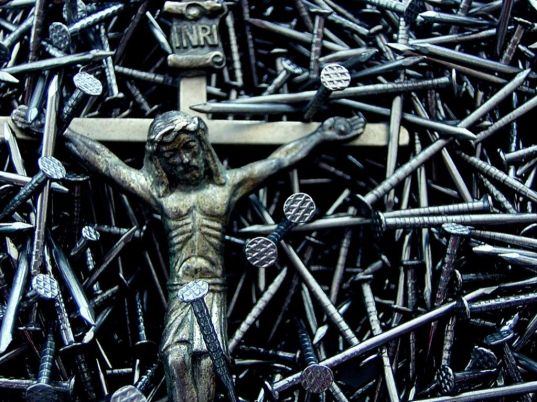
Nothing will ever go right if we try to hear the Lord while we avoid falling and dying.  To put it another way.  There can be no resurrection without a crucifixion first.  We must die if we are going to live.  We must become weak before we can understand power.

Will you realign your life to include ‘falling, and dying?’ 

Do you really want to hear Him?  Will you realign your life to include ‘falling, and dying?’  Will you begin to readjust the way you approach yourself and others?Modern popular versions of our faith will almost always lack this ‘death-life’ component.  These versions are often designed to reflect our society.  And we are terribly self-centered.  We will not ever grow and mature unless we consent to ‘falling and dying’.

Beware of the church whose leaders do not ‘limp.’

Beware of the church whose leaders do not ‘limp.’ Dying to self is a challenging and vital component to our faith that will bring us into an astonishing fruitfulness.  That is what happens to those who die–they bring life to others.

bry-signat (1)


cropped-christiangraffiti1.jpg