A Towel, Not a Title

There are no shortcuts in discipleship
“Jesus knew that the Father had given him authority over everything and that he had come from God and would return to God. 4 So he got up from the table, took off his robe, wrapped a towel around his waist.”  

John 13:3-4, NLT

Jesus was always constant.  Nothing could erode His place or position.  The authority had been His Fathers, and it had been given to Him.  He carried it as a special burden, treasured and separating Him.  Jesus had the freedom to act like the servant.  It didn’t bother or confuse Him, He understood perfectly who He was.

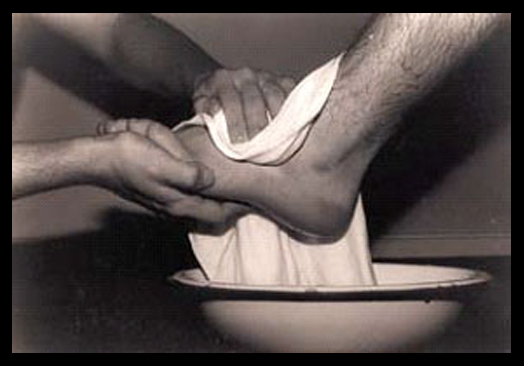
With the supreme authority given to him, he got down on His knees, and began to wash dirty feet.  I can offer no magic or flair to adjust this scene.  He washed off dirt, cleaned between toes, making filthy feet clean.  And all of this ‘as God in human flesh’.  This staggered the disciples, perhaps a baseball bat on the side of the head, would’ve been more compassionate.

This was revolutionary, it completely devastated the disciples.  They just couldn’t grasp what was happening.  Jesus, who was ‘God in flesh’, had decided, in a moment of time, to clean their feet.  Outrageous!  Not really happening!  No way! Never!
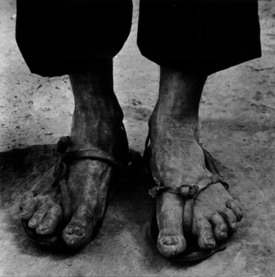
The reality.

This spun them around.  They tried as fast as possible to process what had just happened, and ‘who’ it had happened from.

Essentially, it buried them.  Jesus Christ, as Servant pounded them into the ground.  Servanthood was to take the supremacy from this point forward.  Becoming an indentured slave was now the way of Christlikeness.  This servanthood was to now guide us to a point of slavery.

Gone are the days of Zebedee, when one can ask for a position, on the right or the left.  We can ask, most certainly, but we haven’t been the first.  We can ask but the sheer weight is against us.  So very many have gone before us.  We must become a people who accept, and then presses into His grace, His specialness, His presence.

Today, more towels are what we need.

We have got to turn over our ‘need’ for recognition and pick up from the pile the rag of servanthood, we must ‘ask’ our brother/sister if we can scrub their feet.  We must get on our knees and do the unspeakable.  We must find a way to clean off their feet. This dear one, is what you’ve been told to do.

“There are many of us that are willing to do great things for the Lord, but few of us are willing to do little things.”   D.L. Moody

bry-signat

flourish91

Simple Discipleship, [Understanding]

simple_icon

Each of us who are broken believers will take the following steps. This is simple discipleship. These four will be at the root of everything we do. Our mental illness may influence this walk, but it can’t derail the process. Because it is a supernatural one, everyone starts at the same spot— whether we’ve an illness or not. Each of us must take these four steps and engage them:

  1. Come to Me

  2. Learn of Me

  3. Follow Me

  4. Remain in Me

Disciples will build their lives on these. They are solidly basic but extrapolated out into different unique variations. Each one will be uniquely yours.


COME TO ME:

Come to me, all who labor and are heavy laden, and I will give you rest.” Matthew 11:28, ESV

The source is Jesus, and his presence is sought. Our heavy issues are relieved by his nearness.


LEARN OF ME:

Take my yoke upon you, and learn from me, for I am gentle and lowly in heart, and you will find rest for your souls.” Matthew 11:29

Jesus shares his yoke with every disciple. We are to learn at his feet, and it’s there we learn of his humility. Rest is your evidence of his proximity.


FOLLOW ME:

 Then Jesus told his disciples, “If anyone would come after me, let him deny himself and take up his cross and follow me.” Matthew 16:24

A cross awaits every disciple. Self-denial is critical for every believing disciple. Jesus will show us how it’s to be done.


REMAIN IN ME:

“Remain [abide] in me, and I will remain in you. For a branch cannot produce fruit if it is severed from the vine, and you cannot be fruitful unless you remain in me.” John 15:4

This involves drawing and extracting life from him. We are a branch that pulls its life essence from its core, he is our vitality and our strength.

“Whatsoever one would understand what he hears must hasten to put into practice what he has heard.” –Gregory the Great


bry-signat (1)

cropped-christiangraffiti1.jpg


All About Flawed Lives, [Hope]

perfection-is-a-myth

“Accepting the reality of our broken, flawed lives is the beginning of spirituality not because the spiritual life will remove our flaws but because we let go of seeking perfection and, instead, seek God, the one who is present in the tangledness of our lives.“ 

— Michael Yaconelli

The principle is sound. We let go of our flaws, and make no effort to redeem them. Sounds easy. Although I feel no qualms in doing so, I still wonder. Can He forgive so much, and so many brazen sins?

We can so easily turn on ourselves (at least that’s the tendency) and find accusation.  We become our worst enemy, we desperately carry our guilt like some overloaded and heavy pack all throughout  our broken lives.

We must finally realize we can no longer seek perfection (or its facsimile) by our conduct. Things have gotten far beyond this. We are rascals and ragamuffins– and are likely to remain so. Unless God intervenes decisively.

But love has a way of loosening our rigorous thinking, like a rusted nut on some corroded metal bolt. He wrenches us, and wants to forgive us of everything. He has decided to love us. You must respond to find his forgiveness. Plain and simple.

Instead of seeking perfection, we should be really seeking God. I suppose this can be daunting. But God is comfortable in our difficulties. He rules over our personal confusion. We come with less then zero. He gives us everything.

We can do nothing but accept. His grace. Grace moves us beyond our personal tragedy. Finally accepting we can do nothing, he does everything.. And where does this leave us?

Our striving for a final acceptance comes down to this:  He rules over all our ‘issues,’ and we’re constantly made aware of this excessively extravagant grace. We are rich, only because he has made it so.

There is no one else who can make us worthy. There is no one else who can connect with our sin and then at the same time make us holy in his eyes. There is only God.

Trust in the Lord with all your heart, and do not lean on your own understanding. In all your ways acknowledge him, and he will make straight your paths.

Proverbs 3:5-6

bry-signat (1)

cropped-christiangraffiti1.jpg

The Numbers Don’t Lie: Mental Illness in America

giving-up2

~Mental Illness in America, 2016

Mental disorders are common in the United States and internationally. An estimated 26.2 percent of Americans ages 18 and older — about one in four adults — suffer from a diagnosable mental disorder in a given year.1

When applied to the 2004 U.S. Census residential population estimate for ages 18 and older, this figure translates to 57.7 million people.2 Even though mental disorders are widespread in the population, the main burden of illness is concentrated in a much smaller proportion — about 6 percent, or 1 in 17 — who suffer from a serious mental illness.1

In addition, mental disorders are the leading cause of disability in the U.S. and Canada.3 Many people suffer from more than one mental disorder at a given time. Nearly half (45 percent) of those with any mental disorder meet criteria for 2 or more disorders, with severity strongly related to comorbidity.1

In the U.S., mental disorders are diagnosed based on the Diagnostic and Statistical Manual of Mental Disorders, fourth edition (DSM-V).4

Mood Disorders

Mood disorders include major depressive disorder, dysthymic disorder, and bipolar disorder.

  • Approximately 20.9 million American adults, or about 9.5 percent of the U.S. population age 18 and older in a given year, have a mood disorder.1,2
  • The median age of onset for mood disorders is 30 years.5
  • Depressive disorders often co-occur with anxiety disorders and substance abuse.5

Major Depressive Disorder

  • Major Depressive Disorder is the leading cause of disability in the U.S. for ages 15-44.3
  • Major depressive disorder affects approximately 14.8 million American adults, or about 6.7 percent of the U.S. population age 18 and older in a given year.1, 2
  • While major depressive disorder can develop at any age, the median age at onset is 32.5
  • Major depressive disorder is more prevalent in women than in men.6

Dysthymic Disorder

  • Symptoms of dysthymic disorder (chronic, mild depression) must persist for at least two years in adults (one year in children) to meet criteria for the diagnosis. Dysthymic disorder affects approximately 1.5 percent of the U.S. population age 18 and older in a given year.1, This figure translates to about 3.3 million American adults.2
  • The median age of onset of dysthymic disorder is 31.1

Bipolar Disorder

  • Bipolar disorder affects approximately 5.7 million American adults, or about 2.6 percent of the U.S. population age 18 and older in a given year.1, 2
  • The median age of onset for bipolar disorders is 25 years.5

Suicide

  • In 2006, 33,300 (approximately 11 per 100,000) people died by suicide in the U.S.7
  • More than 90 percent of people who kill themselves have a diagnosable mental disorder, most commonly a depressive disorder or a substance abuse disorder.8
  • The highest suicide rates in the U.S. are found in white men over age 85.9
  • Four times as many men as women die by suicide9; however, women attempt suicide two to three times as often as men.10

Schizophrenia

  • Approximately 2.4 million American adults, or about 1.1 percent of the population age 18 and older in a given year,11, 2 have schizophrenia.
  • Schizophrenia affects men and women with equal frequency.12
  • Schizophrenia often first appears in men in their late teens or early twenties. In contrast, women are generally affected in their twenties or early thirties.12

Anxiety Disorders

Anxiety disorders include panic disorder, obsessive-compulsive disorder, post-traumatic stress disorder, generalized anxiety disorder, and phobias (social phobia, agoraphobia, and specific phobia).

  • Approximately 40 million American adults ages 18 and older, or about 18.1 percent of people in this age group in a given year, have an anxiety disorder.1,2
  • Anxiety disorders frequently co-occur with depressive disorders or substance abuse.1
  • Most people with one anxiety disorder also have another anxiety disorder. Nearly three-quarters of those with an anxiety disorder will have their first episode by age 21.5 5

Panic Disorder

  • Approximately 6 million American adults ages 18 and older, or about 2.7 percent of people in this age group in a given year, have panic disorder.1, 2
  • Panic disorder typically develops in early adulthood (median age of onset is 24), but the age of onset extends throughout adulthood.5
  • About one in three people with panic disorder develops agoraphobia, a condition in which the individual becomes afraid of being in any place or situation where escape might be difficult or help unavailable in the event of a panic attack.12

Obsessive-Compulsive Disorder (OCD)

  • Approximately 2.2 million American adults age 18 and older, or about 1.0 percent of people in this age group in a given year, have OCD.1, 2
  • The first symptoms of OCD often begin during childhood or adolescence, however, the median age of onset is 19.5

Post-Traumatic Stress Disorder (PTSD)

  • Approximately 7.7 million American adults age 18 and older, or about 3.5 percent of people in this age group in a given year, have PTSD.1, 2
  • PTSD can develop at any age, including childhood, but research shows that the median age of onset is 23 years.5
  • About 19 percent of Vietnam veterans experienced PTSD at some point after the war.13 The disorder also frequently occurs after violent personal assaults such as rape, mugging, or domestic violence; terrorism; natural or human-caused disasters; and accidents.

Generalized Anxiety Disorder (GAD)

  • Approximately 6.8 million American adults, or about 3.1 percent of people age 18 and over, have GAD in a given year.1, 2
  • GAD can begin across the life cycle, though the median age of onset is 31 years old.5
To finish reading this article, you will need to go to its source at:

http://www.nimh.nih.gov/health/publications/the-numbers-count-mental-disorders-in-america/index.shtml  


cropped-christiangraffiti1 (1)