The Numbers Don’t Lie: Mental Illness in America

giving-up2

~Mental Illness in America, 2016

Mental disorders are common in the United States and internationally. An estimated 26.2 percent of Americans ages 18 and older — about one in four adults — suffer from a diagnosable mental disorder in a given year.1

When applied to the 2004 U.S. Census residential population estimate for ages 18 and older, this figure translates to 57.7 million people.2 Even though mental disorders are widespread in the population, the main burden of illness is concentrated in a much smaller proportion — about 6 percent, or 1 in 17 — who suffer from a serious mental illness.1

In addition, mental disorders are the leading cause of disability in the U.S. and Canada.3 Many people suffer from more than one mental disorder at a given time. Nearly half (45 percent) of those with any mental disorder meet criteria for 2 or more disorders, with severity strongly related to comorbidity.1

In the U.S., mental disorders are diagnosed based on the Diagnostic and Statistical Manual of Mental Disorders, fourth edition (DSM-V).4

Mood Disorders

Mood disorders include major depressive disorder, dysthymic disorder, and bipolar disorder.

  • Approximately 20.9 million American adults, or about 9.5 percent of the U.S. population age 18 and older in a given year, have a mood disorder.1,2
  • The median age of onset for mood disorders is 30 years.5
  • Depressive disorders often co-occur with anxiety disorders and substance abuse.5

Major Depressive Disorder

  • Major Depressive Disorder is the leading cause of disability in the U.S. for ages 15-44.3
  • Major depressive disorder affects approximately 14.8 million American adults, or about 6.7 percent of the U.S. population age 18 and older in a given year.1, 2
  • While major depressive disorder can develop at any age, the median age at onset is 32.5
  • Major depressive disorder is more prevalent in women than in men.6

Dysthymic Disorder

  • Symptoms of dysthymic disorder (chronic, mild depression) must persist for at least two years in adults (one year in children) to meet criteria for the diagnosis. Dysthymic disorder affects approximately 1.5 percent of the U.S. population age 18 and older in a given year.1, This figure translates to about 3.3 million American adults.2
  • The median age of onset of dysthymic disorder is 31.1

Bipolar Disorder

  • Bipolar disorder affects approximately 5.7 million American adults, or about 2.6 percent of the U.S. population age 18 and older in a given year.1, 2
  • The median age of onset for bipolar disorders is 25 years.5

Suicide

  • In 2006, 33,300 (approximately 11 per 100,000) people died by suicide in the U.S.7
  • More than 90 percent of people who kill themselves have a diagnosable mental disorder, most commonly a depressive disorder or a substance abuse disorder.8
  • The highest suicide rates in the U.S. are found in white men over age 85.9
  • Four times as many men as women die by suicide9; however, women attempt suicide two to three times as often as men.10

Schizophrenia

  • Approximately 2.4 million American adults, or about 1.1 percent of the population age 18 and older in a given year,11, 2 have schizophrenia.
  • Schizophrenia affects men and women with equal frequency.12
  • Schizophrenia often first appears in men in their late teens or early twenties. In contrast, women are generally affected in their twenties or early thirties.12

Anxiety Disorders

Anxiety disorders include panic disorder, obsessive-compulsive disorder, post-traumatic stress disorder, generalized anxiety disorder, and phobias (social phobia, agoraphobia, and specific phobia).

  • Approximately 40 million American adults ages 18 and older, or about 18.1 percent of people in this age group in a given year, have an anxiety disorder.1,2
  • Anxiety disorders frequently co-occur with depressive disorders or substance abuse.1
  • Most people with one anxiety disorder also have another anxiety disorder. Nearly three-quarters of those with an anxiety disorder will have their first episode by age 21.5 5

Panic Disorder

  • Approximately 6 million American adults ages 18 and older, or about 2.7 percent of people in this age group in a given year, have panic disorder.1, 2
  • Panic disorder typically develops in early adulthood (median age of onset is 24), but the age of onset extends throughout adulthood.5
  • About one in three people with panic disorder develops agoraphobia, a condition in which the individual becomes afraid of being in any place or situation where escape might be difficult or help unavailable in the event of a panic attack.12

Obsessive-Compulsive Disorder (OCD)

  • Approximately 2.2 million American adults age 18 and older, or about 1.0 percent of people in this age group in a given year, have OCD.1, 2
  • The first symptoms of OCD often begin during childhood or adolescence, however, the median age of onset is 19.5

Post-Traumatic Stress Disorder (PTSD)

  • Approximately 7.7 million American adults age 18 and older, or about 3.5 percent of people in this age group in a given year, have PTSD.1, 2
  • PTSD can develop at any age, including childhood, but research shows that the median age of onset is 23 years.5
  • About 19 percent of Vietnam veterans experienced PTSD at some point after the war.13 The disorder also frequently occurs after violent personal assaults such as rape, mugging, or domestic violence; terrorism; natural or human-caused disasters; and accidents.

Generalized Anxiety Disorder (GAD)

  • Approximately 6.8 million American adults, or about 3.1 percent of people age 18 and over, have GAD in a given year.1, 2
  • GAD can begin across the life cycle, though the median age of onset is 31 years old.5
To finish reading this article, you will need to go to its source at:

http://www.nimh.nih.gov/health/publications/the-numbers-count-mental-disorders-in-america/index.shtml  


cropped-christiangraffiti1 (1)

Our Life in Babylon

Living-in-babylon-Logo

Christians are now smack-dab in “Babylon.” We must live our lives under the auspices of this hostile world-system, and yet stay faithful to our Lord. We must manage ourselves with the same grace as Daniel or Esther.

In Jeremiah 29 there contains an important historical letter that the prophet Jeremiah wrote to those taken into captivity. In it we can absorb much of what is needful for the moment. For people caught in Babylon it becomes a vital document, advising them of what they should now do.

This list comes straight out of Jeremiah 29.

  • First, prepare for the long haul. Be good citizens of your new land, (vv.5-6.)
  • Second, pray for the peace of the nation you’re captive in. (v.7.)
  • Third, don’t be fooled by it’s culture, Discern what is true and what is false. Babylon is full of false gods and worship.
  • Fourth, remember that God has given you “a future and a hope” (v. 11.)
  • Lastly, extend that same discernment to the spiritual understanding of your own past.

These five should be enough to navigate faithfully through hard times in Babylon. We must admit that we’re only “pilgrims and strangers” here. Our citizenship is in heaven where it is secure. By faith we understand this.

As broken believers we are supervised by the Holy Spirit, even in this difficult place, Our souls are shepherded by God, even in Babylon. Our “captivity” is only temporary– it is not a permanent one.

“And you will seek Me and find Me, when you search for Me with all your heart.”

Jeremiah 29:13, NKJV

“By the rivers of Babylon, There we sat down, yea, we wept When we remembered Zion.”

Psalm 137:1

“She who is in Babylon, elect together with you, greets you; and so does Mark my son.”

1 Peter 5:13

‘Alas, alas, that great city Babylon, that mighty city! For in one hour your judgment has come.’

Revelation 18:10

ybic, Bryan


cropped-christiangraffiti1-2

Finding New Ways to Love

soup_7643cn

“…and may the Lord make you increase and abound in love for one another and for all, as we do for you,”

1 Thessalonians 3:12, ESV

As you mature as a Christian believer you may feel “stalled” by an attained growth. You might feel you’ve finally arrived. And in a sense you have. You have finally worked through a few issues, and although you know your not quite perfect, you feel like things are starting to “click.”

Many times when we finally get to this point, you realize there just has to be something. But you really don’t want to go back and yet this can be a season of complacency. This can be a dangerous time. It’s good to be on guard against the “doldrums of discipleship.”

Serving others can help you work through this curious time. You will find a lot of health in this, it also takes the focus off of self which is a great thing. Since I struggle with depression at times I find myself looking beyond my issues. I focus on someone else. Instead of becoming absorbed in myself, I redirect my vision to serving the Lord by serving another.

“In this life we cannot do great things. We can only do small things with great love.”

Mother Teresa

I’m discovering new ways to love. People I never dreamed of are crossing my path.  As a Christian, I’m called to reach “all that the Father gives me.” The day should (and is) filled with “divine appointments” which my Father desires for me to keep. This won’t make me more “spiritual,” only more available.

We are meant to keep on, “increasing and abounding in love.”

To keep this increase we must continually look for news ways to love. Jesus had this when He saw the 5000. He questioned His disciples to see what they had. The managed to scrap up “five loaves and two fishes” hardly worth mentioning (Matt. 14:16-18). But Jesus had plans for this meager beginning.

Sometimes we stall in our discipleship. We think what we have is too little, or, we don’t see the need of the crowds. Either or both. We limit God’s kingdom by our lack of responsiveness. The Holy Spirit is asking us to “increase and abound.”

Always find new ways to be fruitful. Don’t hinder yourself until you think you’re ready. Look and perceive the appointments of the Lord. Make yourself available and anticipate chances He brings your way. If you’re limited, that’s ok too. He will gracefully multiply what you do have, just like “the loaves and fishes.” :-)

bry-signat-1

cropped-christiangraffiti1 (2)


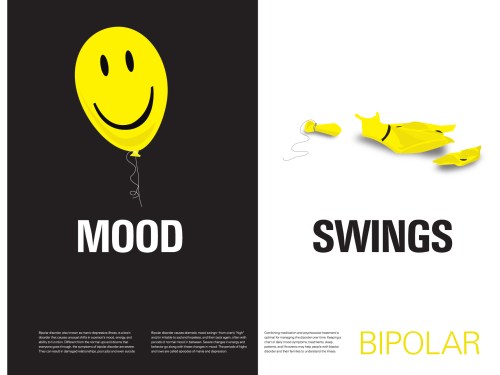
Bipolar Disorder– Basic Stuff


If you have bipolar disorder, you may recognize many below. Not everyone has exactly the same symptoms. Talk with your healthcare provider about your symptoms at each visit.

  • Feeling sad or blue, or “down in the dumps”
  • Loss of interest in things you used to enjoy, including sex
  • Feeling worthless, hopeless, or guilty
  • Sleeping too little or too much
  • Changes in weight or appetite
  • Feeling tired or having little or no energy
  • Feeling restless
  • Problems concentrating or making decisions
  • Thoughts of death or suicide


Symptoms of mania may include:

  • Increased energy level
  • Less need for sleep
  • Racing thoughts or mind jumps around
  • Easily distracted
  • More talkative than usual or feeling pressure to keep talking
  • More self-confident than usual
  • Focused on getting things done, but often completing little
  • Risky or unusual activities to the extreme, even if it’s likely bad things will happen

Here are some behaviors that may be seen in people with bipolar disorder. Please note some of these behaviors may also indicate a different problem, so proper diagnosis is important.

  • Agitation
  • Alcohol or drug abuse
  • Irritability
  • Excessive gambling
  • Violence
  • Poor judgment with decisions
  • Careless spending, buying sprees
  • Talking about hurting oneself
  • Risky sex or change in sexual activity
  • Impulsive financial investments
  • More arguments
  • Change in energy level, appetite, or sleep pattern
  • Relationship problems at home or work
  • Mounting debt
  • Drinking or drugging for ‘escape’ or maintenance purposes
  • Legal/criminal issues
Visit http://www.webmd.com/depression/guide/bipolar-disorder-manic-depression for more detailed information about bipolar disorder and its symptoms.

bry-signat-1

cropped-christiangraffiti1 (2)