Night Terrors, [Protected Children]

night-terrors-21467698 “You will not fear the terror of night, nor the arrow that flies by day,”

Psalm 91:5

flourish14

It is easy to fear. This can be the true reaction of a soul smacking up against the vicissitudes of life. Things do fluctuate, and we really can’t predict its issues with us. We hit it at an alarming speed, which only adds to the confusion. Who can act and react to all the twists and turns?And life can get strange. If you’re not afraid sometimes, you may not be human, lol.

But fear can be extracted from the believing Christian. 

“You will not fear” is the ‘buzzword’ repeated over and over. in scripture. And fear is such a complicated thing. (It really doesn’t ‘snack,’ it devours a person.) The believer carries the only antidote to the stark raving fear that eats away at the soul.

“The terror of night,” is a clear description of all that can occur in this life. Terror is such a powerful word. It embeds within with foreboding and a noxious kind of fear. It’s a kind of ‘panic’ in the face of an acute evil. It is hostile to the spirit and it claims all that it gets. Fear can drive a person to do some regrettable things.

 “Nor the arrow that flies by day,” Daylight means that the archer can see his prey. He doesn’t work at night, but uses his eyesight during the day. The arrow he shoots focuses at a singular point. He wants to pierce the heart. He strains at his bow, at the precise moment lets loose.

But we are given this precious promise, that gives us faith and acts like a shield and a buckler. The promise is given to unworthy persons. No one deserves the grace that has been given so freely. But we do take what He gives. We have a ‘stark-raving’ fear on one side, and on the other is a soul under protection. Our decision is obvious.

“You will not fear the terror of night, nor the arrow that flies by day,”

Psalm 91:5

This simple verse puts everything in its place. I’ve read it, and now choose to make it live by faith in this ragged heart of mine. Yes, the promise is real– no mirage and no tricks, no ‘smoke, or mirrors.’ It is a true offer of protection for the ‘child of God.’ He alone meets the need inside our hearts for safety.

aabryscript

Like this? Check out:

https://brokenbelievers.com/2014/06/26/the-snare-of-the-fowler-psalms-91/
The Difference the Holy Spirit Makes

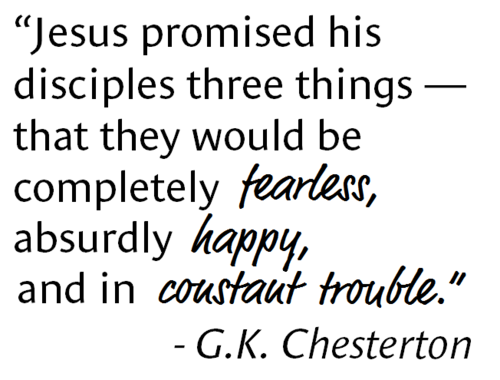
Chesterton-disciple

I like this quote. The early Church was all of these things: Fearless, happy, and very much in trouble. Luke wrote of the nascent exploits of this group of people in the Book of Acts, and while some believers will debate different aspects of theology, none can diminish the reality. These were human beings irrevocably touched by the Holy Spirit.

Some have even suggested that the title of the book be changed to “the Acts of the Holy Spirit.” (Instead of “Acts of the Apostles”).

When the fire of the Holy Spirit meets the dry tinder of the heart, it explodes into a conflagration that can’t be contained. It boils over and touches everyone around it. The disciples became fearless. Their boldness could not be diminished or diluted. They were so courageous (and contagious) that they preached to both kings and beggars.

They were “happy.” Once they had surrendered their personal ‘agendas’ they became immune to the negative issues of life. They soared with the eagles of contentment and joy. They no longer lived in the ‘mud’ of human life. They were ‘Teflon’ to that which can be so sticky. Happiness is the deep evidence of a personal contact with God’s own spirit.

But they ‘were in constant trouble.’ There may never been a people so maligned and persecuted. The apostle Paul faced daily obstacles. As the de facto leader of the church, he absorbed a lot of hatred and wrath that was focused on the early Church. Everywhere he went this darkness would descend, and each time God met him.

I suppose that we might ask ourselves, is this our experience? Am I fearless, and happy? Am I in ‘constant trouble” for the sake of the Gospel? (Do the police have my ‘mug shot?’)

Honest reflection is in order I think. We should really determine if we have the very same spirit that the early Church possessed. Whether or not, we should amend our relationship with the Spirit of God, and seek to be more tractable to His work. We start by believing the truth about our hearts and lives. The Truth is stronger than the lies.

This post was not intended to condemn. If you have read that into these words, I ask forgiveness. But reading this over, I will retract nothing. But I still ask that you ‘spiritually check’ each thought. Is it biblical, and does it glorify the Lord Jesus?

“I have told you all this so that you may have peace in me. Here on earth you will have many trials and sorrows. But take heart, because I have overcome the world.”

John 16:33, NLT


aabryscript


cropped-christiangraffiti1-3

Mundane Atrocities, [Woundings]

home-care-options-abound-for-people-suffering-from-depression-in-home-care-support-services

“Keep your heart with all diligence,
For out of it spring the issues of life.”

Proverbs 4:23

We often carry in our hearts the woundings from other’s actions and sins. We will typically respond in different ways. Some insulate themselves, others get quirky; quite a few turn on to drugs and alcohol to ease the pain. Very few handle these wounds properly without God’s intervention.

We can get quite innovative building and maintaining these deceptions and protections. If you’ve been ‘wounded’ you know what I mean. I struggled for the longest time over something spoken in jest– harmless banter that became poisonous over time. We can hurt from just simple trifles.

There is something I call, ‘mundane atrocities.’ They are casual encounters that are woven over time to produce nasty results. They can often be the raw material for the deceptions that shape us.

The story of Joseph in the Book of Genesis 39-50 provides us insight into the life of one man who sincerely follows the Lord, through outrageous ‘twists & turns.’ He navigates as a dreamer and a loved son, to slave and then prison. Over the years Joseph is hurt by the brokenness of those around him, yet he moves through these without becoming derailed.

Joseph says something toward the end that is quite perceptive. In Genesis we read of his heart in these mundane atrocities. These are the words of a broken man, from a broken family

“But now, do not therefore be grieved or angry with yourselves because you sold me here; for God sent me before you to preserve life.” (45:5)

 “But as for you, you meant evil against me; but God meant it for good, in order to bring it about as it is this day, to save many people alive.” (50:20)

Mind you, this is after years of false imprisonment and vicious misunderstanding. Joseph sees God’s hand in deep injustice. He keeps his spirit clean through it all. He could’ve reacted and insisted on vengeance, but that would not happen.

I believe there exists a “Holy Order of the Josephites.”

Joseph is a prototype, a real example for us who must navigate through the tangledness of life. I believe there exists a “Holy Order of the Josephites.” It is bestowed on those who have experienced this first-hand and come through with their spirits clean. (We call this Christlikeness.)

Jesus himself walks by your side through all this pain. Fix your eyes on the one who understands intimately your situation. “God means it for good” and intends on bringing you through this, you will stand by His side one day soon.

bry-signat


flourish9

The Sinning Servant

St Elijah FBol

God responds to our personal falterings in an amazing way. The prophet Elijah had experienced considerable fireworks in his ministry. One could easily dismiss an incident when he failed big time.

“Ahab told Jezebel all that Elijah had done, and how he had killed all the prophets with the sword. 2 Then Jezebel sent a messenger to Elijah, saying, “So may the gods do to me and more also, if I do not make your life as the life of one of them by this time tomorrow.” 3 Then he was afraid, and he arose and ran for his life and came to Beersheba, which belongs to Judah, and left his servant there.”

1 Kings 19:1-3, ESV

Up to this time:

  1. Elijah was coming off Mt. Carmel having witnessed fire from heaven.
  2. The 450 prophets of Baal had been executed.
  3. Rain was coming through his prayer, the long drought was ending.

Things seemed right on track for a nationwide revival. Life was good for Elijah, and for the Kingdom of Israel. “Laissez les bons temps rouler.”

But Queen Jezebel wasn’t about to give up her stranglehold on the kingdom. She threatens Elijah. A messenger is dispatched to him; and Elijah is completely intimidated. He reacts by running as fast as he can to get away. The prophet known for boldness and miracles flees for his life into the wilderness.

What was it about Jezebel that caused such a frantic and irrational move? Why didn’t Elijah’s faith stand this test? He had been in stickier places.

“But he himself went a day’s journey into the wilderness and came and sat down under a broom tree. And he asked that he might die, saying, “It is enough; now, O Lord, take away my life, for I am no better than my fathers.”

1 Kings 19:4

Fear and fatigue were working on Elijah’s mind. This is a fact, if you’re acting unscripturally you will behave irrationally.

God ministers to his sinning servant with a powerful and formidable gentleness. It takes awhile for Elijah to react to this tenderness. But there is a no condemnation, no recrimination, no words of rebuke; all we hear is God’s still small voice. God doesn’t chide, but quietly asks his prophet to consider. All Elijah does is accept a certain grace. That’s it.

“And when Elijah heard it, he wrapped his face in his cloak and went out and stood at the entrance of the cave. And behold, there came a voice to him and said, “What are you doing here, Elijah?” 

1 Kings 19:13

Fear, defeat, and self-pity were real issues for Elijah (the man of God). Scripture tells us that, “Elijah was a man with a nature like ours” (James 5:17). We are not machines, but mere men who falter and trip. That is good to remember.

In 2 Corinthians 12:10 Paul comments, “For when I am weak, then I am strong.” The Gospel is predicated on human weakness and flaws. It reaches us consistently where we need it most. The God of Elijah still whispers to broken hearts.

aabryscript


cropped-christiangraffiti1 (3)