Hope for the Hopeless [Joy]

Titanic-Hitting-The-Icebery

12 Rejoice in hope, be patient in tribulation, be constant in prayer.”

Romans 12:12

Three things are critical for the New Testament believer:

  1. To rejoice out of a real hope,
  2. a deliberate endurance,
  3. and a prayer life that is unceasing.

These three are vital for us if we want to be authentic saints. These three aspects must become foremost in our discipleship.

Of the three, the first is to rejoice out of a real hope is the most important. It seems like I take the most “hits” over this one. There is a constant erosion  over my joy and my hope. I encounter the false belief that I will be one of the damned. A variation is that I’m ‘cursed’ by God and my life from this point is always going to be hellish and miserable. Frozen like a mosquito in ancient amber.

For me, my mental illness is a sin– the sin of despair. I don’t insist on the right terminology or of definitions. Some believe these issues are demonic. Some wonder about the use of meds, or the value of seeing a psychiatrist or going into therapy. These are all valid, but it seems like polishing the brass rails as the Titanic is seeking.

I won’t try to give answers, because there isn’t a single one to be found. There’s a complexity about the human heart, and God’s sovereign plan that I can’t venture anything. I will only suggest we give room for our own misunderstandings. Perhaps it’s the presence of Jesus we can agree on.

Rejoice in hope,” goes a long ways to combat the enemy, our own fallenness and our own sin of despair. A ‘song to the Lord’ breaks our souls free and is the brokenbelievers true hope is the best antidepressant. But I vote we keep singing out of our cells (Acts 16:25).

bry-signat (1)

cropped-christiangraffiti1.jpg


The Awful Pain of Job

job-and-his-friends

“Oh, why give light to those in misery,
    and life to those who are bitter?
21 They long for death, and it won’t come.
    They search for death more eagerly than for hidden treasure.
22 They’re filled with joy when they finally die,
    and rejoice when they find the grave.
2Why is life given to those with no future,
    those God has surrounded with difficulties?”

Job 3:20-23, NLT

Job begins to curse his existence and his words are saturated with frustration. He grieves for all of his dead children and is sickened by his afflictions. Job is a man pushed beyond the edge.

Job is the “poster child” of human suffering. He is completely without pretense as he openly grieves. He voices exactly what is in his heart.

Let us be clear about this; He is devastated, ravaged by Satan’s grim ministry. Job to his credit, is oblivious to Satan’s wager with the Almighty God. He has no clue that he has been chosen by God in this matter. The Lord keeps His secrets.

All Job knows is the pain, and there is the endless grief that even his tears can’t help.

In Job’s first speech he asks some basic questions:

  • Why is light given to those who are full of pain?
  • Why does life unfold to the one who rather not live anymore?

Death has a powerful influence in this three verses, He wants to die, and end the charade. He wishes for non-existence and laments that he can not die fast enough.

People with disabilities and chronic pain can understand Job’s desire for release. Once they were “whole” people. Death was something to be avoided at all costs. But now it is seen as an escape.

Hurting people will often turn to drinking and drugging as a way of coping. We’ll try anything to numb our thinking. It’s what gets us through the day. Oblivion has become my best friend.

For Job (the patron saint of pain) finds that nothing will fix him. His friends have come, but they seem to only accuse and confuse job. Honestly he is better when they just sat with him in silence.

“God wants us to choose to love him freely, even when that choice involves pain, because we are committed to him, not to our own good feelings and rewards. He wants us to cleave to him, as Job did, even when we have every reason to deny him hotly.”

–Philip Yancey

“Come quickly, Lord, and answer me, for my depression deepens. Don’t turn away from me, or I will die. Let me hear of your unfailing love each morning, for I am trusting you. Show me where to walk, for I give myself to you.”

Psalm 143:7-8

ybic, Bryan


cropped-christiangraffiti1 (3)


For My Friends in Battle

1554402_10152223234708089_4062854179017774870_n

 “And I am certain that God, who began the good work within you, will continue his work until it is finally finished on the day when Christ Jesus returns.”

Philippians 1:6

bry-signat (1)

cropped-christiangraffiti1.jpg

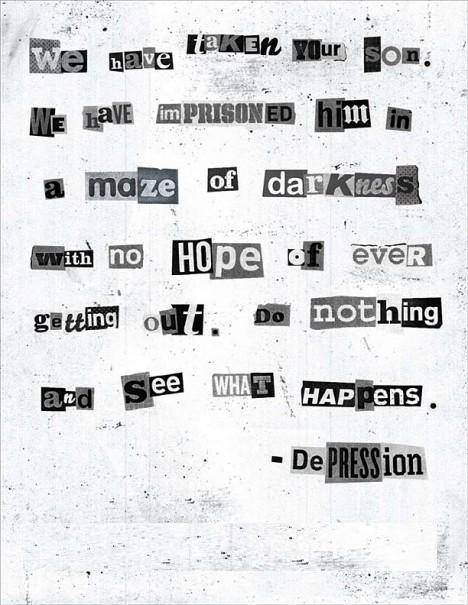
The Ransom Note

depression-note

“We collapse in the dust,
    lying face down in the dirt.
26 Rise up! Help us!
    Ransom us because of your unfailing love.”

Psalm 44:25-26, NLT

“For even the Son of Man came not to be served but to serve others and to give his life as a ransom for many.”

Mark 10:45

“God chose him as your ransom long before the world began, but he has now revealed him to you in these last days.”

1 Peter 1:20

I think that God has more or less ransacked the human language in His effort to get through to us the critical nature of what exactly has been done just for us. When it comes to our salvation and what that means to the universe, the word, “ransom” is used.

The connection for us, as we consider the implications, has mainly a connection with the crime of “kidnapping.” This is when someone is captured by other men, and held in captivity until certain terms are met. When the kidnapper feels his needs are fully met, then the hostage is released.

In the Bible sense, we should work through several verses. There are at least three Hebrew words. In the N.T. Greek just a single word to explain “ransom” is seen. And yet we can say, each word is linked back to the idea of being “helpless.” And helpless is far more than a definition, rather it is a description of a “state of being.”

We come to understand that helplessness is the natural state of human beings. We each have been captured, taken away and are being held, until terms are met for our release. I suppose that some see this helplessness easier than others. (And I’m sure a few will never acknowledge it at all). But nevertheless, it is real and it describes every single person that has ever lived.

Being completely helpless is hardly a situation we would ever choose. Having ransom demands being made to set us free is mostly awkward. And it’s an affront. Perhaps, we feel we are worth more? But the issues here are eternal, and currency concepts are never the consideration.

But there is a present need, to purchase back those who are being held as captives. The absolute clear position is that the Lord Jesus Christ, died in our place. Choosing to die for us, he was essentially tortured before his cruel death. In this decision, he himself paid my ransom. In doing this, I was set free and fully able to return home.

There are many who have been free. But there is a thing called “the Stockholm Syndrome.” This refers to those in captivity who somehow “connect” with their kidnappers through a prolonged captivity. This is to the point where they begin to act less than the victims, and more like the captor. It is confusing. They seem to go out of their way to act “pro-kidnapper”. This can get very disturbing.

We must look to our children, and closest family and our friends. They are toiling for Satan, the captor of our souls (past-tense). Many different tactics are being used– depression, addictions, lust, greed, anger, gluttony, pride, guilt and many other deceitful things. They are being held, until faith (the key) “springs” them out of their prison.

Thank you Jesus, for coming to free us. Thank you for forgiving us. We have been released, and now walk away free. You died, so we might live. We desperately want to see the others we love set free.

*

ybic, Bryan


cropped-christiangraffiti1 (3)

*