Front and Center

John 8:3-11

Then the scribes and the Pharisees brought a woman caught in adultery, making her stand in the center. “Teacher,” they said to him, “this woman was caught in the act of committing adultery. In the law Moses commanded us to stone such women. So what do you say?” They asked this to trap him, in order that they might have evidence to accuse him.

Jesus stooped down and started writing on the ground with his finger. When they persisted in questioning him, he stood up and said to them, “The one without sin among you should be the first to throw a stone at her.” Then he stooped down again and continued writing on the ground. When they heard this, they left one by one, starting with the older men. Only he was left, with the woman in the center. 10 When Jesus stood up, he said to her, “Woman, where are they? Has no one condemned you?”

11 “No one, Lord,” she answered.

John 8:3-11

I remember how Jesus defended me. I had been led through the crowds. The temple was filled with people who were there for the festival. It was a time of joy and feasting, but not for me.

Especially not for me.

The temple police escorted me to Jesus. I was now the focus of everyone’s attention. I felt dirty and ashamed. Standing there I could feel the lustful looks from the Pharisees; but there was something else as well, a look from Jesus that I had never seen before. There was compassion there, something quite extraordinary.

I’m ashamed, I committed adultery, I had slept with another man who wasn’t my husband.

I was to be stoned, to have hard rocks thrown at me by “holy” men. The Law had pronounced my guilt, and I knew how I was to be punished. And I deserved it. Yet the man who I slept with was never charged, he escaped and it was I that would be put to death. I didn’t blame him.

My shame was now public knowledge–everyone knew, the Pharisees made sure of that.

They put me front and center. They were going to test Him. They were going to destroy me.

These men who brought me had ulterior motives, they desperately hoped Jesus would stumble. I think they wanted to prove once and all to the crowds that were watching that Jesus really wasn’t the Messiah. They wanted to trap him.

Jesus seemed to understand the implications of this satanic effort.

Only Rome had the power of execution, and yet the Mosaic Law declared that I was to die. I stood waiting, expecting the worst. What else could I do?

It’s funny, but Jesus understood all of this. He seemed to look right through this theological trick, and He responded in a way that really shocked everyone. He never spoke, but bowed low and began to write in the dirt with his finger. Amidst their vicious accusations, they pressed their case.

Jesus bent down again, and he wrote some more.

I never knew what he wrote–but I had to believe it must have been something that revealed the sin in the hidden hearts of the men who were accusing me. In that moment, they quickly dropped the case against me. They all filed out, one by one, in dramatic fashion. I now stood alone with Jesus.

And it was then that Jesus looked directly at me.

I was still afraid, but it was strange, I felt a wave of peace as well. I quietly waited, not knowing what He was going to say to me. I suppose I half expected the worst.

Yes, he did confront me. But He wanted me to acknowledge that those accusing men had left. I saw it and understood. Jesus was asking me to believe that I was now really free. But then he wanted me to understand something that seemed quite crucial.

“Neither do I condemn you,” said Jesus. “Go, and from now on do not sin anymore.”

That dear one was a powerful moment. He set me free with the understanding that He did not condemn me. But my freedom from judgement came with a catch–sort of. I knew then that my sin must be renounced. My freedom came with a price. But knowing I was completely released, meant I was now a free woman.

At that moment I understood completely.

“God pardons like a mother, who kisses the offense into everlasting forgiveness.”

    Henry Ward Beecher

My Facebook page: https://www.facebook.com/bryan.lowe

An Attack of Panic

A panic attack affects one out of 75 people, and it often can be quite disconcerting.  My panic attacks occur roughly once a month and last for about 1/2 hour.  When the acute symptoms first appear my first reaction is to resist giving in to it.  I get the “shakes.” For a long time, I didn’t know what caused them or more importantly what could stop it.

A panic attack is a sudden surge of an incredible fear.

Typically it comes without warning and without any obvious reason. It is far more intense than the feeling of being ‘stressed out’ that most people experience.

As a believer in Jesus, the physical symptoms can be quite real, but the spiritual issues become obvious when we consider Satan’s attacks on our faith. Although we may have a proclivity, we don’t have to surrender to panic as the way of life.

Symptoms of a panic attack include:

  • racing heartbeat
  • difficulty breathing, feeling as though you ‘can’t get enough air’
  • a terror, that is almost paralyzing, a seeming irrational fear
  • dizziness, lightheadedness or nausea
  • trembling, sweating, shaking
  • choking, chest pains
  • hot flashes, or sudden chills
  • tingling in fingers or toes, (‘pins and needles’).
  • fear that you’re going to go crazy, or are about to die

You probably recognize this as the classic ‘flight or fight’ response that human beings experience when we are in a situation of danger. But during a panic attack, these symptoms seem to rise from out of nowhere. They occur in seemingly harmless situations–they can even happen while you are asleep.

In addition to the above symptoms, a panic attack is marked by the following conditions:

  1. it occurs suddenly, without any warning and without any way to stop it.
  2. the level of fear is way out of proportion to the actual situation; often, in fact, it’s completely unrelated.
  3. it passes in several minutes; the body cannot sustain the ‘fight or flight’ response for longer than that. However, repeated attacks can continue to recur for hours.

A panic attack is not dangerous, but it can be a bit terrifying.

Largely because it feels ‘crazy’ and ‘out of control.’ Panic disorder is frightening because of the symptoms associated with it, and also because it often leads to other complications such as phobias, depression, substance abuse, medical complications, even suicide.

Its effects can range from mild social impairment or just pretty a total inability to face the outside world.

As a follower of Jesus, I’m certain that Psalm 91 is written for me. If I may, attacks of fear shouldn’t be faced head on, rather we set our hearts on Jesus, and allow Him to defend and protect us. I suppose we’ll always be susceptible, but we dare not be defeated.

Psalm 91:5, ESV

Further reading and help on panic attacks check out these sites:

What Will it Be, Fire or Blackberries?

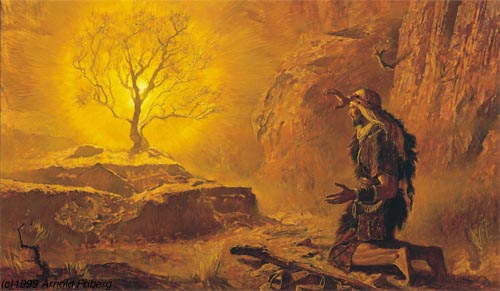
“Earth’s crammed with heaven, and every common bush afire with God; But only he who sees, takes off his shoes, The rest sit round it and pluck blackberries.”

Elizabeth Barrett Browning

Psalm 33:8

The most phenomenal night skies were in Mexico while camping on the beach. We had no electricity, no light pollution. I laid on the sand and stared up into the Milky Way. The conditions were perfect. It seemed there were 1000 times more stars than ever seen before.

But as I laid on the beach I gazed up, a weird surge of fear gripped me.

I started to panic then–I was trembling and shaking. I got up and ran to our tent. I just couldn’t handle the incredible universe with no buffer. I was completely undone and reduced to a quivering speck of dust. I tried to tell my wife Lynn what had just happened to me, but I couldn’t. I was too scrambled. I couldn’t speak.

I now know that what I had experienced was called “awe.”

It was a word used commonly a few generations ago. We’ve side-stepped this perspective in these more modern times. We rarely contemplate the night sky. No one told me this might happen!

We seldom, if ever, have seen fire in a bush.

MINOLTA DIGITAL CAMERA

It seems we have traded our awareness of an authentically Almighty God, and in turn, we get to pick all blackberries we can haul. We reason it out and feel we have made a better bargain. But when we extricate this from our souls, don’t be surprised if we suddenly find that we have become spiritual paupers. 

Maybe we should learn to see those things that are invisible.

Each of us has the opportunity now to see the spiritual world that swirls around us. Why wait for heaven? Ask the Father to reveal His glory right now in this present moment. Learn to see that which can’t be seen by our eyes, but must be seen only through the optics of our faith.

And after all, only faith can breakdown our ignorant illusions, it’s “the conviction of things not seen.” (Hebrews 11:1.)

“The heavens are telling of the glory of God; And the expanse [of heaven] is declaring the work of His hands.”

Psalms 19:1, Amplified

Poetry of the Broken

Last Saturday I purchased a wonderful find at Powell’s Books (Portland, Oregon’s own homegrown new and used bookstore) – a used book called “Invisible Light: Poems about God” – for only $4.50. And it is in excellent condition.

It’s a collection of poems by various poets, some well-known and some not so well-known, as well as a few Psalms and other pieces of poetic scripture. I noticed in the table of contents that there were two poems by William Cowper, who I first heard of when reading “When the Darkness Will Not Lift” by John Piper. (See my book review of that book here).

Both of Cowper’s poems were so beautiful; it made me wonder why I even try to write poetry. (But I do know my poetry is getting better, and reading poems like Cowper’s just makes me want to learn more about poetry and get better at writing it).

I want to share one of Cowper’s poems with the readers at Broken Believers. I do so because it is a great reminder that even when we think we are too lost and broken to be of any use to God, even then God can do the impossible. He can take a broken vessel and cause great light and wonder to pour from its cracks. I am thankful for the poetry Cowper wrote, and for the witness that he provides of the truth that God uses the broken for astonishing things.

William Cowper, English poet and hymnodist
(1731-1800)

Cowper suffered from recurrent bouts of depression and severe mental illness. At times he was convinced that he was damned for all eternity and that he was a lost soul. Nonetheless, he was able to write some truly inspiring poetry and hymns to glorify God. This particular poem will cause the “Comfortless, broken, afflicted to delight in the joy of a life to come where all pain and sorrow will cease, and the glory of Jesus will be all we need.”

If you are struggling, feeling like you can never be of any use to God, take heart. God is in the business of using His power and wisdom in tandem with the broken believer to accomplish great things.

The Future Peace and Glory of the Church
by William Cowper

Hear what the Lord hath spoken:-
O my people, faint and few;
Comfortless, afflicted, broken,
Fair abodes I build for you:
Thorns of heartfelt tribulation
Shall no more perplex your ways;
You shall name your walls, Salvation,
And your gates shall all be Praise.
There, like streams that feed the garden,
Pleasures, without end, shall flow;
For the LORD, your faith rewarding,

All his bounty shall bestow:
Still in undisturb’d possession,
Peace and righteousness shall reign;
Never shall you feel oppression,
Hear the voice of war again.
You no more your suns descending,
Waning moons no more shall see;
But, your griefs forever ending,
Find eternal noon in me:
God shall rise, and shining o’er ye,
Change to day the gloom of night;
He, the LORD, shall be your glory,
God, your everlasting light.

Hymn No. 10 of The Olney Hymns

Peace, Linda K.

You can find Linda’s own blog at anotherfearlessyear.net.

8