Tardive Dyskinesia (TD) is a condition of involuntary, repetitive movements of the jaw, tongue or other body movements. It frequently is a side effect of the long-term use of antipsychotic drugs used to treat schizophrenia or bipolar disorder. It is almost always permanent. I’ve been told Vitamin E might help a bit. Benzodiazepines have also been used with mixed results on a short-term basis.
Some examples of these types of involuntary movements include:
Grimacing
Tongue movements
Lip smacking
Lip puckering
Pursing of the lips
Excessive eye blinking
(Wikipedia)
I recently was diagnosed as having TD after the use of Zyprexa. My version is my lower jaw moves from side-to-side, unless I concentrate on not doing it. I quickly revert to this involuntary movement when I’m not aware of it. I recently saw a video of myself (with my family) and sure enough there I was, doing the ‘jaw thing.’ It was very obvious. It was also very embarrassing. (I have the ‘lithium jitters’— where my hands always shake, but TD is different.)
There are a couple of things I might mention:
1) I’ve discovered that there is a real social isolation with this TD stuff. To be doing this in public is “not acceptable.” I have had people come up to me wanting to know what’s my problem. Since I can’t control the movement I just say, “It’s my meds— they affect me this way.” In a way it’s like wearing a neon sign saying, “I’m a fruit cake.” Having a mental illness is stigma enough, but the TD just puts a new edge on it.
2) As a natural introvert the isolation has only deepened. (I avoid crowds and most social engagements.) I guess if the truth be told, I’m uncomfortable when others look at me strangely or whisper to each other. My standard ‘paranoia level’ has taken a new twist. I feel I’m compelled to explain. I guess I’m embarrassed when others are embarrassed.
3) I settle myself down in my faith to cope. I know I’m not alone in this– the Lord Jesus is always with me. He holds me tight through all these twists and turns. Since I isolate myself so much, I savor the connection I have with a few friends who have become inured to my condition. Social media helps out— Facebook is a big help, as well as my two blogs.
4) One of the things I try to remember are the issues of selfishness and pride. I keep reminding myself it’s not about me all the time. One of the significant areas mentally ill people deal with is self-absorbed thinking. It seems it comes with the illness.
5) I try to keep a sense of humor everyday. It breaks down the mental pain to tolerable levels. We can take ourselves too seriously sometimes. Be more patient with yourself. I know I have to.
I ask that you remember me in prayer from time-to-time. I’m in ‘uncharted waters’ (it seems) and I sometimes feel all alone with my mental illness and all its tangents. I want good to come out of this. (An instantaneous healing would be o.k. But, I’m not too finicky.) Sorry for so much.
If you can’t pray, don’t feel at all impinged upon.
“Whoever dwells in the shelter of the Most High will rest in the shadow of the Almighty. 2 I will say of the Lord, “He is my refuge and my fortress, my God, in whom I trust.”
Psalm 91:1-2, NIV
Psalm 91 focuses on being intimate with our heavenly Father.
Throughout the entire chapter we see personal pronouns used. In contrast to other psalms that are directed to the nation, this one is written to an individual. This personal focus makes this a favorite psalm for many.
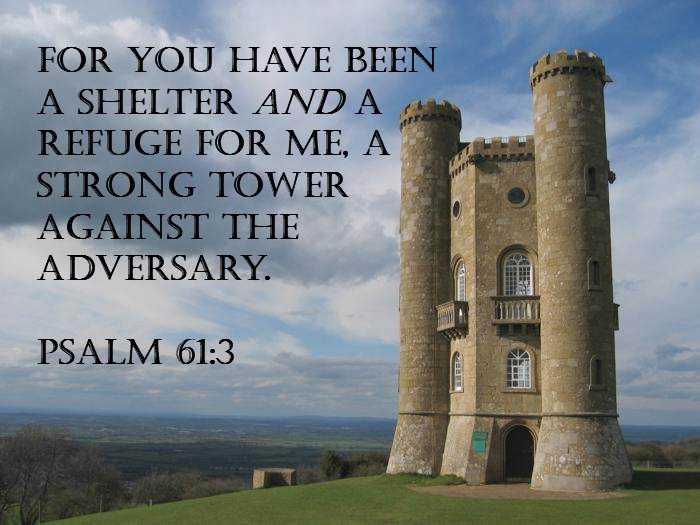
Shelter and shadow, refuge and trusting.
These four are the opening ‘word pictures,’ and they are used with wisdom and an alert discernment. The psalmist writes what he knows, and it is apparent that he understand the needs of the human spirit, and our need for protection.
Each of these four words creates a common link between believers. Each of us need a working understanding of all four protections.
These four are necessary elements for Psalm 91 to really work. I should ‘dwell’ in God’s sheltered care. All too often, I wander out past the security of the Lord (or maybe I’m lured out?) But there is safety in having God so close to us.
His proximity is for my protection.
“Surely he will save you from the fowler’s snare and from the deadly pestilence. 4 He will cover you with his feathers, and under his wings you will find refuge; his faithfulness will be your shield and rampart.”
Psalm 91:3-4
V.v. 3-4, maintains its personal or familiar tone. ‘Save you’ (salvation) is far more that a theological term. For the psalmist however, it’s not about ‘doctrine’; rather the psalm is an embrace. He is rescued from the trap, and the sickness that seems so contagious never touches him. Moving from metaphor to metaphor, he engages our imaginations to ‘see’ God’s salvation. The writer knows his stuff.
The Lord is pictured as a protective bird that covers his chicks with His wings.
We have a sure confidence as we gather together in that warm and safe spot under His wing. Whatever is after us has to go through God first. His presence is formidable. In His company is found true safety.
“What, then, shall we say in response to these things? If God is for us, who can be against us? Who will bring any charge against those whom God has chosen? It is God who justifies.”
Romans 8:31, 33
All of heaven is rallying for your well-being. You are sure of this based on your faith in God’s own word. He has ‘busted us’ out of a dark cage, and now defends you against all your enemies. And that is a very good thing.
“Why have you made me your target?…Why do you hide your face?…Why should I struggle in vain?…Why does the Almighty not set times for judgment?…Why then did you bring me out of the womb?”
Job 7:20, 13:24, 9:29, 24:1, 10:18
Didn’t Job get “hammered?” His monumental suffering is unparalleled in history. He is essentially a godly man who loses everything (except his faith). Job must pick up the pieces after “catastrophic ” sudden pain and total loss.
Job is being tested with the ultimate horrors. Will he “curse God and die” as his wife suggests? Will he cave in to the final four (his friends) and agree to their twisted theology? (You have to read chapters 38-39 to find out).
The Book of Job has been regarded as inaccessible and archaic by many.
Unfortunately many believe this assessment and look elsewhere for comfort. I would agree that Job is a challenging book, but so is Macbeth or Plato. (I guess you should find an easier translation).
Job is less an explanation and more a revelation of suffering. “Why” questions go unanswered. “Who” questions matter. I suppose this seems unfair. It certainly seems so, but straight answers in a fallen world won’t get any mileage at all.
One more thing. The Book of Job is about “twisted” theology. Job’s friends “toe-the-party-line” of theology that is logical. But don’t be mislead by their pronouncements, for they seem reasonable but they are flawed. It is a doctrine without love.
“If I have the gift of prophecy and can fathom all mysteries and all knowledge, and if I have a faith that can move mountains, but do not have love, I am nothing.”
1 Cor. 13:2
You can’t split your theology from love and get away with it.
When you read “Job’s friends” you must remember that. These are lessons it takes a long time to learn.
The broken believer, hobbled by chronic illness, has much to learn from Job. He is like “the poster child” for those afflicted. My mental illness is an issue (of course) but God is fully in control. He brings beauty out of the ashes.
“To bestow on them a crown of beauty instead of ashes, the oil of joy instead of mourning, and a garment of praise instead of a spirit of despair. They will be called oaks of righteousness, a planting of the Lord for the display of his splendor.”
“And he said, “Listen, all Judah and inhabitants of Jerusalem and King Jehoshaphat: Thus says the Lord to you, ‘Do not be afraid and do not be dismayed at this great horde, for the battle is not yours but God’s.”
2 Chronicles 20:15, ESV
We certainly don’t face a human army, yet the spiritual battle is just as consuming. Satan and his hordes are working 24/7 to capture our hearts and minds. He wants to enslave our spirits, and to assimilate us into his rebellion against God. For the broken believer, we know where we are weakest. Satanic influence can be fierce. However we are not alone.
Jehoshaphat’s own situation was precarious. Vastly out numbered, his own troops were about to be slaughtered and Jerusalem captured. Jehoshaphat responds by praying. He acknowledges God, and asks for divine help. We find him desperate, and that is how humility grows.
‘Do not be afraid and do not be dismayed at this great horde, for the battle is not yours but God’s.”
When God intervenes, we can only watch (and trust) His deliverance. King Jehoshaphat arranged for his army to be led by singers. There is a confidence here. Praise and worship is the way the enemy is defeated. “The battle belongs to God.” A great victory is won.
Make God your general. Infuse the atmosphere with prayer and praise. Impossible things are about to happen. Victory can be yours if you can only ‘get out of the way.’ This is the wisest and the safest course. (My worst defeats have come when I try my hardest to battle on my own.) When the enemy is pounding at the door, ask Jesus to answer it. He alone will bring you the victory.