The Difference the Holy Spirit Makes

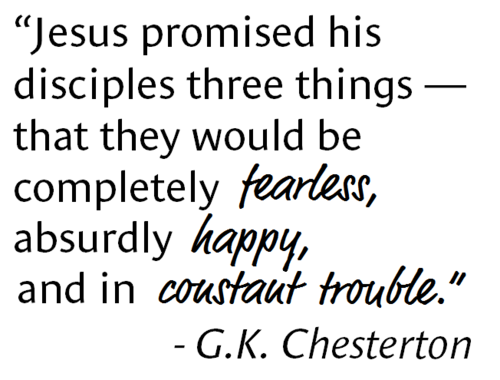
Chesterton-disciple

I like this quote. The early Church was all of these things: Fearless, happy, and very much in trouble. Luke wrote of the nascent exploits of this group of people in the Book of Acts, and while some believers will debate different aspects of theology, none can diminish the reality. These were human beings irrevocably touched by the Holy Spirit.

Some have even suggested that the title of the book be changed to “the Acts of the Holy Spirit.” (Instead of “Acts of the Apostles”).

When the fire of the Holy Spirit meets the dry tinder of the heart, it explodes into a conflagration that can’t be contained. It boils over and touches everyone around it. The disciples became fearless. Their boldness could not be diminished or diluted. They were so courageous (and contagious) that they preached to both kings and beggars.

They were “happy.” Once they had surrendered their personal ‘agendas’ they became immune to the negative issues of life. They soared with the eagles of contentment and joy. They no longer lived in the ‘mud’ of human life. They were ‘Teflon’ to that which can be so sticky. Happiness is the deep evidence of a personal contact with God’s own spirit.

But they ‘were in constant trouble.’ There may never been a people so maligned and persecuted. The apostle Paul faced daily obstacles. As the de facto leader of the church, he absorbed a lot of hatred and wrath that was focused on the early Church. Everywhere he went this darkness would descend, and each time God met him.

I suppose that we might ask ourselves, is this our experience? Am I fearless, and happy? Am I in ‘constant trouble” for the sake of the Gospel? (Do the police have my ‘mug shot?’)

Honest reflection is in order I think. We should really determine if we have the very same spirit that the early Church possessed. Whether or not, we should amend our relationship with the Spirit of God, and seek to be more tractable to His work. We start by believing the truth about our hearts and lives. The Truth is stronger than the lies.

This post was not intended to condemn. If you have read that into these words, I ask forgiveness. But reading this over, I will retract nothing. But I still ask that you ‘spiritually check’ each thought. Is it biblical, and does it glorify the Lord Jesus?

“I have told you all this so that you may have peace in me. Here on earth you will have many trials and sorrows. But take heart, because I have overcome the world.”

John 16:33, NLT

 

aabryscript


cropped-christiangraffiti1-3

The Real Treasures, [Weaknesses]

treasure

As Christians often our theology tells us that mental illness, depression, and bipolar disorder have no place in the believer’s life.  So we hide, sneaking into our sessions with our therapists, and change the subject to minimize our exposure to direct questions. We have had to hide our issues really well. 

But I would submit to you that it is we who are closest to the Kingdom of God. It is far easier for us to approach the Father, in our brokenness, humility, and general lostness. We have needs; a sound mind, a healthy body and we know it. We have no illusions of wellness, nothing can convince us that we are well. We are not.

We are broken and only our loving creator can mend us.

You might say that the Church needs us. An Archbishop was given an ultimatum by the Huns who surrounded his cathedral. “You have 24 hours to bring your wealth to these steps”, the war-leader demanded. The next morning the Archbishop came out leading the poor, the blind, the lame, and the lunatics. “Where is your treasure? Why have you brought out these… people?” The Archbishop simply and quietly replied, “These are the treasures of the Church, these who are weak are our valuables. They make us rich.”

We often can value giftedness more than weakness.

I am afraid the the Western Church no longer sees its “treasures” like it should. In our pride and self-centeredness we have operated our churches like successful businesses. We value giftedness more than weakness. We definitely have no room for the desperately weak. I suppose it’s time for the Church to begin to act like Jesus.

Church isn’t where you meet. Church isn’t a building. Church is what you do. Church should be a verb.  Church is who you are. Church is the human outworking of the person of Jesus Christ. Let’s not go to Church, let’s be the Church.

bry-signat

flourish88

Cleaning the Stables, [Becoming Holy]

$_35

“But when the goodness and loving kindness of God our Savior appeared, he saved us,not because of works done by us in righteousness, but according to his own mercy, by the washing of regeneration and renewal of the Holy Spirit, whom he poured out on us richly through Jesus Christ our Savior,”

Titus 3:4-6, ESV

Within the Greek mythology, about 600 B.C. we’re introduced to Hercules, who is given 12 impossible labors to perform as penance.

For the fifth labor, Eurystheus ordered Hercules to clean up King Augeas’ stables. Hercules knew this job would mean getting dirty and smelly, but sometimes even a hero has to do these things. Then Eurystheus made Hercules’ task even harder: he had to clean up after the cattle of Augeas in a single day. It was really meant to humiliate Hercules, and ‘show up’ his weakness.

Now King Augeas owned more cattle than anyone in Greece. Some say that he was a son of one of the great gods, and others that he was a son of a mortal; whosoever son he was, Augeas was very rich, and he had many herds of cows, bulls, goats, sheep and horses. Hercules went to King Augeas, and without telling anything about Eurystheus, said that he would clean out the stables in one day, if only Augeas would give him a tenth of his fine cattle.

Augeas couldn’t believe his ears, but promised. Hercules brought Augeas’s son along to be a witness. First the hero tore a big opening in the wall of the cattle-yard where the stables were. Then he made another opening in the wall on the opposite side of the yard. These stables had not been cleaned in over 30 years, and over 1,000 cattle lived there. (Just imagine the piles.)

Next, he dug wide trenches to two rivers which flowed nearby. He turned the course of the rivers into the yard. The rivers rushed through the stables, flushing them out, and all the mess flowed out the hole in the wall on other side of the stables.

By diverting the rivers, Hercules had easily done the impossible. The rivers blasted away the filth, and Hercules had won his bet.

Jesus is like Hercules, only infinitely more so. We are the Augean Stables. The slippery sludge and piles of excrement have choked us for far too long; we have a long history of living in our disgusting waste. But the Lord has come, and in one fell swoop, washed our sins away. Perhaps many have tried to clean the hearts of men; we have great philosophies and religions that have tried. The human condition remains unaltered. None can do what Jesus has done. What Hercules did– Jesus has done far, far more.

Jesus Christ is the conduit of spiritual salvation. He comes by his spirit to the worst, and completely cleanses us. Our piles of filth are washed away. Nothing can side-track or nullify what he has done. There maybe a small mountain of toxic sludge, but it will not stand. We hate the filth that we have become. Our responsibility is to ask for help, and then to let Him work. He has promised to flush us clean.

“When we were utterly helpless, Christ came at just the right time and died for us sinners. Now, most people would not be willing to die for an upright person, though someone might perhaps be willing to die for a person who is especially good. But God showed his great love for us by sending Christ to die for us while we were still sinners.”

Romans 5:6-8

No sin is too great; no sinner is too far gone.

Sometimes we forget what has been done for us. We forget how bad it once was, (or maybe still is.)  Ask him to work in your heart, you need not fear about being ‘taken for a ride.’ But if the truth be told– you really are helpless and hopeless. Without the ‘super’ heroism of Jesus, you will be lost in your sin. Come to him and be cleansed.

 “So just as sin ruled over all people and brought them to death, now God’s wonderful grace rules instead, giving us right standing with God and resulting in eternal life through Jesus Christ our Lord.”

Romans 5:21

bry-signat (2)

flourish9

Dinged Up Disciples, [But No Separation]

love-of-christ

“Can anything ever separate us from Christ’s love? Does it mean he no longer loves us if we have trouble or calamity, or are persecuted, or hungry, or destitute, or in danger, or threatened with death?”

Romans 8:35, NLT

A simple question is asked. Our response is requested, and expected. We must settle this in our thinking in order to progress with Him. Why? Three reasons.

  • There is something inside of us that militates against God, and the things of God.
  • We have an active enemy that has declared war on our soul.
  • The world we live in is both cruel and very hard at times.

But again, the question remains– “Who can separate us from Christ’s love?” Paul lists the seven issues that might scramble us:

  1. trouble 
  2. calamity
  3. persecution
  4. hunger
  5. destitution
  6. danger
  7. threatened with death

Each one carries its unique twist. Some are general, others more specific. They do overlap, but each are distinct. Each are hostile and mean. I think what Paul is seeing is that believers face “magnetic suffering.” Certain things that are weirdly attracted to us, and we can’t do a thing to change them.

These seven are offered as reasons we find ourselves struggling so hard. But even in them, the apostle declares a victory. They won’t— shouldn’t—can’t really divide us from Jesus’ love.

An ant would have an easier time stopping a roaring freight train!

Paul reminds us again, in the midst our sad and savage situation, that Jesus Christ isn’t even slightly turned back. His love is ‘outrageously’ outrageous. We must keep this close to our hearts. It is truly all we have– but it is also all we need.

bry-signat (1)

cropped-christiangraffiti1.jpg

*