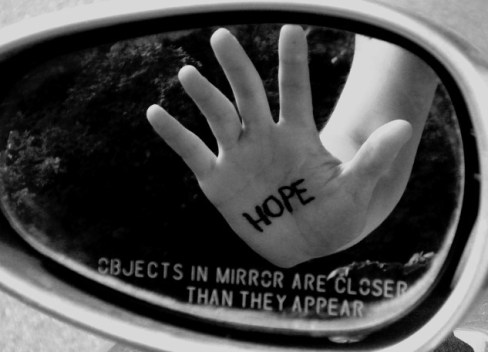
Give Us This Day, Our Daily Meds

My particular issue is with Bipolar 1, with psychotic features.  I have social anxiety which factors in as well as weird delusions.  The anxiety and delusions are pretty much one and the same.  They are often the things that will touch other people, while the rest is less obtrusive and can be hidden.

I have a tendency to hatch ‘mini-conspiracies’ almost daily.  They can be really paranoid as I think the worse about people, and life as it enfolds around me.  Facebook with its social networking helps, but it has also intensified my issues.  I am very much a recluse, and only get out and about twice a week. There are some who can see through my issues and really help. They are worth more then gold to me.

Depression, which is part of the Bipolar, has been more of a factor just in the last few months.  Suicide, that dark word, will deepen if the depression goes too long without lifting. It is an awful and brutal thing. My last bout was just two months ago and I quit functioning. I really did pray for death. Debilitated, I laid in bed powerless to do anything but sleep, and hide. I didn’t take a shower or bath for almost a month. Just the thought of being pelted by water seemed too violent.

Being a believer gives me a reason to live.  The Holy Spirit is so patient with me.  His companionship is far more helpful than any anti-depressant.  He doesn’t require that I become symptom free to fellowship with Him.  Instead, He weaves with the materials He has, and my discipleship is really no different than other Christian believers. This gives me a constant hope.

Overall, in spite of a very tumultuous, and ‘see-saw life’, I find that life with Jesus (discipleship) is truly grand.  He understands me, and is guiding me.  He is the Shepherd who is good, and I am His sheep who needs kindness and forgiveness always. He bruises no reed, nor does He quench the smoking candle (Matthew 12:20.)

One more thing.  Having a mental illness has, I believe, made me more compassionate and tender toward others.  When I meet a difficult person, I will be the last one to give up on him.  Others will bail out, but I stick.  I guess this can be a bad trait, but I can’t help it.  I love people, esp. those who hurt.

Here’s a list of my daily meds.  I hope this helps someone navigate the wild seas of psychiatry safely.

AM– lithium, 600 mg/Zoloft 200mg/Seroquel 400 mg/Provigil 200mg

NOON-Seroquel 200 mg

PM-lithium 600 mg/Seroquel 400 mg/Lunesta 2 mg

The lithium works mostly on mania, but does help depressive states.  The Zoloft is an anti-depressant (similar to Paxil)  The Provigil is for alertness, I have had issues with daytime sleepiness, esp. since my brain tumor.  Finally the Lunesta is a sleeping pill. This may seem a lot, but it has taken 2-3 years to get it figured out.  If I can help explain any of this, please let me know.  I aim to please!
Ignoring a Mentally Ill Believer

mental-illness

45 “And he will answer, ‘I tell you the truth, when you refused to help the least of these my brothers and sisters, you were refusing to help me.’”

Matthew 25:45, NLT

The truth of the matter is that the Church can be the wrong place to have a mental illness. This is a generalization, I know. But many times it is true. We have a strong tendency to offer only token acknowledgement of “the least among us.” We will smile and nod, and, oh so quickly move away; we feel we’ve performed our ‘duty’ as a Christian. We are somewhat relieved to ‘get away’ and dodge the problem person.

Stereotypes abound for the mentally ill. Afterall, they can be demanding, unpredictable, and dangerous. The worst are those who are dirty, unkempt. They say things that are odd and out-of-place. Have weird delusions and paranoia. They move to the margins, and usually sit in the back. But as a general rule, the mentally ill get ignored.

“People with mental illness sometimes behave in ways other people don’t understand and can’t make sense of. People with severe depression sometimes stay in bed all day, unable to manage the most basic motivation to move. People with anxiety disorders can be gripped by irrational or even unidentifiable fears that don’t incapacitate other people. Those affected by psychotic disorders may see things that aren’t real, hear voices that don’t exist, and sometimes lose the ability to discern reality at all.”

Amy Wilson, Christianity Today, 4/10/13

Often, a believer must find valuable help outside ‘the four walls’ of the Church. Some resources are often found with wise psychiatrists and caring therapists in clinical care. Medications (which are a godsend) give the afflicted much relief. The local Church just don’t always have the resources but that is o.k. It isn’t their role exactly.

However, the Church of Jesus has the only ‘real corner’ of the spiritual side of things. The body of believers encourages, teaches and guides. Without it, the mentally ill Christian would be severely effected. The local church feeds us spiritually. It can’t be replaced. It has ‘the goods’ for discipleship. It has the Word of God and motivating worship. It has elders and other leaders who shepherd each believer, into a holy life. It provides fellowship which the believer with a mental illness must have.

It’s also a place of ministry: each one using his/her gift in the corporate body of the saints. This is vital. The broken believer has an opportunity to serve, which is such a factor in the walk of the disciple. We need them in our fellowships, and they need to be there too. God blesses those who will serve Him in this. Fellowship is critical for disabled believers.

As Jesus’ representatives in this present moment, we need to extend our hands. We may not fully understand the afflicted, but we can reach through the issues (ours and theirs) and administer the love of Jesus. We might pray that this scourge of mental illness be lifted out of our society.

bry-signat (1)

Please follow this post up. Check out: https://brokenbelievers.com/the-weak-treasures-of-the-church/

cropped-christiangraffiti1.jpg

What Do I Really Need?

“The depressed don’t simply need to feel better. They need a Redeemer who says, “Take heart, my son, my daughter; what you really need has been supplied. Life no longer need be about your goodness, success, righteousness, or failure. I’ve given you something infinitely more valuable than good feelings: your sins are forgiven.” 

Elyse M. Fitzpatrick

 “And this same God who takes care of me will supply all your needs from his glorious riches, which have been given to us in Christ Jesus.”

Philippians 4:19

It really does come down to “needs” after all.  I don’t need to feel better, and I don’t need a to take another Zoloft.  Do I believe in psych drugs? Yes, most definitely.  I do need to control my moods. But when we talk about need (its really an emphatic word, it needs to be drawn out) I have discovered I really have very few needs.

I’ll tell you what I need.  I need to follow Jesus with my cross.  I need to pray and worship in His presence.  I need to love my wife and children.  I need to love my neighbor.  I need the Word, both ‘rhema’ and ‘logos.’  I need a good pastor, and I need to fellowship with other believers more than I do.

Its good to go through this sifting process.  I do not need to feel happy, healthy, wealthy, content, strong, moral or helpful.  I do need God however. Yes, I am “mentally” ill.  I do take meds to keep me from burning down our house and shooting our dog.  I’ve been listening to music in my head that others can’t hear.  I see things, astonishing things.  I sometimes have to deal with paranoid feelings that would curl your hair.

But what do I really need?  I desperately need God.

I need his love.  I need to know all my sins are forgiven.  I need to know that I will be with him forever and ever.  I guess the challenge is now yours, sort out these issues.  It doesn’t matter what flavor of mental illness you have.  You need Him.  Everything else is mostly froth and scum.

“I will answer them before they even call to me. While they are still talking about their needs, I will go ahead and answer their prayers!”

Isaiah 65:24

bry-signat

flourish18


Q & A: Will I need to stay on my depression meds forever?

Asked by Ally, Washington

“I am 26 years old and have had four major depressive episodes. I did not seek treatment until the last (and worst) episode and have since been taking two different antidepressants.

My question is this: Will I ever get off these meds?

To be honest, my last episode was so bad that I am not too keen on the idea of going without. However, I am aware that the more episodes of depression a person has makes the person that much more likely to have another one and that the severity of the depression gets progressively worse with each episode. I shudder to think what a worse episode would be but at the same time do not want to take medications that I do not need.

Expert Bio PictureMental Health Expert
Dr. Charles Raison Psychiatrist,
Emory University Medical School

Expert answer

Dear Ally, let me start by applauding your very accurate understanding of depression, terrible illness that it is. Your question is an interesting one because, of course, you could get off the medications any time you like simply by ceasing to take them. But what you mean, of course, is whether you will ever be able to stop taking the medications and not have to worry about falling back into another depressive episode.

This brings up a very important point about psychiatric disorders: Anything is possible. So anytime someone asks a question that starts with some variation of “Is it possible …?” the answer is always, “Yes.” Why? Because all psychiatric illnesses are probabilistic, not deterministic. Probabilistic means that although some things are a lot more common than others, nothing is certain and nothing is impossible.

I sometimes resort to physics as a metaphor to explain this idea. Isaac Newton used mathematics to paint the universe as an absolutely rigid machine in which causes always led to results in a predictable manner. In his view of the universe, if you knew what every particle in the universe was doing at this second, you’d be able to predict all future events flawlessly out to the end of time.

This way of thinking about things works very well for many practical things like firing cannon balls, sending rockets to the moon or building bridges, but it turns out that when you look really closely at matter, it only approximates the certainty that Newton described. This realization has become enshrined in a theory called quantum mechanics, which — in essence — says that no final certainties exist in the physical world, only various degrees of likelihood.

For example, although most of us think of atoms like little solar systems with the nucleus being like the sun and electrons swirling around it like planets, the physical reality is much weirder. In fact, an electron only tends to stay close to the atom of which it is a part. The further away you go from the atom the less likelihood there is for finding one of its electrons, but the chance isn’t zero, and it is possible that you might find an atom’s electron on the other side of the universe. It’s not impossible, just so unlikely that it might as well be impossible.


To get the rest of this article you will need to go to: http://www.cnn.com/2009/HEALTH/expert.q.a/12/08/

depression.medication.raison/index.html#cnnSTCText


cropped-christiangraffiti1 (3)