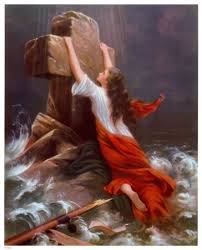
Bitter Water, [The Cross]

bitterwater

24 Then the people complained and turned against Moses. “What are we going to drink?” they demanded. 25 So Moses cried out to the Lord for help, and the Lord showed him a piece of wood. Moses threw it into the water, and this made the water good to drink.

It was there at Marah that the Lord set before them the following decree as a standard to test their faithfulness to him.”

Exodus 15

In this brief narration we have a graphic portrait of the condition of many within the Church today. The situation is becoming critical and its effects are devastasting. Some call it ‘crossless Christianity,’ ‘cheap grace’ or the ‘new cross.’ The writer of Exodus 15 calls it ‘bitter water.’

The children of Israel had begun to murmur. They demanded water for the long and hot journey through the Sinai desert. Coming to the ‘springs of Marah’ they discovered it bitter and undrinkable.

Moses responds directly to directly quell this potential rebellion. He begins to cry out to the Lord (what else can you do?) and begs the Lord for wisdom. He must know the next step.  So Moses cried out to the Lord for help,”

There was a tree, a piece of wood, and when that wood was tossed into the waters, the water were made sweet.

********

Today– people are waiting— searching for water. And never, ever has there been such a desperate search. They stampede to any new well on the horizon, and they search for anything.  Any well will do. Most will seek there lives away, only to perish at the ‘end.’ They’re chasing a mirage.

The Church is to be a well, an oasis in a dry and desperate land. But the water is becoming ‘bitter.’ We have defiled it with ‘sin and self.’ Friends, please understand— the ‘bitterness’ of our ‘uncrucified’ flesh pollutes our wells. We have poisoned our own selves.

We need ‘the cross.’ It is a sweet source for our ‘bitterness.’

We must return to ‘the old rugged cross.’ We need to embrace its reality again. Jesus, himself said this: “Whoever doesn’t bear his cross, and follow me cannot be my disciple.’ Those who followed after Him needed no preacher to interpret.

Rome had a nasty habit of executing her criminals publicly. Everyone who had listened to Jesus Christ had seen people crucified.

One Roman general, after suppressing a Jewish rebellion crucified 2,000 men at one time. The roads into Jerusalem were lined with crosses of dying men. This was done purposefully and publicly.

Every man and woman would see the terrible price of resisting Rome. This would result in death, and there are no halfway about it. A cross is a radical thing. There is nothing ‘halfway’ about it. It demands ‘no less than all.”

The Cross is in danger of being misinterpreted’ today. Our cross seems somehow different. It seems softer, and more padded, it doesn’t rub us the wrong way.” It allows us much: our favorite habits, our prideful ways, and our self-centered ideas. It would seem that what we call ‘our cross’ has a built-in ‘life-support’ system that keeps our old man alive just a little bit longer.

********

Dr. A.W. Tozer in an article entitled “The Old Cross and the New” wrote:

“The new cross is not opposed to the human race, rather it is a friendly pal, and if understood aright, it is the source of oceans of good clean fun, and innocent enjoyment. His life motivation is unchanged, he still lives for his own pleasure, only he takes delight in singing choruses and watching religious films, instead of singing bawdy songs, and drinking hard liquor. The accent is still on enjoyment, though the fun is on a higher plane morally, if not intellectually.The new cross does not slay the sinner, but redirects him.”

The old cross is a symbol of death. It stands for an abrupt and violent end of a human being.

 “Examine yourselves to see if your faith is genuine. Test yourselves. Surely you know that Jesus Christ is among you; if not, you have failed the test of genuine faith.”

2 Corinthians 13:5

Are we really carrying the cross of the Bible? Is our faith real? Are we carrying the real cross? We cannot be really His disciples unless we do so, and we are apostate if we do not.

“Then, calling the crowd to join his disciples, he said, “If any of you wants to be my follower, you must turn from your selfish ways, take up your cross, and follow me.”

Mark 8:34

bry-signat (1)

cropped-christiangraffiti1.jpg

A Jubilate Discipleship: Psalm 95

Montage-Jubilate

A Psalms Study

“Come, let’s sing for joy to the Lord.
    Let’s shout praises to the Rock who saves us.
Let’s come to him with thanksgiving.
    Let’s sing songs to him,
because the Lord is the great God,
    the great King over all gods.
The deepest places on earth are his,
    and the highest mountains belong to him.
The sea is his because he made it,
    and he created the land with his own hands.

Come, let’s worship him and bow down.
    Let’s kneel before the Lord who made us,
because he is our God
    and we are the people he takes care of,
    the sheep that he tends.

Today listen to what he says:

Psalm 95:1-7, NCV

Such joy: it just bubbles through the words. This is a psalm saturated with excitement. These first seven verses are ‘carbonated joy.’ They pronounce an excitement of a living God that excels in every way. These are simple words made to escort us into a true worship, unlike any other. We might use the word, “jubilant” when hearing this psalm. And we wouldn’t be far off.

“The Lord is the great God,” and He is the King of any ‘so-called’ gods. Everything concerning the earth is His doing– for He created it, with His own hands! And our creating God is also our Shepherd, tending and caring for us as His very own flock.

These verses extol our God, to the point of exuberance. It channels us to the point of worship upon our knees, with the realization of the greatness of God. But this Psalm continues for four more verses.

Today listen to what he says:
“Do not be stubborn, as your ancestors were at Meribah,
    as they were that day at Massah in the desert.
There your ancestors tested me
    and tried me even though they saw what I did.
10 I was angry with those people for forty years.
    I said, ‘They are not loyal to me
    and have not understood my ways.’
11 I was angry and made a promise,
    ‘They will never enter my rest.’”

Psalm 95:7-11

There are two parts to Psalm 95. The first is of jubilant worship. But the second part emphasizes a solid obedience. The phrase, “Today listen to what he says:’ welds these two sections together.

Worship must always lead to obedience. You can do ‘cartwheels’ on Sunday morning, as long as you follow Him on Monday.

The issue is an history lesson that goes back to Israel’s days of Moses and the days following the Exodus. Because they were so hard and stubborn, they would wander for forty years in the desert. Their continued ‘stubbornness’ not only closed off the Promised Land, but also closed off their relationship with God— a relationship that would’ve been ‘jubilant’ and  profound (at the same time). They missed out on verses 1-6 and settled on verses 8-11. How tragically sad.

There is a thread that works through scripture called “the rest of God.” The book of Hebrews uses in 12x usually as a warning:“Now, since God has left us the promise that we may enter his rest, let us be very careful so none of you will fail to enter.” (Heb. 4:1).

 “Let us try as hard as we can to enter God’s rest so that no one will fail by following the example of those who refused to obey.”

Heb.4:11

To be in God’s rest is to be in harmony with Him. It is a mixture of confident faith mixed with a careful obedience. When you combine these two, you have the recipe for joy.

I believe this rest is the believer’s place of joy, peace and confident faith. It obeys because it really wants to. It is Psalm 95:1-7 in action. It is for the jubilant Christian.

bry-signat (1)

cropped-christiangraffiti1.jpg

I Come, Clinging


cling-to-cross
I will come and cling

 “For everyone has sinned; we all fall short of God’s glorious standard.”

Romans 3:23, NLT

I know myself pretty well.  I fully understand how dark I can be.  I’m nasty and mean, selfish and destructive.  I am the “King of Filth and Deceit.”  (That is my official title, look it up.)  King Midas turned everything he touched into gold.  It seems that everything I touch turns black and putrid. I have come to understand Martin Luther’s own assessment, “Sin boldly, but believe in God more boldly still.” He wasn’t encouraging sin; nor was he giving out ‘a license to sin.’ He was simply acknowledging our nature. He was also speaking of God’s wonderful gift of grace, and the faith needed to obtain it.

But I have heard that there is a place where I can be made white and bright; fully and truly cleansed of an immensity of evil.  He can heal me, and I do not have to continue to produce such wickedness.  I do not have to hurt His dear ones anymore. When I accept Him, His blood releases me. He makes it possible for me to have a new life.

So I come to Him, and cling.  I will not let go, I grab Jesus and hang on.

I won’t slide back into this painful darkness.  I will latch on to Him with everything I have. I cry out for ‘the spiritual velcro’ of Grace. I do this over, and over– until it works. Just give my sin-addled soul Jesus. I’ve had enough religion, now I want Him.

I’m learning that I must learn to forgive myself.  He has already forgiven me.  A weaver works diligently on a rug that he is making.  He uses even the dark thread as he does his work.  In the same way, those deep transgressions must become a part of the Spirit’s work from my life.  He takes it up, without flinching, and weaves it into His work. What He does is miraculous.

God’s specialty is turning rascals into sons and daughters.

I see sadness and confusion, and He sees glory.  I see nothing but evil, and He chooses to turn it into a special grace.  And so, I cling to Him and wait for the Lord to meet me.  He is not overwhelmed by my stains, and He promises a complete deliverance from my great darkness.  So I cling, as a drowning man latches on to a life preserver.

Oh, dear one.  Someone has been looking for you.  Jesus has been searching, trying to save you.  You can go your own way, but I predict nothing but a difficult sorrow, if that is your real choice.  But, there is a way of escape, and it is full of joy and peace.  And it is real.

I know, (first-hand,) that it difficult, but that is just the first stage.  There is a raucous joy that is waiting for you.  You will find such a purpose and completeness that will make your head spin.  He will launch on you into a love and a kindness that you will hardly be able to contain.

“God blesses those who are poor and realize their need for him,
    for the Kingdom of Heaven is theirs.
God blesses those who mourn,
    for they will be comforted.”

Matthew 5:3-4


bry-signat (1)


cropped-christiangraffiti1.jpg


Meeting Samson

samson-and-delilah

The story of Samson (Judges 13-16) is painful. It ranks as one of the saddest tales in Biblical history, and reading it through again only frustrates me. Have you ever seen a piece of fraying cloth. Threads have worked loose and the edges no longer hold together. The mid section maybe fine, but hem is coming apart. The issue is one of integrity.

That is what I think the judge Samson was like. Incredibly gifted, but irrevocably flawed, he was ordained to be a deliverer. Think of him as a “freedom fighter,” called and equipped to set his people free. He was a man of intense contrasts:

  1. uncommonly gifted, yet strangely unconsecrated,
  2. incredibly strong, yet spiritually weak,
  3. called to deliver, but yet died as a captive

You might say he could never conquer himself. Forbidden things became permissible. He never could really say the most important word– No! Lust drove him as often as the Spirit of God did. Samson became a tragic figure in the history of Israel, known more for his failures than his victories.

“Then she called, “Samson, the Philistines are upon you!” He awoke from his sleep and thought, “I’ll go out as before and shake myself free.” But he did not know that the Lord had left him” (Judges 16:20, NIV).

This is perhaps the most tragic verse in Scripture. Samson had compromised to the point of being released from his gift. His attitude was that it would always be there for him, but that wasn’t the case anymore. They would gouge out his eyes, and chain him to a millstone to grind out grain.

Interestingly, in Hebrews 11:32 Samson is mentioned as an example of faith. But how much pain was afflicted on him, and how more brightly would’ve been if he would’ve learned to resist his appetites.

I have a tendency to fray at the edges myself, leaving me with an unsettled feeling. The hems don’t always hold. They come apart. The story of Samson reminds me of my need to watch myself closely. The lesson is loud and clear. Perhaps there is a Samson in everyone of us.

aabryscript

cropped-christiangraffiti1-2