Like Well-Watered Gardens: Isaiah 58

 988260_555532177842117_1231249567_n

Feed the hungry,
    and help those in trouble.
Then your light will shine out from the darkness,
    and the darkness around you will be as bright as noon.
11 The Lord will guide you continually,
    giving you water when you are dry
    and restoring your strength.
You will be like a well-watered garden,
    like an ever-flowing spring.”

Isaiah 58:10-11, NLT

This is the precise key many need for this moment. It just could be as vital as your next breath.

You see our faith was never intended to be a personal ‘spiritual make-over.’ Discipleship was not meant to be about becoming a ‘new-and-improved’ person. That simply is not the message. There can be an emphasis placed on a selfish preoccupation with becoming better (and nicer) and we miss out on God’s real intent for His redeemed people. The difference is subtle but significant. We cannot sanctify our selfishness— no matter how hard we might try. 

For years I travelled under a misconception that God wanted from me ‘a better Bryan.’ I felt like a juggler trying to keep the balls moving. But by making this my focus, and not on others, I only exacerbated my mental illness. For me, my depression is only intensified when I look inside. Often I can’t see the needs around me. All I can see are my own issues (which are formidable.)

Isaiah prophesies a spiritual ’cause-and-effect.” If a person will only reach out to others will there be a spiritual blessing. Often we struggle because we don’t realize the implications of being spent for others. We become ‘a well-watered garden’ if we will only reach out to others. If we would only learn that it is when we give out— we receive. The kingdom is reciprocal in the way blessings come.

“And I have been a constant example of how you can help those in need by working hard. You should remember the words of the Lord Jesus: ‘It is more blessed to give than to receive.’

Acts 20:35

The entire chapter of Isaiah 58 makes it a vital point to the people of God. Our own healing is contingent on becoming a blessing to others. If we will pour out we will be poured on. We become ‘a well-watered garden’ when we begin to serve others. Our own ‘healing’ will come when we reach out to the desperate needs around us. After all, isn’t that what we’re supposed to be about?

bry-signat (1)

cropped-christiangraffiti1.jpg

More Current, Please!

angel1I have always had a crazy connection with electricity. As a young boy of six or seven I started to push nails into the wall outlets of our home. My mom would come in to find me in a heap, with the nail still in the outlet. It would blow me backwards, and I remember “smelling the ozone” from each experience. I did this fairly often. Mom grew very concerned about me.

Then I discovered the shocking world of electric fences. Most were “pulse” currents, which meant they were alternately energized– and then off. If you grabbed it at the right time, you could beat the fencer and not be shocked. Of course, complicating things would be standing on wet grass. But bringing your little brother meant you could grab his hand, touch the wire, and he would get the full voltage. This was always fun.

Coming into the presence of a holy and loving God should be a powerful jolt. But it needs to be real– never theatrical or showy. Whether it is prayer or worship, we reach into a real world. While electrical shock is detrimental, the Holy Spirit is always strengthening and affirming. My prayer the last few months has been this: “May it be the real me who connects with the real You.”

In a nuclear power plant the workers clearly understand the nature of fission. They can’t see it, or feel it. They must take precautions, because what they handle is really dangerous. In 1 Samuel 6, we read of the time when the Philistines controlled the Ark of the Covenant. But the power they received was not anything they could handle or manage. They finally sent it back. “But the Lord killed seventy men from Beth-shemesh because they looked into the Ark of the Lord. And the people mourned greatly because of what the Lord had done. “Who is able to stand in the presence of the Lord, this holy God?” they cried out. “Where can we send the Ark from here?”

God is dangerous, “my Bible tells me so.” My thinking often would regard Him as docile and tame, but I challenge you to understand differently. I submit to you that our faith should put us into a perilous place– one in which we are asked to do outrageous things. Like building an ark, or going from a slave to a prime minister, or getting out of our boat and walking on the sea. Furthermore, the Book of Revelation is John’s account of being in God’s power and majesty (Rev. 15).

“We worship a dangerous God and He is coming to threaten every area of your life.  God is a loving God, do not be mistaken about that.  His love, however, is unlike any human love; its chief concern is not to make you comfortable, but to make you free and to be free is dangerous and the act of making us free is dangerous.” Joe Spann (and below)

electric-shockPlease don’t try to domesticate God.

He is wild and pretty much unpredictable– and we will not ever tame or teach Him. You can’t manage Him, or train Him to use a box. (He will defy this.) If we are truly going to draw close it will be like stepping into a spiritual reactor, or sticking a figurative nail into a metaphorical wall outlet.

“He is about to become dangerous to your everyday trappings, dangerous to your comfort, dangerous to your retirement plan, dangerous to your schedule, dangerous to your social standing, dangerous to your secrets, and dangerous to your religion. The good news is, He is also dangerous to your limits, dangerous to your fear, dangerous to your addictions, dangerous to your sickness, dangerous to your unforgiveness, dangerous to the chains that bind you chains that you have become way too comfortable with.”

The end result of this is that He wants to make you dangerous again; dangerous to your neighbors bondage, dangerous to the pain in the people around you, dangerous to the generations of abuse and pain in your family and the families you know, dangerous to the culture you are in every single day. And He wants to make us dangerous again. Dangerous to our neighborhoods, dangerous to our friends, dangerous to our culture, dangerous to the kingdom of darkness.”

I would like to make a toast, “May you see God as He is truly, and may you stick your nail into direct contact with Him. May you never settle for less, or want for anything more.” Amen.

1brobry-sig4

cropped-christiangraffiti1 (1)


*

A Towel, Not a Title

There are no shortcuts in discipleship
“Jesus knew that the Father had given him authority over everything and that he had come from God and would return to God. 4 So he got up from the table, took off his robe, wrapped a towel around his waist.”  

John 13:3-4, NLT

Jesus was always constant.  Nothing could erode His place or position.  The authority had been His Fathers, and it had been given to Him.  He carried it as a special burden, treasured and separating Him.  Jesus had the freedom to act like the servant.  It didn’t bother or confuse Him, He understood perfectly who He was.

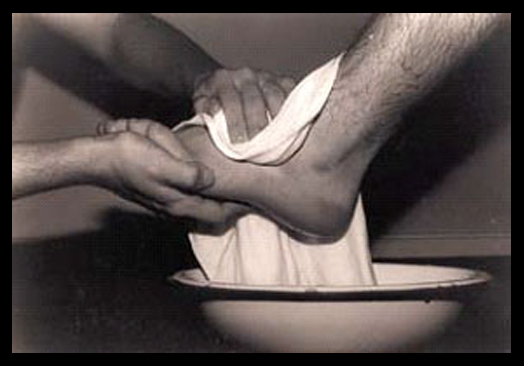
With the supreme authority given to him, he got down on His knees, and began to wash dirty feet.  I can offer no magic or flair to adjust this scene.  He washed off dirt, cleaned between toes, making filthy feet clean.  And all of this ‘as God in human flesh’.  This staggered the disciples, perhaps a baseball bat on the side of the head, would’ve been more compassionate.

This was revolutionary, it completely devastated the disciples.  They just couldn’t grasp what was happening.  Jesus, who was ‘God in flesh’, had decided, in a moment of time, to clean their feet.  Outrageous!  Not really happening!  No way! Never!

The reality.

This spun them around.  They tried as fast as possible to process what had just happened, and ‘who’ it had happened from.

Essentially, it buried them.  Jesus Christ, as Servant pounded them into the ground.  Servanthood was to take the supremacy from this point forward.  Becoming an indentured slave was now the way of Christlikeness.  This servanthood was to now guide us to a point of slavery.

Gone are the days of Zebedee, when one can ask for a position, on the right or the left.  We can ask, most certainly, but we haven’t been the first.  We can ask but the sheer weight is against us.  So very many have gone before us.  We must become a people who accept, and then presses into His grace, His specialness, His presence.

Today, more towels are what we need.

We have got to turn over our ‘need’ for recognition and pick up from the pile the rag of servanthood, we must ‘ask’ our brother/sister if we can scrub their feet.  We must get on our knees and do the unspeakable.  We must find a way to clean off their feet. This dear one, is what you’ve been told to do.

“There are many of us that are willing to do great things for the Lord, but few of us are willing to do little things.”   D.L. Moody

bry-signat

flourish91

Bitter Water, [The Cross]

bitterwater

24 Then the people complained and turned against Moses. “What are we going to drink?” they demanded. 25 So Moses cried out to the Lord for help, and the Lord showed him a piece of wood. Moses threw it into the water, and this made the water good to drink.

It was there at Marah that the Lord set before them the following decree as a standard to test their faithfulness to him.”

Exodus 15

In this brief narration we have a graphic portrait of the condition of many within the Church today. The situation is becoming critical and its effects are devastasting. Some call it ‘crossless Christianity,’ ‘cheap grace’ or the ‘new cross.’ The writer of Exodus 15 calls it ‘bitter water.’

The children of Israel had begun to murmur. They demanded water for the long and hot journey through the Sinai desert. Coming to the ‘springs of Marah’ they discovered it bitter and undrinkable.

Moses responds directly to directly quell this potential rebellion. He begins to cry out to the Lord (what else can you do?) and begs the Lord for wisdom. He must know the next step.  So Moses cried out to the Lord for help,”

There was a tree, a piece of wood, and when that wood was tossed into the waters, the water were made sweet.

********

Today– people are waiting— searching for water. And never, ever has there been such a desperate search. They stampede to any new well on the horizon, and they search for anything.  Any well will do. Most will seek there lives away, only to perish at the ‘end.’ They’re chasing a mirage.

The Church is to be a well, an oasis in a dry and desperate land. But the water is becoming ‘bitter.’ We have defiled it with ‘sin and self.’ Friends, please understand— the ‘bitterness’ of our ‘uncrucified’ flesh pollutes our wells. We have poisoned our own selves.

We need ‘the cross.’ It is a sweet source for our ‘bitterness.’

We must return to ‘the old rugged cross.’ We need to embrace its reality again. Jesus, himself said this: “Whoever doesn’t bear his cross, and follow me cannot be my disciple.’ Those who followed after Him needed no preacher to interpret.

Rome had a nasty habit of executing her criminals publicly. Everyone who had listened to Jesus Christ had seen people crucified.

One Roman general, after suppressing a Jewish rebellion crucified 2,000 men at one time. The roads into Jerusalem were lined with crosses of dying men. This was done purposefully and publicly.

Every man and woman would see the terrible price of resisting Rome. This would result in death, and there are no halfway about it. A cross is a radical thing. There is nothing ‘halfway’ about it. It demands ‘no less than all.”

The Cross is in danger of being misinterpreted’ today. Our cross seems somehow different. It seems softer, and more padded, it doesn’t rub us the wrong way.” It allows us much: our favorite habits, our prideful ways, and our self-centered ideas. It would seem that what we call ‘our cross’ has a built-in ‘life-support’ system that keeps our old man alive just a little bit longer.

********

Dr. A.W. Tozer in an article entitled “The Old Cross and the New” wrote:

“The new cross is not opposed to the human race, rather it is a friendly pal, and if understood aright, it is the source of oceans of good clean fun, and innocent enjoyment. His life motivation is unchanged, he still lives for his own pleasure, only he takes delight in singing choruses and watching religious films, instead of singing bawdy songs, and drinking hard liquor. The accent is still on enjoyment, though the fun is on a higher plane morally, if not intellectually.The new cross does not slay the sinner, but redirects him.”

The old cross is a symbol of death. It stands for an abrupt and violent end of a human being.

 “Examine yourselves to see if your faith is genuine. Test yourselves. Surely you know that Jesus Christ is among you; if not, you have failed the test of genuine faith.”

2 Corinthians 13:5

Are we really carrying the cross of the Bible? Is our faith real? Are we carrying the real cross? We cannot be really His disciples unless we do so, and we are apostate if we do not.

“Then, calling the crowd to join his disciples, he said, “If any of you wants to be my follower, you must turn from your selfish ways, take up your cross, and follow me.”

Mark 8:34

bry-signat (1)

cropped-christiangraffiti1.jpg