Here Be Giants!


“Do not be afraid or discouraged, for the Lord will personally go ahead of you. He will be with you; he will neither fail you nor abandon you.”

Deuteronomy 31:8, NLT

There is an ancient map in London, England dated from 1525, that has some interesting notations written on it. At one edge someone wrote, “From this point there are fiery scorpions.’  And also written, was “Here be dragons.” On the other margin somebody else noted, ‘Here be giants.” But a believer named Sir John Franklin wrote on this same map, “Here is God.”

Certainly cartographical scorpions, dragons and giants seem to be bit quaint. We certainly don’t really believe in such things anymore. Yet the presence of God is true and quite real. He is present, and is quite active in the lives of everyone who has ever used a map of any sort.

35 “As evening came, Jesus said to his disciples, “Let’s cross to the other side of the lake.” 36 So they took Jesus in the boat and started out, leaving the crowds behind (although other boats followed). 37 But soon a fierce storm came up. High waves were breaking into the boat, and it began to fill with water.

38 Jesus was sleeping at the back of the boat with his head on a cushion. The disciples woke him up, shouting, “Teacher, don’t you care that we’re going to drown?”

39 When Jesus woke up, he rebuked the wind and said to the waves, “Silence! Be still!” Suddenly the wind stopped, and there was a great calm. 40 Then he asked them, “Why are you afraid? Do you still have no faith?”

41 The disciples were absolutely terrified. “Who is this man?” they asked each other. “Even the wind and waves obey him!”

Mark 4:25-41, NLT

The Sea of Galilee actually has four names, and it actually isn’t a sea, but a lake with sweet and good water. The lake is over 13 miles long and 7 miles at its widest point. The way the hills surround the lake can produce waves over 20 feet, due to unique weather pattern that exists today.

The disciples were seasoned fishermen. They had each seen tough times, but what is going to be unleashed on them is far and above anything they have ever seen. They were frightened.

Jesus was pretty much exhausted. He had been ministering for several days. This was a stretch. A trip across the lake would give Him a definite break. He is so tired, He falls asleep, using a “boat cushion” as a pillow. He is soon sound asleep.

The disciples seem to respect Jesus’ need for rest. But it all gets chaotic and confused quite quickly. None of them had experienced such a terrible storm. They woke Jesus up, and strongly suggested that He do something decisive. Otherwise, they would all be lost.

Jesus was awakened to another need. My guess is that He needed more sleep, but the present moment He needed to speak boldly into this ugly storm. The waves are quite nasty, but at His Word spoken, everything becomes quite serene.

His disciples are undone. They simply draw different conclusions. What they have just seen strips them down to a basic level. The deep presence of Him takes apart of all they understand. God takes them apart, and they end up in a very interesting position.

Our perceptions shouldn’t alter the presence of God. He is our steady rock in our ‘quicksand world.’ He shuts down our storms. You can truly rest with Him in your boat, controlling the storms.

bry-signat (1)

cropped-christiangraffiti1.jpg

$

Simply Golden

by Norman Rockwell, 1961

“And as you wish that others would do to you, do so to them.”

Luke 6:31, ESV — The Golden Rule

 “Here is a simple rule of thumb for behavior: Ask yourself what you want people to do for you; then grab the initiative and do it for them! If you only love the lovable, do you expect a pat on the back? Run-of-the-mill sinners do that.” 

Luke 6:31-32, MSG

Sometimes it seems, I hit the switch, and shut it all down. Essentially, I get wrapped up with one of my favorite sins and soon I turn off my faith, unplugging myself from the wall.  I have a desire to escape from what I see as restrictions that I believe faith brings me.  I want to have fun–I don’t want to pray, or read the Bible.

Actually I can do this subtly.  I just raise the volume of my sinful desires, and try to drown out that still small voice.  I can maintain a holy life for my Christian friends, while I enjoy the pleasures of my favorite sins.  Sins or holiness, I want to go for both– but the reality is I just get one.

There is still a voice that is speaking profoundly. “And as you wish that others would do to you, do so to them.”  Our particular concepts of Christianity so rarely include this–“the golden rule.”  In my own mind, I diminish this as a little bit antiquated.  I will rarely feel its pinch or pull.  It is never a topic of serious thought or meditation.  It seems that it has become what I call–“an optional truth.”  It is very much real, but it is not connected to me in my daily walk.

Treating others, the very way you want to be treated—do this!  Love other people outrageously and deeply; because you like it when they do this to you.  There is reciprocal action here, a sort of spiritual circle of kindness.  Our vernacular says, “What goes around, comes around.”  And it certainly has a ring of truth in it.

All too often we have a version of Christianity that has had its teeth pulled. We have tamed it, and brought the sharp teeth of the faith under our personal decision-making process.  The wildness of a true faith is domesticated and ‘house-broken.’  And we start the rush to unplug things.  The golden rule gets detached right away.

As I struggle as a mentally ill Christian, it is mandatory that the truth be lifted up in my life.  I can become quite disturbed and manipulated by life’s dealings.  My issues of paranoia and delusion cripple me, or they could become the step-stool for those wonderous things on the shelf of grace.

Dear ones, use your illness to reach for the best, live this and change your world.

%

1brobry-sig4


cropped-christiangraffiti1 (1)

Plunging the Depths of Grace

“One of the Pharisees asked him to eat with him, and he went into the Pharisee’s house and reclined at the table. 37 And behold, a woman of the city, who was a sinner, when she learned that he was reclining at table in the Pharisee’s house, brought an alabaster flask of ointment, 38 and standing behind him at his feet, weeping, she began to wet his feet with her tears and wiped them with the hair of her head and kissed his feet and anointed them with the ointment. 39 Now when the Pharisee who had invited him saw this, he said to himself, “If this man were a prophet, he would have known who and what sort of woman this is who is touching him, for she is a sinner.”

Luke 7:36-39, ESV

A woman of the city, that explains so much.  She comes with a lot of baggage; she has seen all the world at its worst.  Her life has been hard, she has made poor decisions. Enough to pull her into the presence of Jesus.

She may be a stripper, an addict, a porn star. It doesn’t matter, she is a sinner, and scripture does not elaborate beyond this.  All we know is she is ‘a woman of the city,” and that she is referred to as “a sinner.” The sin has made her a desperate person. She steps forward, and does not care about what the crowds are saying about her. She has heard it all before. She comes with her flawed and inadequate heart, to anoint him with an ointment that is somewhat susceptible because of her past.

She pushes forward, pressing past the inner ring of disciples who are ‘protecting’ Jesus.  She takes what she has, and pours it on Jesus’ feet.  It is a concentrate of a perfume that is intense, and very much a declaration of what her heart is wants to do. The scent of this ointment undoubtedly very strong, and lingers, being a concentrate. It probably comforted Jesus while he was being nailed to the cross. He would remember what she had done to him. Her love would comfort him as he was dying.

Jesus acknowledges her decision to bless him in this unique way.  She pushes to him with a single mindedness that we can only marvel at.  She falls at his feet, and Jesus allows himself to be touched by a women that has such a difficult and dark past.  I truly believe He takes everyone whoever comes to him. He passes no judgement on her, and people who are like her— like me.

He has no issues, and accepts all who the Father brings to him.

This sinful woman has shown the way for sinners like us to connect.  Her action establishes for us a precedent— a sure way to advance into his presence.  We start by admitting that we are in a very desperate state.  Her example focuses everyone to all  what is truly important, and we dare not slip past her example. “All have sinned, and come short of the glory of God.” We know that this is true.

We must come, as she has come, in faith that only He can forgive us.  We should come with a radically intense intention to be with him.  There must be a real decision (on our part) to follow after him.  When we actually fall at his feet, we will find ourselves to be completely forgiven.

“Therefore I tell you, her sins, which are many, are forgiven—for she loved much. But he who is forgiven little, loves little.” 48 And he said to her, “Your sins are forgiven.”

Luke 7:47-48

bry-signat (1)

cropped-christiangraffiti1.jpg

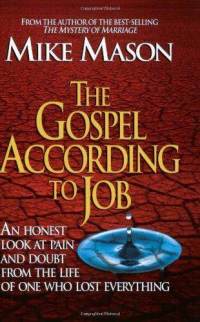
The Gospel According to Job

Today, I want to bring out this book, out into the spotlight.  It is a tremendous devotional that makes its way through the book of Job.  I have leaned on it, and it has held me nicely.  I challlenge you to get a copy of this, and to let it work in the confines of your spirit and mind. ––Bryan

A

Excerpt from “The Gospel According to Job,” by Mike Mason


“An Honest Look at Pain and Doubt from the Life of One who Lost Everything”

_______________________

A“Once I met a man who, like Abraham, had moved his entire household halfway around the world on the strength of a vision from God. When I asked him to tell me the story, he answered that there were three versions of that story, and which one did I want to hear? First, there was the version of the story that he told to Christians. Then there was the version he told to non-Christians. Finally, there was the truth. Job is a book that tells things from the third point of view. Probably, along with Ecclesiastes, it does this better than any other book in the Bible.

Not that the other Scriptures do not tell the truth. But Job tells the truth in a way that makes it almost impossible to pervert the truth into pious pabulum. A few years ago I went through a difficult time. Never mind what the problem was. It was nothing compared to the trials of Job. In fact, it was nothing at all compared to the sufferings of many of my neighbors right there on the quiet street where I lived.

But pain is pain, and suffice it to say that my pain was enough to drive me to my knees, totally defeated, half-crazy at times, and crying out for relief. Month after month the battles raged on, thick, dark, agonizing. I prayed, but somehow prayer did not ‘work.’ Usually nothing at all worked, except lying low and gritting my teeth until, for reasons entirely obscure to me, the straightjacket of oppression began to loosen a little––at least enough for me to get on with my life for another day or so before the screws tightened again. What else could I do? How was I to fight this?

In retrospect I can see that a large part of my anguish was rooted in the fact that there really was nothing I could do to control what was happening to me. I was absolutely helpless, and it is this, perhaps, that is the soul of suffering, this terrifying impotence. It is a little taste of the final and most terrifying impotence of all, which is death.

We Christians do not like to think about being absolutely helpless in the hands of our God. With all of our faith, and with all of His grace, we still prefer to maintain some semblance of control over our lives. When difficulties arise, we like to think that there are certain steps we can take, or attitudes we can adopt, to alleviate our anguish and be happy. Sometimes there are. But anyone who has truly suffered will know that when it comes to the real thing there is no help for it, no human help whatsoever.

Simply put, when we are in a deep dark hole we cannot think our way out; neither can we hope, sing, pray, or even love our way out. In fact there is absolutely nothing either we or anyone else can do to better our situation. We can have faith, yes; but in itself faith will not change anything. Neither faith, nor any other good thing that a person might have or do, can actually lift the cloud, move the mountain, or bring about an end to the problem.

Only the Lord Himself can do that, and when He does, as Exodus 6:6 puts it, “Then you will know that I am the Lord your God, who brought you out from under the yoke.” How will we know? Simply because nothing and no one else could possibly have done it. In this kind of crucible, therefore, we come to a new understanding of what it means to be saved, what it means to be snatched away from the brink of destruction.

Here we get down to the bedrock of the gospel. During my night of anguish, I turned to the book of Job, and there I began to make contact with the gospel in a way that somehow I never had in studying the New Testament. Reading Job, I found myself experiencing in new and astonishing depth the reality of Jesus’ promise in John 8:32,

 “You will know the truth, and the truth will set you free.”


cropped-christiangraffiti1.jpg