Pouring Oil on the Waves (Peace)

“Storm Warning”

“…And through him God reconciled everything to himself.  He made peace with everything in heaven and on earth by means of Christ’s blood on the cross.”

Colossians 1:20, NLT

Jesus has brought a complete peace into God’s world. Everything is now reconciled, taken care of by what Jesus has done. The precise word is “shalom.” It has within it the idea of ‘wholeness, or healthiness.’ It is in a general sense, being ‘made whole or complete.’ This present ‘sickness’ has become obsolete. That is our message.

There is no room really for any “peace” without completeness, it just isn’t possible. The “peace” that the Bible teaches is far more comprehensive, and total. The word in Hebrew, has a strong attachment to health, harmony and prosperity. It has the sense of being well, with the complete absence of turmoil or conflict.

“And he will be called:
Wonderful Counselor, Mighty God,
    Everlasting Father, Prince of Peace.
7 His government and its peace
    will never end.”

Isaiah 9:6-7, NLT

Peace is more than a snazzy marketing approach. At its basic sense it is what He fully intends for the “peoples of the earth.” But this all comes to us with a price. In Isaiah 53:5, (ESV)

“But he was pierced for our transgressions;
he was crushed for our iniquities;
upon him was the chastisement that brought us peace,
and with his wounds we are healed.”

The brutalization of Jesus had a purpose. He “brought us peace.” And we needed peace, desperately. But, oh, the cost!

In ancient times, sailors in a nasty tempest, would pray to their gods, and then pour oil on the waves. They believed the oil, poured out in barrels would settle the violent seas. (I suppose they figured the viscosity of the oil on the waves, would give them some time to manage their ship.)

Today, we know that it doesn’t work this way. Our storms however, are just as bitter, and challenging. Things get so tumultuous, and savagely extreme. But somehow, we want to pour God’s peace on our awful storm. Inherently we know that His peaceful presence can restore some sanity on our crazy lives.

Jesus is “the Prince of Peace.” We look right at Him when things get so ugly. He has come to do this. He is God’s solution to our sad conflict. He brings the oil, for our storm.

bry-signat (1)

cropped-christiangraffiti1.jpg

Redeeming Pain

When history speaks, do we listen?

by Terry Powell

It’s one thing to say that God’s sovereignty redeems our pain or weakness for a greater purpose. It’s another thing altogether to see a vivid illustration of the truth.

David Brainerd (1718-1747) took the gospel of Christ to Indians in Massachusetts, Pennsylvania, and New Jersey, often living alone with sparse food rations and exposure to cold. Extremely melancholy in temperament, Brainerd endured long episodes of joylessness, often slinking into despair over awareness of his sin, or over an incapacity to feel more love for the people he was trying to reach. Physical frailty accompanied his psychological anguish. He died of tuberculosis before his thirtieth birthday.

A couple years after launching missionary work among the Indians, in 1845, God’s Spirit brought a spiritual awakening in New Jersey. Within a year, the church Brainerd started numbered 130.

Brainerd kept diaries in which he described bouts of despondency, disclosed his consciousness of sin in light of God’s holiness, and recounted efforts to evangelize the Indians. Their pages teem with honest self-disclosure as well as desperate dependence on God for physical and emotional sustenance.

Twenty-two places in his diaries he yearned for death as an escape from his misery. Yet he persisted in proclaiming Christ, even when his own temperamental makeup eclipsed his ability to experience the joy inherent in the gospel. One entry revealed his acceptance of weakness and deeply-entrenched desire to finish well: “Oh, for more of God in my soul! Oh, this pleasing pain! It makes my soul press after God… Oh, that I might never loiter on my heavenly journey.”

After his death, the fruit of Brainerd’s life multiplied exponentially. In 1749, Jonathan Edwards, in whose home Brainerd died, took the diaries and published them as a Life of Brainerd, a book that’s never been out of print. Renown missionaries and leaders galvanized by Brainerd’s story include John Wesley, Henry Martyn, William Carey, Robert McCheyne, David Livingstone, Andrew Murray, and Jim Elliot.

The borders of Brainerd’s impact weren’t expanded in spite of his emotional and physical afflictions, but because of them.

His story resonates with so many servants over the years because when push comes to shove, they, too, wrestle with sinful propensities, episodes of despondency, and physical frailties. They believe they are candidates for the same divine grace they observe in Brainerd’s life. John Piper, himself buoyed by Brainerd’s story, offers this apt summary statement: “Brainerd’s life is a vivid, powerful testimony to the truth that God can and does use weak, sick, discouraged, beat-down, lonely, struggling saints who cry to him day and night to accomplish amazing things for his glory.”

How can God use you despite physical or emotional frailty?

For biblical indicators that God uses weak, needy people, read these texts: 1 Corinthians 1:26-29; 2 Corinthians 4:7; 12:9-10. Resources quoted are The Life of David Brainerd, by Jonathan Edwards, and The Hidden Smile of God: The Fruit of Affliction on the Lives of John Bunyan, William Cowper, and David Brainerd, by John Piper.


Terry teaches in the areas of Church Ministry and Ministry Leadership at Columbia International University in South Carolina. He has served as a Christian Education staff member for three  churches, and he’s a licensed preacher in the Presbyterian Church of America.  His current books in print are Serve Strong:  Biblical Encouragement to Sustain God’s Servants, and  Now That’s Good A Question!  How To Lead Quality Bible Discussions. Terry has been married for 46 years, and has two sons, a daughter-in-law, one grandson, and a dachshund.  His constant prayer is, “Lord, make me half the man my dog thinks I am!”

Terry has a new blog at http://www.penetratingthedarkness.com. It deals with the believer’s depression and other mental issues. Please visit him and tell him “Hi” from me.

Psalm 13, Your Deliverance is Ready

Psalm 13, For the choir director: A psalm of David.

Five Questions

 1 “O Lord, how long will you forget me? Forever?
How long will you look the other way?
2 How long must I struggle with anguish in my soul,
with sorrow in my heart every day?
How long will my enemy have the upper hand?”

Nothing is as stretching and painful as the belief that God has given up on you.  I have personally experienced this misbelief.  It was like my entire nervous system was ripped out of my body.  Suicide seemed a logical thing to do.

Sometimes, the struggle to remain a believer is difficult.  It is a war, often accentuated by depression and sadness.  It’s relentless and its arena of conflict is in our hearts.  David asks five questions.  They are the questions of the besieged heart when our abandonment seems possible.

 3 “Turn and answer me, O Lord my God!
Restore the sparkle to my eyes, or I will die.
4 Don’t let my enemies gloat, saying, “We have defeated him!”
Don’t let them rejoice at my downfall.”

David recognizes that he needs God’s answer.  He also needs meaning to be restored to him.  The “sparkle”, or that joy of having a purpose is what gives life meaning.  Once you taste it, nothing else will satisfy.  Verse 3 tells us that David saw this as a “life or death” matter.

Furthermore, David could see that the enemies of his soul had gathered.  They spoke with a common voice, reflecting a unified purpose, “We have defeated him!”  We must be cognizant of the reality of evil around us.  God has a will for your life, but so does Satan.  It involves your corruption and destruction.

5 “But I trust in your unfailing love.
I will rejoice because you have rescued me.
6 I will sing to the Lord
because he is good to me.”          ~~New Living Translation

We fast-forward ahead to David’s deliverance.  He has an uncommon confidence in the character of God.  David’s declaration, He rescued me and He is good to me!  Both verses 5-6 illustrate that worship finds its root in times of personal emancipation.

bry-signat (1)

cropped-christiangraffiti1.jpg

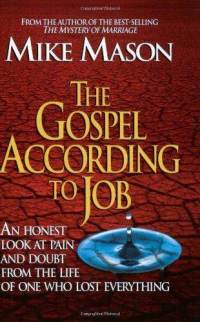
The Gospel According to Job

Today, I want to bring out this book, out into the spotlight.  It is a tremendous devotional that makes its way through the book of Job.  I have leaned on it, and it has held me nicely.  I challlenge you to get a copy of this, and to let it work in the confines of your spirit and mind. ––Bryan

A

Excerpt from “The Gospel According to Job,” by Mike Mason


“An Honest Look at Pain and Doubt from the Life of One who Lost Everything”

_______________________

A“Once I met a man who, like Abraham, had moved his entire household halfway around the world on the strength of a vision from God. When I asked him to tell me the story, he answered that there were three versions of that story, and which one did I want to hear? First, there was the version of the story that he told to Christians. Then there was the version he told to non-Christians. Finally, there was the truth. Job is a book that tells things from the third point of view. Probably, along with Ecclesiastes, it does this better than any other book in the Bible.

Not that the other Scriptures do not tell the truth. But Job tells the truth in a way that makes it almost impossible to pervert the truth into pious pabulum. A few years ago I went through a difficult time. Never mind what the problem was. It was nothing compared to the trials of Job. In fact, it was nothing at all compared to the sufferings of many of my neighbors right there on the quiet street where I lived.

But pain is pain, and suffice it to say that my pain was enough to drive me to my knees, totally defeated, half-crazy at times, and crying out for relief. Month after month the battles raged on, thick, dark, agonizing. I prayed, but somehow prayer did not ‘work.’ Usually nothing at all worked, except lying low and gritting my teeth until, for reasons entirely obscure to me, the straightjacket of oppression began to loosen a little––at least enough for me to get on with my life for another day or so before the screws tightened again. What else could I do? How was I to fight this?

In retrospect I can see that a large part of my anguish was rooted in the fact that there really was nothing I could do to control what was happening to me. I was absolutely helpless, and it is this, perhaps, that is the soul of suffering, this terrifying impotence. It is a little taste of the final and most terrifying impotence of all, which is death.

We Christians do not like to think about being absolutely helpless in the hands of our God. With all of our faith, and with all of His grace, we still prefer to maintain some semblance of control over our lives. When difficulties arise, we like to think that there are certain steps we can take, or attitudes we can adopt, to alleviate our anguish and be happy. Sometimes there are. But anyone who has truly suffered will know that when it comes to the real thing there is no help for it, no human help whatsoever.

Simply put, when we are in a deep dark hole we cannot think our way out; neither can we hope, sing, pray, or even love our way out. In fact there is absolutely nothing either we or anyone else can do to better our situation. We can have faith, yes; but in itself faith will not change anything. Neither faith, nor any other good thing that a person might have or do, can actually lift the cloud, move the mountain, or bring about an end to the problem.

Only the Lord Himself can do that, and when He does, as Exodus 6:6 puts it, “Then you will know that I am the Lord your God, who brought you out from under the yoke.” How will we know? Simply because nothing and no one else could possibly have done it. In this kind of crucible, therefore, we come to a new understanding of what it means to be saved, what it means to be snatched away from the brink of destruction.

Here we get down to the bedrock of the gospel. During my night of anguish, I turned to the book of Job, and there I began to make contact with the gospel in a way that somehow I never had in studying the New Testament. Reading Job, I found myself experiencing in new and astonishing depth the reality of Jesus’ promise in John 8:32,

 “You will know the truth, and the truth will set you free.”


cropped-christiangraffiti1.jpg